
In May 1845, Sir John Franklin and an exploration party aboard the HMS Erebus and HMS Terror began an expedition to the Arctic. They were in search of the north-west passage, a sea route connecting the Atlantic and Pacific oceans. It was a risky journey, and became a fatal one when the two ships and everyone aboard went missing.
Seven years later, in 1852, another expedition left for the Arctic. This was the British naval search expedition of 1852-54, seeking the lost Franklin expedition. Given the circumstances, it was also a risky undertaking.
Two ships in the search party were the HMS North Star and HMS Assistance, and aboard was my first cousin five times removed, Francis Yeates Toms. He was 26 and the expedition’s Assistant Surgeon.
Francis was known in his extended family as Frank Yeates, to distinguish him from others in the family called Frank, like my 3x great-grandfather.
He trained alongside his uncle, my 4x great-grandfather William Toms, and gained his medical diplomas by 1848. Frank’s first appointment in the Royal Navy was in January 1849, as assistant surgeon aboard the Impregnable then the Superb.
Frank was recognised as a Member of the Royal College of Surgeons in April 1852. This was reported in conjunction with his appointment to HMS North Star, and its departure in search of the missing Franklin expedition.
HMS North Star was the store ship for the expedition, and its surgeon was Robert McCormick. While searching, they explored the Wellington Channel, which McCormick mapped part of. He described encountering and naming landmarks, also making sketches of what he saw. One landmark was named after Frank.
At 8.30 P.M. doubled the next cape, to which I gave the name of Toms, after my friend the Assistant Surgeon of the “North Star”, an enterprising young officer.
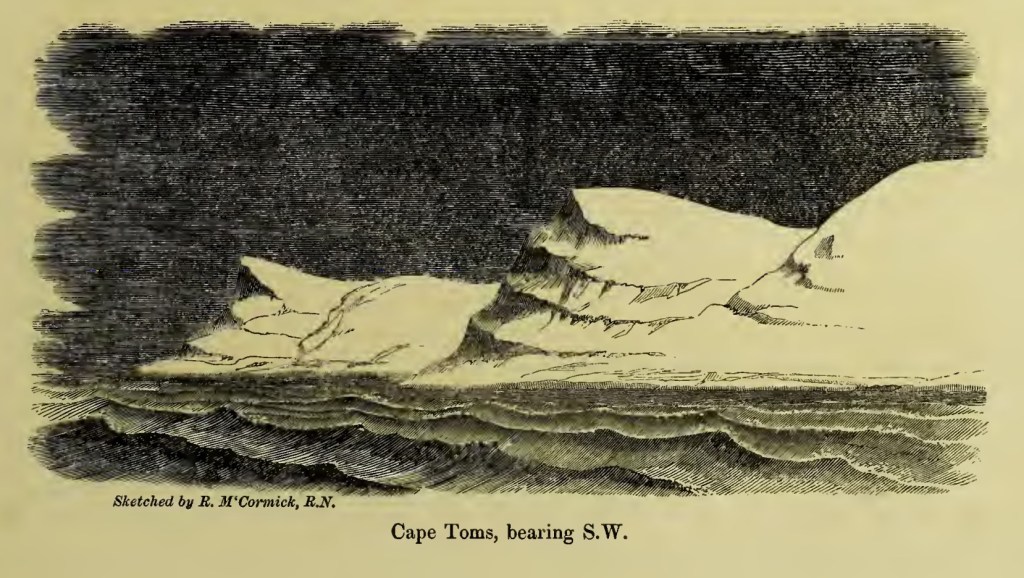
Insight into the conditions and risks encountered can be found in McCormick’s personal narrative in which he mentions sharing a particular experience with Frank.
…I passed a whole day and night without food, or shelter, beyond what the snow-drift afforded, about seven miles from the ship, having been overtaken by a dense fog on the open plain when returning from an excursion to Caswall Tower, accompanied by my friend Dr. Toms, of the “North Star,” and “Erebus” and “Terror”, my two Esquimaux dogs. When overwhelmed by the darkness of night blending with the fog, and a gale approaching, we cut with a hunting knife a trench in the snow-clad plain, about two feet deep, and in this truly Arctic bivouac (at all times to be found) we, with our canine friends, passed the night, without a tent or other clothing than our usual walking dress.
The gale which swept over us soon forming a white coverlet of snow drift, protected us from the blast, less than an hour’s exposure to the inclemency and intensity of cold of which would inevitably have ended in our destruction; not even the dogs would have survived it. The thermometer that night fell to 32° below zero, or 64° below the freezing point. The fog clearing off sufficiently to make out the land, about four o’clock in the morning we started again, and reached the ship between six and seven A.M., without having incurred even a frostbite, and after an ablution and breakfast, felt as fresh as ever.
~ Robert McCormick, Narrative of a Boat Expedition up The Wellington Channel In the Year 1852, Under the Command of R. M’Cormick, R.N., F.R.C.S., in H.M.B. “Forlorn Hope,” in Search of Sir John Franklin; with Chart, Illustrations, and Plans of Search, printed by George Edward Eyre and William Spittiswoode, Printers to the Queen’s Most Excellent Majesty, London, 1854.
As a member of the search expedition, Frank was issued an Arctic Medal. He went on to further serve the Royal Navy in the decades to come, including in Malta during the Crimean War up to 1856, and the China War in 1859-60, also known as the second Opium War.
After the Crimean War, Frank married Marianne Read, whose father was paymaster for the Royal Navy. They had a son, yet another Frank Toms, whose full name was Francis Bevill Read Toms.
Frank became Fleet Surgeon in 1872, and retired in 1881, at which time he was given the honorary title of Deputy-Inspector General of Hospitals and Fleets (now called Surgeon-General).
After retirement, Frank remained active in the Hove community where he lived. He died in 1922, aged 96, still remembered as a member of the 1852-54 search expedition.
It wasn’t until almost 100 years later, in 2014, that HMS Erebus was found, and HMS Terror was found two years after that.
The wrecks of HMS Erebus and HMS Terror, along with human remains, relics and snippets of information discovered over many years, showed the men of the expedition had left the ships trapped in the ice and attempted to travel south on foot. It’s believed that multiple factors—including scurvy, starvation, inadequate clothing, lead poisoning, and the treacherous climate and conditions in the Arctic—contributed to the loss of Franklin’s expedition.
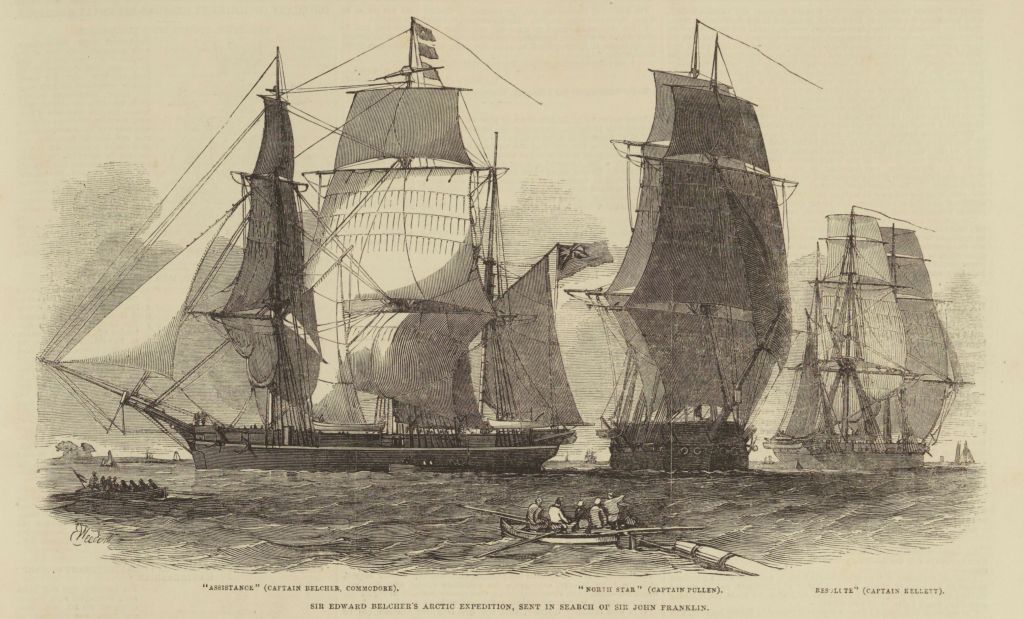
‘Sir Edward Belcher’s Arctic Expedition, Sent in Search of Sir John Franklin’, The Illustrated London News, 17 April 1852, page 305.
Select references
‘Deputy Inspector-General Francis Yeates Toms’, British Medical Journal, 1922; 2:1051, https://doi.org/10.1136/bmj.2.3230.1051-c, accessed 8 November 2026.
Robert McCormick, Narrative of a Boat Expedition up The Wellington Channel In the Year 1852, Under the Command of R. M’Cormick, R.N., F.R.C.S., in H.M.B. “Forlorn Hope,” in Search of Sir John Franklin; with Chart, Illustrations, and Plans of Search, printed by George Edward Eyre and William Spittiswoode, Printers to the Queen’s Most Excellent Majesty, London, 1854.
‘Sir Edward Belcher’s Arctic Expedition, Sent in Search of Sir John Franklin’, The Illustrated London News, 17 April 1852, page 305.
‘What happened to HMS Erebus and Terror?”, Royal Museums of Greenwich, https://www.rmg.co.uk/stories/maritime-history/what-happened-to-erebus-terror-crew-true-story, accessed 5 November 2026.
‘HMS Terror and Erebus’, Royal Museums of Greenwich, https://www.rmg.co.uk/stories/maritime-history/hms-terror-erebus-history-franklin-lost-expedition, accessed 5 November 2026.
‘Remembering the lost Franklin expedition’, Royal Scottish Geographical Society, https://www.rsgs.org/blog/remembering-the-lost-franklin-expedition, accessed 5 November 2026.
‘Franklin’s lost expedition: The 170-year search for HMS Erebus and Terror’, The Age of Exploration, https://theageofexploration.com/franklins-lost-expedition-the-170-year-search-for-hms-erebus-and-terror/, accessed 5 November 2026.

