
When my 4x great-grandmother Eliza emigrated from Ireland with her young family in 1833, she would probably have been both nervous and excited, hoping for a prosperous new life. Unfortunately life appears to have been a struggle right from the start.
Family tragedy soon after arrival meant Eliza had to grasp any opportunity to survive. That included finding protection in the form of a new spouse. Her children at the time were aged from four to fourteen. While her four-year-old daughter Julia remained with her until she was older, it’s likely her boys who were seven, twelve and fourteen, would have been forced to find work and board of some kind.
Information I’ve discovered about Eliza’s later life is from a few newspaper reports.
In an 1856 court case, Eliza claimed she had been hired as a general servant by a Mrs Lawrence, at six shillings a week, and was owed pay for 55 weeks’ service.
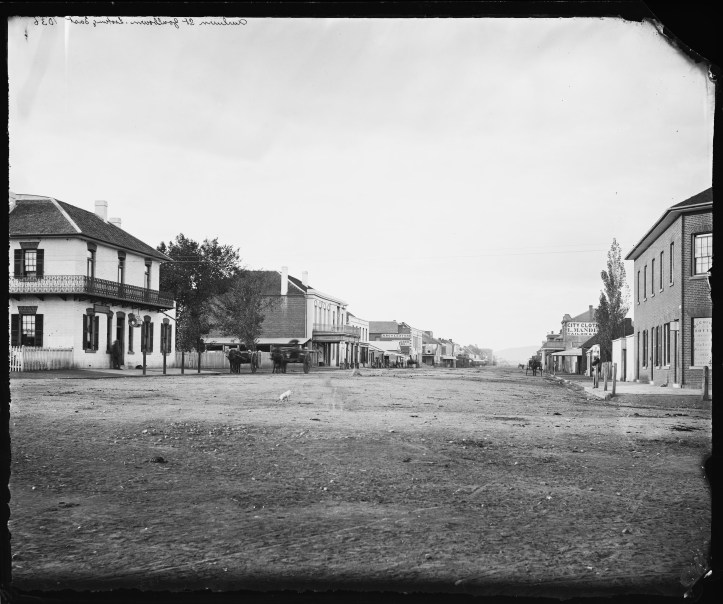
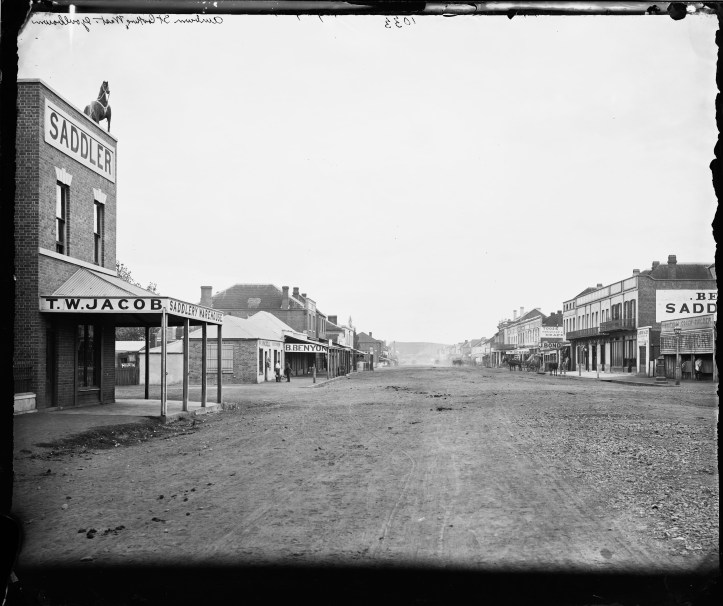
Mrs Lawrence’s husband, John Lawrence, claimed otherwise, and he had far greater power and financial means than Eliza. His bakery and general store, Mallow House, appears to have been a prosperous business, located on Auburn Street, opposite the market square in Goulburn.
Eliza’s fight for wages was quite courageous under the circumstances—or perhaps just desperate.
Eliza’s claim was heard in court under the Master and Servants’ Act 1828, seeking £16 10s in unpaid wages. This was probably unusual because the Act, which was enacted in New South Wales due to concern over civil unrest in England, was considered biased in favour of employers.
In stating his case, the solicitor for Mr Lawrence said:
[Eliza] had been living in very impoverished circumstances, living in a hut at the back of Carroll’s, the butcher, and had been taken in by the defendant purely out of charity; that she had been permitted by him to occupy a detached place at the back of the premises and had been supplied by him with many necessaries of life.
~ ‘Friday, Oct. 24. Before the Police Magistrate.’, The Goulburn Herald and County of Argyle Advertiser, 25 October 1856, p. 4, http://nla.gov.au/nla.news-article118313062, accessed 2 March 2024.
It was claimed by Lawrence’s solicitor there was no agreement made with Eliza and she had not demanded wages. However, Eliza’s evidence said that she was hired by Mrs Lawrence on 28 August 1855, when Mr Lawrence was absent.
Mrs Lawrence was called to give evidence, but it seems she wouldn’t do so, with her husband’s solicitor saying that she “was averse to appearing before a Court of Justice”. He claimed his client had a good enough case to have the complaint dismissed.
Evidence from witnesses on both sides was contradictory. However, Eliza won her case, receiving £8 5s compensation. This was only six months’ wages because the Master and Servants’ Act which was used as grounds for her case had a limit of six months’ wages. Still, it was a victory for Eliza.
A note about Eliza’s surname
Eliza’s maiden name is unknown, although some researchers believe it might be Byrnes. She married Robert Collins in Ireland, sometime before or around her eldest son’s birth in 1819, and went by her married name until after her husband’s death in 1833.
Eliza then went by the surname of her common law spouse, Adam Rainey, for many years. She had a short lived marriage to Robert Clark/Clarke in 1854, and seems to have soon reverted to using the surnames Rainey and Collins.
Eliza’s death in Sydney in 1873 is recorded under the surname Collins.
Select references
‘Friday, Oct. 24. Before the Police Magistrate.’, The Goulburn Herald and County of Argyle Advertiser, 25 October 1856, p. 4, http://nla.gov.au/nla.news-article118313062, accessed 2 March 2024.
‘Tuesday, Oct. 28. Master and Servants’ Act.’, The Goulburn Herald and County of Argyle Advertiser, 1 November 1856, p. 4, http://nla.gov.au/nla.news-article118307526, accessed 2 March 2024.
‘Mallow House’, The Goulburn Herald and County of Argyle Advertiser, 2 July 1953, p. 1, http://nla.gov.au/nla.news-article101730961, accessed 27 September 2026.
‘To the Fast Increasing Inhabitants of Goulburn’, The Goulburn Herald and County of Argyle Advertiser, 23 October 1858, p. 1, http://nla.gov.au/nla.news-article101730961, accessed 27 September 2026.
Auburn Street, Goulburn, 1872, digitised glass negative, part of Holtermann aggregated collection of photographs, papers and realia, American & Australasian Photographic Company, Mitchell Library, State Library of New South Wales, https://collection.sl.nsw.gov.au/digital/mxKxLr8o7alNo, image out of copyright.
Auburn Street, Goulburn from T. W. Jacob’s saddlery, 1872, digitised glass negative, part of Holtermann aggregated collection of photographs, papers and realia, American & Australasian Photographic Company, Mitchell Library, State Library of New South Wales, https://collection.sl.nsw.gov.au/record/1kVRZVxn, image out of copyright.

