
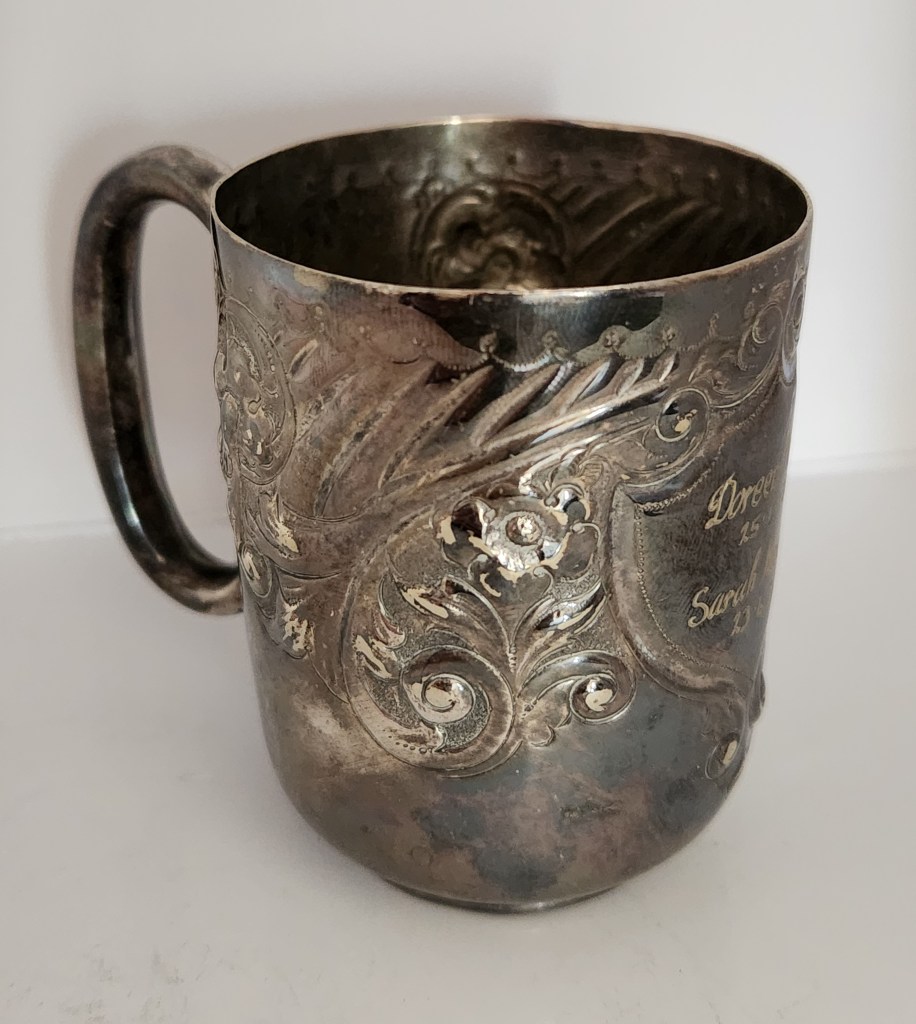
This christening mug belonged to my paternal grandmother and is at least 106 years old. It was later given to me for my own christening. The mug, which is 75mm high and 60mm diameter, has decorative detail and is inscribed with both our names and dates of birth. It has historical and sentimental significance for me, because of the relationship with my grandmother.
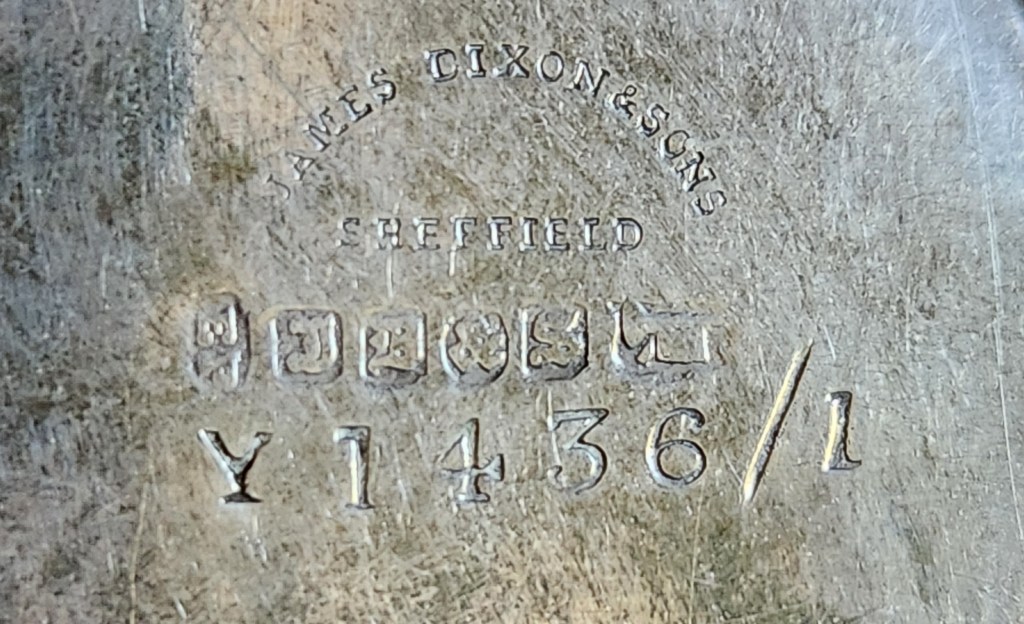
Markings on the bottom of the mug identify it as having been made by James Dixon & Sons, an English silverware manufacturer established in 1806. They’re still operating today as a “family run independent Sheffield business” whose aim is “to keep the traditional silversmithing craft alive, to produce the highest quality and well-designed silverware which will last for generations to come”.
I contacted James Dixon & Sons to see what they might be able to tell me about the christening mug.
They confirmed the markings identified it as electroplated silver made by their company, with EP for electroplated silver, JD&S for the company’s name, and a trumpet symbol which was put on all the company’s products. Additional numbers punched underneath the symbols probably refer to its shape and catalogue number at the time it was made.
I’m unsure of the mug’s provenance before it was my grandmother’s, and whether it was new at that time. Archives of the company are held by Sheffield City Archives, so to uncover any more I’d need to find someone local who can help with a bit of research, and have a good dose of luck finding anything.
Seeing photos of the mug, James Dixon & Sons commented that it’s a lovely piece and its detail was “all hand chased in and very skilled”, with not many people able to do such work anymore. Hand chasing is a traditional metalwork technique involving use of special tools like hammers and punches to create designs straight onto the metal.
History of christening cups
Gifts of silver were often given to mark rites of passage, such as marriage, retirement or christening. The custom of a christening gift may have begun in the Tudor period (1485-1603). Silver spoons were a popular present, hence the saying ‘born with a silver spoon in the mouth’. …. Cups and porringers (small, two-handled bowls) could also be given as christening presents.
By the 19th century the standard gift for a christening was a set of cutlery, a cup or a mug. Manufacturers’ catalogues from the later part of the century show boxed sets of cutlery with a cup, mug or egg cup. These could cost over £12 depending on the number of pieces and the richness of the decoration.
~ Christening cup, Victoria & Albert Museum, https://collections.vam.ac.uk/item/O78656/christening-cup-barnard–sons/, accessed 5 September 2026.
Selected references
About James Dixon & Sons, James Dixon & Sons, https://jamesdixonandsons.com/about/, accessed 29 August 2026.
Christening cup, Victoria & Albert Museum, https://collections.vam.ac.uk/item/O78656/christening-cup-barnard–sons/, accessed 5 September 2026.


Yes. Sheffield is known for its silver as well as its steel and cutlery. The Sheffield United football team are nicknamed the Blades. We had silver serviette rings when we were children but I don’t know what happened to them.
LikeLiked by 1 person