
My 6x great-granduncle, Stephen Reynolds, a gardener and milkman, was arrested in 1797 and tried with his older brother, my 6x great-grandfather Edward. When Stephen was found not guilty of a first indictment, but guilty of a second, he was sentenced to death. Although his sentence was commuted to transportation for life, petitions for clemency were made over an extensive period.
A long list of friends, acquaintances and employers pleaded Stephen’s case. Also found in the petition papers is a letter which suggests why he wasn’t transported. It was written in October 1800 and explains that while in Newgate Prison, Stephen looked after a man who had been arrested for trying to kill the King!
“If I had not been afraid of intruding on you in a busy hour, I would have paid my respects to you this morning, for the purpose of reminding you of poor Stephen Reynolds, who is still groaning in captivity. In addition to what I have already told you of his good conduct in Newgate, I just beg leave to mention that Mr Kirby [the keeper of Newgate] made choice of him to attend and watch over Hatfield [sic], the lunatic, whose attempt, on his Majesty’s sacred person was so providentially frustrated. In this department he conducted himself with such propriety, as to obtain the highest applause from Mr Kirby.”
James Hadfield
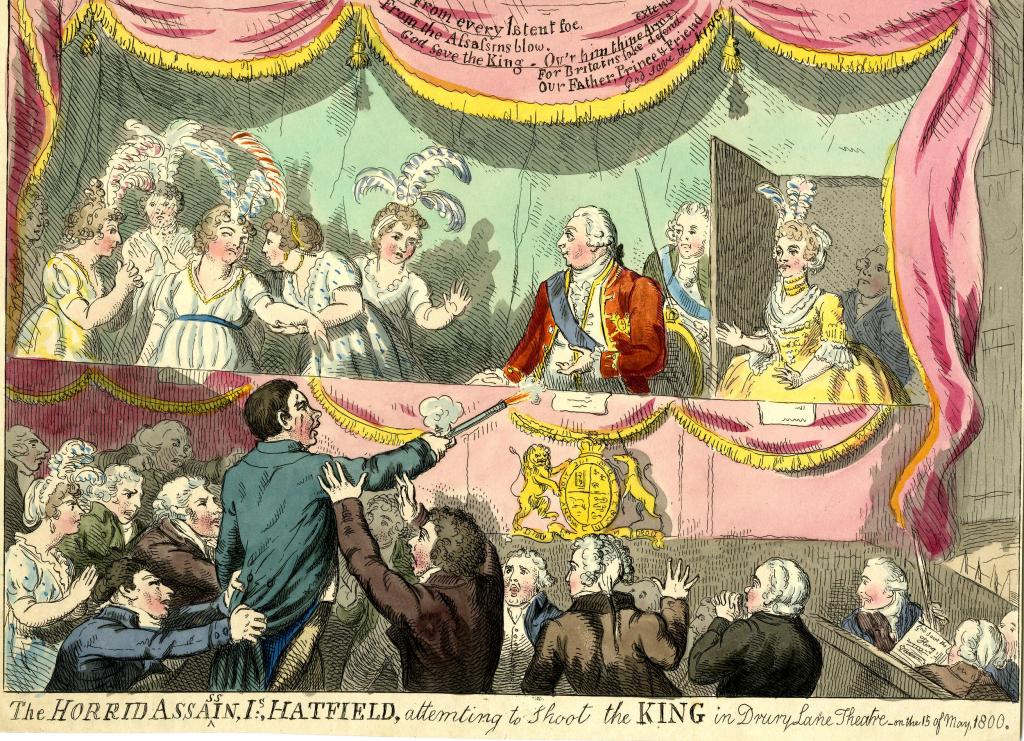
James Hadfield was a soldier who had served with the Duke of York‘s 1793-1795 campaign in Flanders, and is understood to have sustained severe brain damage during that time. Several years later and suffering from delusions, Hadfield made an attempt on the life of King George III. The King and his family were attending the Theatre Royal Drury Lane on 15 May 1800, and Hadfield fired a pistol as they entered the Royal Box, missing by twelve inches.
Hadfield was captured at the theatre and charged with treason. It was likely during the six weeks that followed, while he was in prison awaiting trial, that he was watched over by Stephen Reynolds. At trial a number of witnesses testified to Hadfield’s mental illness, describing behaviour over some time as being insane. The trial was stopped and Hadfield was eventually found “Not guilty, being under the influence of insanity at the time the act was committed”.
The case saw the creation of a new law, the Criminal Lunatics Act 1800. Hadfield was taken to the Bethlem Hospital, also known as Bedlam, where he spent most of the next 40 years, until his death.
What happened to Stephen?
On 5 January 1802, about four years after his original imprisonment, Stephen received a Royal Pardon on condition he was given security for seven years. In other words, providing someone bailed him by giving him work for that time, he would be released. It’s believed that’s just what happened.
Selected references
Trial of William Smith, otherwise Flint, Edward Reynolds, Stephen Reynolds. 6 December 1797, Old Bailey Proceedings Online (t17971206-22), accessed 14 June 2026.
Trial of Stephen Reynolds. 10 January 1798, Old Bailey Proceedings Online (t17980110-1), accessed 14 June 2026.
Stephen Reynolds, 4 January 1802, Judges’ Reports On Criminals 1784-1830 – Correspondence, HO 47/27, England & Wales, Crime, Prisons & Punishment, 1770-1935, National Archives UK.
Trial of Stephen Reynolds. 10 January 1821, Old Bailey Proceedings Online (t18210110-59), accessed 14 June 2026.
Trial file record for Stephen Reynolds, Capital Convictions at the Old Bailey, https://hcmc.uvic.ca/project/oldbailey/record.php?trial_file=4539, accessed 10 June 2026.
Double assassination attempt on George III 15 May 1800, Regency History, https://www.regencyhistory.net/blog/george-iii-double-assassination-attempt, accessed 18 June 2026.
The Story of James Hadfield and His Squirrel, Bethlem Museum of the Mind, https://museumofthemind.org.uk/blog/the-story-of-james-hadfield-and-the-squirrel, accessed 18 June 2026.
James Hadfield, The French Revolution and the Redefinition of Insanity, Bethlem Museum of the Mind, https://museumofthemind.org.uk/blog/james-hadfield-the-french-revolution-and-the-redefinition-of-insanity-by-sophia-gal-part-one, accessed 20 June 2026.
‘Important legal cases of the 19th century – James Hadfield’, Thomas Bewley Madness to Mental Illness. A History of the Royal College of Psychiatrists. Online archive 17, James Hadfield, https://www.rcpsych.ac.uk/docs/default-source/about-us/library-archives/archives/madness-to-mental-illness-online-archive/important-legal-cases-of-the-19th-century-james-hadfield.pdf?sfvrsn=e4cedf57_6, accessed 18 June 2026.
Hand-coloured etching: The horrid assassin Is Hatfield, attempting to shoot the King in Drury Lane theatre- on the 15th of May, 1800, published by J Garbaneti 4, Great Russel St Bedford Square, British Museum 1868,0808.6887, image CC BY-NC0SA 4.0.
 Untangled Family History
The story is that my Grandma was abandoned after the altar. There’s one picture that looks very much like a wedding dress. Until the truth is untangled, I don’t know my name for sure. I have lots of “unlinked trees” tied to my DNA on Ancestry.com.
LikeLike
Hi Debra. Are you connected to the Reynolds family then?
LikeLiked by 1 person
Well, family called me Debbie – after Debbie Reynolds. LOL The question surprised me. I celebrate my Grandma’s name, and leave the mystery for the other side. God promises to reveal the truth of everything. 🙂
LikeLike