
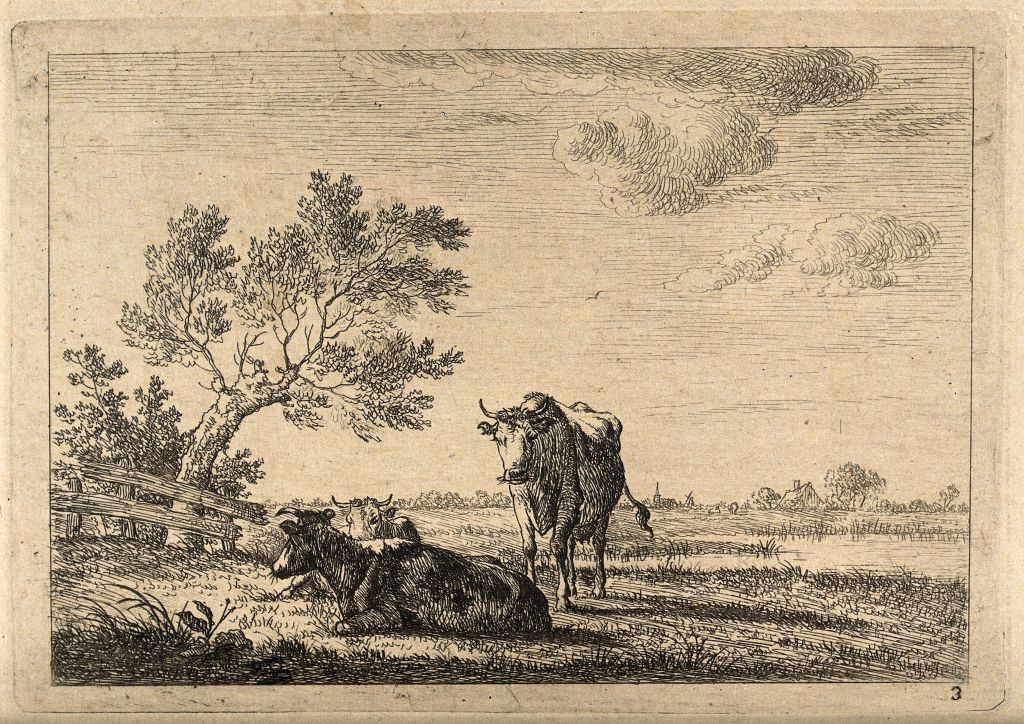
My 6x great-grandfather, Edward Reynolds, was convicted of stealing cows, and was transported to New South Wales aboard the Royal Admiral in 1800. At the time of his 1797 arrest, Edward was about 33, and had been working as a gardener. He was married with six children.
Arrested
Reports of Edward’s committal said he was part of a gang of cattle and horse stealers, including his brother Stephen. They were described as having “infested Middlesex and Essex” for a long time with a “system of wholesale depredation…artfully carried on, by the cattle stolen in one county being regularly consigned for sale to their associates in the other”. It was claimed that nearly 100 horses and cattle had been stolen within just ten miles of Chelmsford “during the short reign of this desperate gang”.
Tried and transported
Tried at the Old Bailey with his brother and another man, each gave different accounts of what happened, including Edward pleading ignorance. He was found not guilty, however, he faced separate, similar charges and appeared in court again, this time in Aylesbury, Buckinghamshire in February 1798. He was found guilty and sentenced to death.
Edward’s wife Sarah wrote a letter in June, pleading his innocence, and asking for his sentence to be mitigated, saying he’d innocently bought the cattle. Edward’s sentence was reduced transportation for life.
His family arrives
Five years after Edward arrived in New South Wales, his wife Sarah and some of their children, including my 5x great-grandmother Mary Ann, followed him as free settlers. They travelled on the William Pitt, arriving in April 1806.
It’s unlikely the reunion was a particularly happy one, and it certainly didn’t last long. Like many convicts so far from families they never expected to see again, Edward had moved on, and Sarah must have, too, because in July 1806, just a couple of months after arriving, she gave birth to a daughter, Eliza. Edward couldn’t have been the father, and it’s unknown who was.
Separate lives
Notices in the newspaper in January 1807 announced Edward and Sarah’s separation, declaring that Edward would give his wife a specified amount of wheat, and his son David, who was about thirteen, a breeding sow. This settlement was perhaps unusual for the time, but would have been important to the survival of Sarah and their children.
Sarah’s relationship with Edward further soured in late 1808, when she placed notices in the newspaper warning that Edward wasn’t to be trusted. Despite having no legal claim to do so, Edward had been using a property Sarah had purchased for herself at The Rocks, behind the General Hospital, as security for his own gain.
In 1814, Sarah sold her house and land at auction and returned to England on the Seringapatam with her youngest daughters Amelia and Eliza. She died in Moulsham, Essex less than three years later.
As for Edward, he lived much of his time in New South Wales in the Hawkesbury region, where he was granted a license in 1814 to sell ale, beer and cider. He married Jane Robson in 1817, and died at Windsor the following year.
Selected references
‘Cattle Stealers’, Maidstone Journal and Kentish Advertiser, 26 September 1797, p. 4.
‘Chelmsford, Sept. 22.’, Reading Mercury, 2 October 1797, p. 2.
Trial of William Smith, otherwise Flint, Edward Reynolds, Stephen Reynolds. 6 December 1797, Old Bailey Proceedings Online (t17971206-22), accessed 14 June 2026.
‘Notices’, Sydney Gazette, 4 September 1808, p. 1, http://nla.gov.au/nla.news-article627577, accessed 14 June 2026.
‘Notices’, Sydney Gazette, 2 October 1808, p. 1, http://nla.gov.au/nla.news-article627595, accessed 14 June 2026.
‘Court of Criminal Jurisdiction’, Sydney Gazette, 24 August 1811, p. 1, http://nla.gov.au/nla.news-article628301, accessed 14 June 2026.
‘Ship News’, Sydney Gazette, 10 September 1814, p. 2, http://nla.gov.au/nla.news-article628978, accessed 14 June 2026.
‘Sales By Auction’, Sydney Gazette, 17 September 1814, p. 2, http://nla.gov.au/nla.news-article628985, accessed 14 June 2026.
‘Government Notice’, Sydney Gazette, 8 April 1815, p. 1, http://nla.gov.au/nla.news-article629092, accessed 14 June 2026.
 Untangled Family History
[…] Edward Reynolds was married with six children when he arrived on the Royal Admiral in 1800, convicted of stealing cows. It wasn’t the first time he’d been charged with this offence, having been acquitted less than six months earlier. His wife Sarah and some of their children, including Mary Ann, followed him as free settlers several years later, but Sarah eventually returned to England. […]
LikeLike
[…] Stephen Reynolds, a gardener and milkman, was arrested in 1797 and tried with his older brother, my 6x great-grandfather Edward. When Stephen was found not guilty of a first indictment, but guilty of a second, he was sentenced […]
LikeLike
[…] separation of my 6x great-grandparents Edward and Sarah Reynolds is recorded on 17 January 1807, along with a settlement agreement between them (including wheat and […]
LikeLike