
William Vaughan seems to have disappeared from his family’s life after the birth of his sixth child. He may have been in contact with them, but I’ve not found any paper evidence of it. What was the story? I’ve been trying to untangle and connect the clues and I have a theory, but not a resolution.
A convict from Worcestershire
William was a convict from Worcestershire, who was transported on the Fairlie in 1834. He and Mary Ann Rankin are my 3x great-grandparents. They appear to have had a defacto relationship, probably because when they started having children together, Mary Ann’s first husband was still alive.
Mary Ann Rankin had married former convict Joseph Lowe in 1830, almost eighteen months after she arrived as a convict on the Sovereign. Their son James Lowe was born in 1833, when Mary Ann and Joseph were living in the Parramatta region.
Children with Mary Ann Rankin
Joseph Lowe died in 1846, however he and Mary Ann probably split by about 1839 or earlier, because Mary Ann’s first child with William Vaughan was born in April 1840. That child was William Vaughan junior, my 2x great-grandfather. The records show his birth as registered in the Maneroo district (now known as Monaro), which is inland, from Michelago in the north to Brown Mountain in the south, and bounded by the Snowy River and Bombala regions.
Five more children followed for Mary Ann and William: Alfred born 1842, Thomas born 1844, Elizabeth in 1846, George in 1851, and Mary Ann born 1854. Alfred’s birth was registered in the Maneroo district like William’s. Thomas, Elizabeth, George and Mary Ann’s births were registered in the Yass region, just north of the Maneroo district. This may have been a matter of his and Mary Ann’s convict assignments, and where each was living at the time of their children’s births.
William’s occupation was described in different ways over the years. On arrival, convict records list him as a farm laborer and waggoner. When his children’s births and marriages were recorded his occupation included brick maker, sawyer, laborer, and farmer. The variation is not surprising given he was a convict and worked when and where he was assigned.
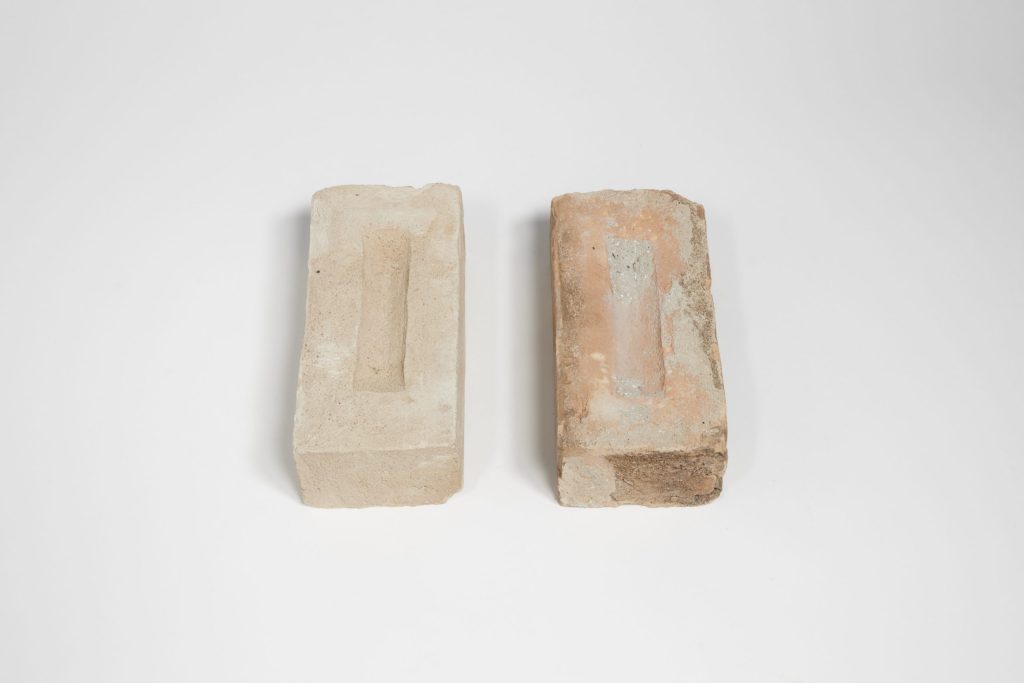
Tickets of leave and a conditional pardon
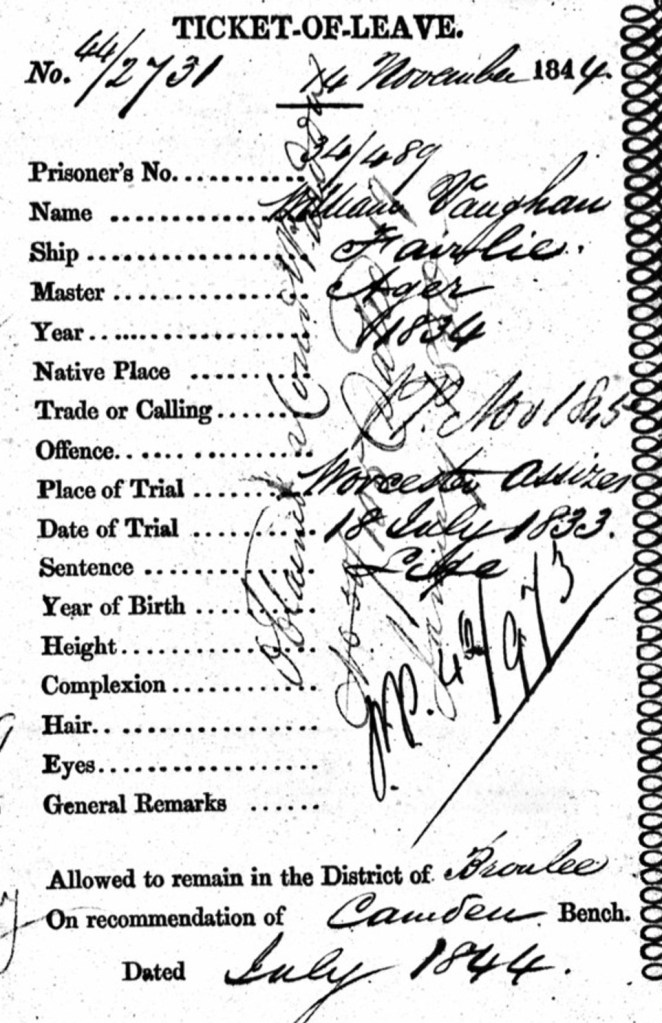
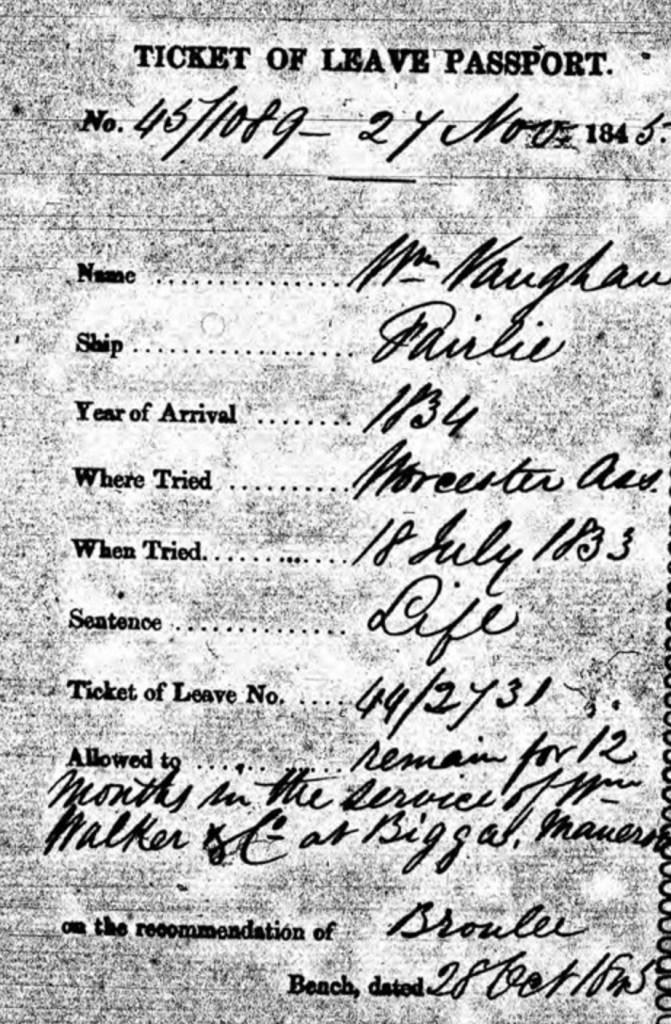
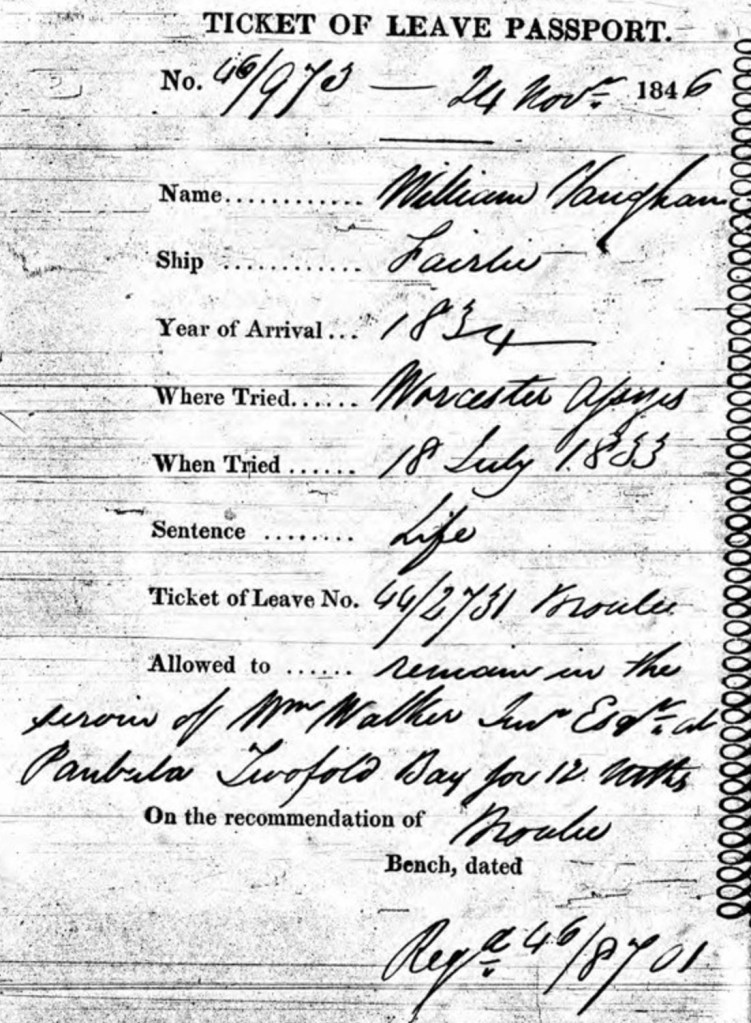
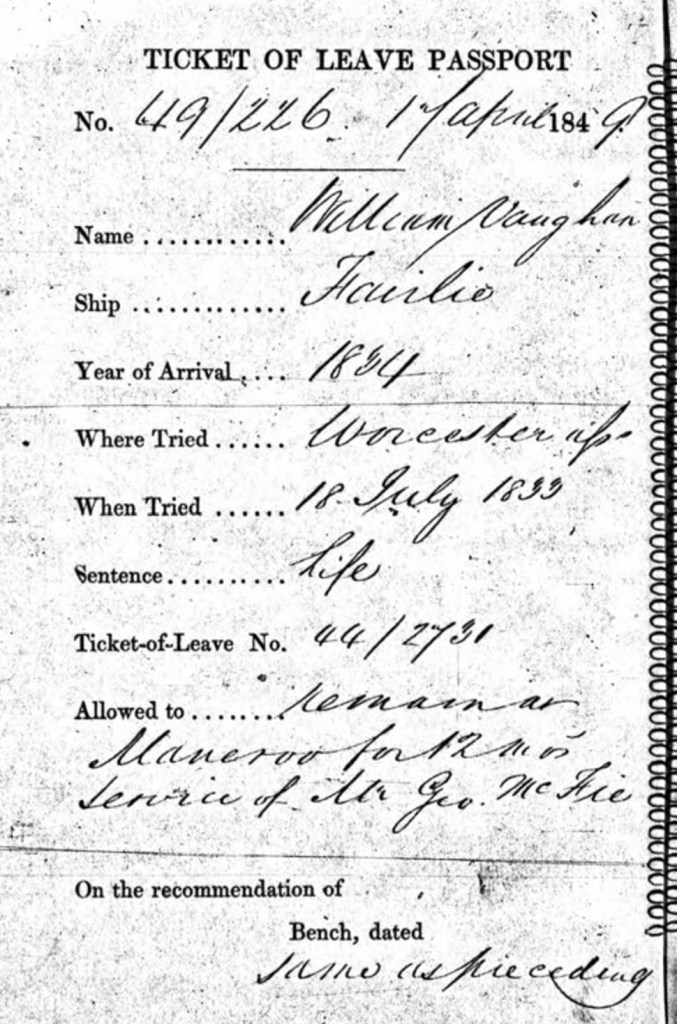
There are four tickets of leave on record for William Vaughan, convict per the Fairlie. The first, in November 1844 (44/2731) refers to him remaining in the district of Broulee. The second from November 1845 (45/1089) has him working for William Walker at Bigga, Maneroo (Monaro). The third is from November 1846 (46/973), refers to Maneroo (Monaro) and says William was to “remain in the service of William Walker esq at Pambula Twofold Bay for 12 months”. The fourth ticket of leave is from April 1849 (49/226). It says William was to “remain at Maneroo for 12 months service of Mr Geo.[George] McFie”. Then in January 1850, William earned a conditional pardon (50/105).
The places referenced on all four of William’s tickets of leave show he must have spent time not only in the Maneroo (Monaro) region where his children were born, but also on the south coast of New South Wales at Broulee and Twofold Bay.
After his conditional pardon
It’s on the south coast where the name William Vaughan appears again. Land grant records show that on 21 July 1854 a William Vaughan paid 61 pounds, 2 shillings and 9 pence for 16 acres and 3 roods of land at Pambula. It was number one of the Lake Merimbula allotments. Is it the same William Vaughan? I can’t be certain. The location makes sense, but he has an awful lot of money for someone who was a convict only four years earlier.

Then the name appears in connection with the births of four children to Mary Lally. Those children were Elizabeth born 1856, Anne 1858, William 1861, and Thomas 1863. While it seems odd that William Vaughan might have more than one child with the same name (two Williams and two Elizabeths), it’s not impossible if he had two separate families, and is something I’ve found elsewhere in my family tree.
The births of all four children with Mary Lally were all registered at Eden. Twofold Bay, which is mentioned on William’s second ticket of leave, is part of Eden. The father’s occupation listed on these birth registrations included bullock driver and carrier, descriptions which may have been used interchangeably.
A death record
In February 1864 there’s a death registered in the district of Eden for William Vaughan, whose occupation is given as a carrier. It says he died at Lithgow’s Flat, about 35 kilometres north of Twofold Bay, and was buried at Pambula, about 20km north of Twofold Bay.
As a carrier, William would have been travelling a lot, and one of the main routes of the time was from Braidwood to Broulee and then to Twofold Bay. These locations match with the information on the death registration and the tickets of leave.
The death registration says William was born in England and had spent thirty years in New South Wales, meaning he would have arrived about 1834, which aligns with arriving on the Fairlie in that year. It also says he was married to Mary Lally at Pambula in 1855, however no record of that marriage has yet been found.
As for my 3x great-grandmother, Mary Ann Lowe, nee Rankin, in 1867 when she was sixty years old, she married Hugh Gorman. Mary Ann’s name is recorded then as Mary Ann Vaughan, widow, which she was – her legal husband Joseph Lowe’s death was in 1846 and her defacto husband William Vaughan’s death was in 1864, that’s assuming I have it correct and it was the same William Vaughan.
One William or two?
I think it’s probable these two men named William Vaughan, are actually one and the same man. That William separated from Mary Ann Rankin, or perhaps deserted his family, started a second family with Mary Lally, and died in 1864. I hope to one day resolve the mystery more conclusively, perhaps with the help of a DNA match. Meanwhile, I’ll keep searching for clues.
Selected references
William Vaughan, Fairlie, 1834, Convict Indents, New South Wales, Australia, Convict Indents, 1788-1842, NSW State Archives, Ancestry.com, accessed 21 December 2024.
Birth registrations, Registry of Births, Deaths and Marriages, New South Wales:
- James Lowe 54/1833 V183354 17
- William Vaughan 2147/1840 V18402147 26A
- Alfred Vaughan NSW 2146/1842 V18422146 26A
- Thomas Vaughan 1826/1844 V18441826 31A
- Elizabeth Vaughan 1646/1846 V18461646 32A
- George Vaughan 2078/1851 V18512078 37A
- Mary A Vaughan 2447/1854 V18542447 56
- Elizabeth Vaughan 4512/1856
- Anne Vaughan 6840/1858
- William Vaughan 7223/1861
- Thomas Vaughan 7525/1863
New South Wales, Australia, Tickets of Leave, 1824-1867, Ancestry.com, accessed 16 January 2022.
William Vaughan, Fairlie, 1834, Conditional Pardon, NSW, Australia, Convict Registers of Conditional and Absolute Pardons, 1791-1867, NSW State Archives, 50/105, Ancestry.com, accessed 22 November 2021.
Death registration of William Vaughan, died 3 February 1864, Registry of Births, Deaths and Marriages, New South Wales, 3668/1864.
Maddrell, Roslyn, Braidwood & District Post Offices & People: Chronicle of events of Royal Mail & Tabloid of people who formed our mail service 1835-1900, Braidwood, N.S.W., 1995.
Land Grants for William Vaughan, 21 July 1854, Copies of Deeds of Grant to Land Alienated by Grant, Lease or Purchase, Volume 156 Town Purchases 1854, New South Wales, Australia, Land Grants, State Records Authority of New South Wales; Kingswood, NSW, Australia; Archive Reel: 1765; Series: 1216, Ancestry.com, accessed 21 December 2024.
Fiona Starr for Lake Tabourie Museum, ‘The House That Jack Found: Convict-Made Bricks from Murramarang Point’, story date: 7 August 2023, https://storyplace.org.au/story/the-house-that-jack-found/, accessed on: 21 December 2024.
 Untangled Family History
[…] about 1839 Mary was in a defacto relationship with William Vaughan, and they had six children together: William, Alfred, Thomas, Elizabeth, George, and Mary Ann. […]
LikeLike
[…] William Vaughan was from Worcestershire where he was charged and found guilty of highway robbery when he stole a watch and some money. He arrived on the Fairlie in 1833 at the age of 21. […]
LikeLike