
I have strong Scottish heritage and one of my earliest memories is of a piper at a family event. I was quite young, and still have the impression of looking up at the adults around me, including the piper and his bagpipes. In fact, a piper and pipe music have been part of a number of family birthdays, weddings and funerals.
Growing up, and even now, watching the Royal Edinburgh Military Tattoo has always been a traditional thing to do on New Year’s, too. That’s when it’s traditionally shown on TV here in Australia, and if you’ve seen that annual event, you’ll know how big a part the bagpipes have in it, including the Lone Piper‘s traditional final moments.
I think the distinctive sound of bagpipe music stirs a kind of deep connection that’s difficult to ignore. It’s the kind that gets feet tapping. On visits to Scotland, I’ve found myself just stopping in my tracks when encountering a piper playing live on the street, and busking bands like The Spinning Blowfish mashing up traditional and contemporary instruments and tunes. I also attended a music festival in the town where my grandmother was born, which was packed with traditional and contemporary music.
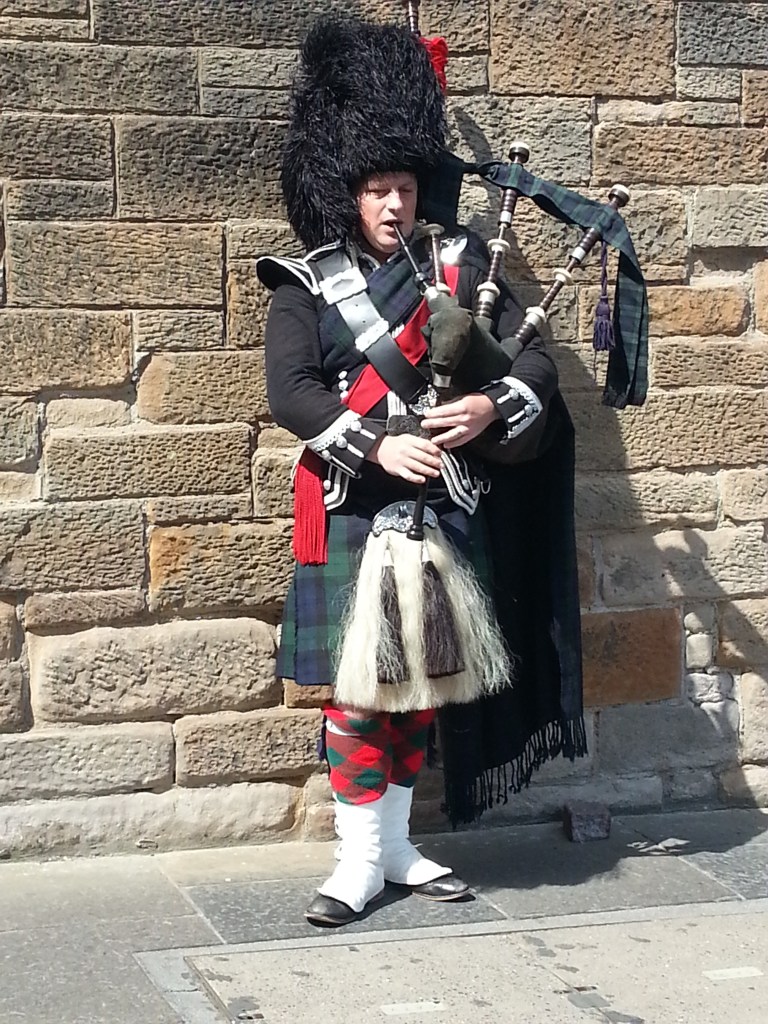
Although an early form of the instrument is believed to have originated in ancient Egypt, what we generally recognise as bagpipes have symbolic, cultural and historic ties to Scotland. Having a key role in the early military, including rallying and leading men into battle, they’re now more often used in ceremonies and celebrations.
Did you know?
There are two main types of bagpipes in Scotland: the great Highland bagpipe and the lowland or Border bagpipe, which is generally smaller.
Making bagpipes involves using a lathe to shape materials like ebony, East African blackwood and Cuban Curcus wood. The bag is made from sheepskin, wax linen thread and cord linen string, along with a tartan cover. You can watch a video about making bagpipes via the National Library of Scotland website (9:57).
Piobaireachd is pipe playing or pipe music, pibroch is a form of bagpipe music, and the musical notation for bagpipes is known as canntaireachd.
Following the 1746 Battle of Culloden, when an Act of Parliament made carrying weapons illegal, bagpipes were effectively banned as ‘instruments of war’. The Act was repealed in 1785.
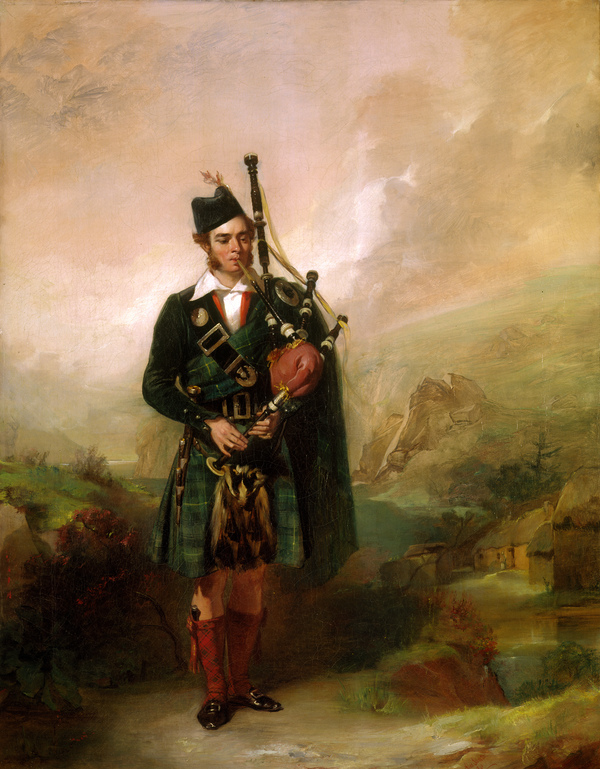
Angus MacKay (pictured below) was a composer and performer who won an 1835 Edinburgh piping competition. He published Collection of Ancient Piobaireachd or Highland Pipe Music and went on to become the first household piper to Queen Victoria, a position which is known as Piper to the Sovereign.
Selected references
National Library of Scotland, ‘Instruments: The Bagpipe’, https://digital.nls.uk/learning/ceol-nan-gaidheal/english/instruments/bagpipe/index.html, accessed 10 November 2024.
National Library of Scotland, ‘Making Bagpipes’, https://movingimage.nls.uk/film/6832, accessed 10 November 2024.
Historic UK, ‘The Piob Mhor, or the Great Highland Bagpipes’, https://www.historic-uk.com/HistoryUK/HistoryofScotland/The-Piob-Mhor-or-the-Great-Highland-Bagpipes/, accessed 10 November 2024.
The Piobaireachd Society, ‘What is Piobaireachd?’, https://www.piobaireachd.co.uk/what-is-piobaireachd, accessed 10 November 2024.
Alexander Johnston, Angus Mackay, 1813-1859, Piper to Queen Victoria, 1843-1854, 1840, oil on canvas, National Galleries of Scotland, PG2675, https://www.nationalgalleries.org/art-and-artists/3109. Image licensed under Creative Commons CC by NC, photography by Antonia Reeve.
 Untangled Family History
I have always loved the pipes too. I don’t know if I have any Scottish blood in me (my mother’s maiden name is Argyle) but they stir something in me.
LikeLiked by 1 person
I, too, love the bagpipes. Doing some family history found out that some of my ancestors were from Scotland (& my DNA reckons I am 65% Scottish, Irish & Welsh).
My dearly departed Mother though, did not like the bagpipes. She said it sounded like a bunch of cats fighting :).
LikeLiked by 1 person
They are perhaps a bit of an acquired taste. I imagine it also depends on what tune is being played and the talent of the piper!
LikeLike
[…] mainly Scottish and Irish origins. As might be expected it’s derived from the occupation of a bagpiper. Variations include Piper, Pypar, and […]
LikeLike