
William Bligh’s reputation is rather synonymous with notoriety, thanks to the historical record and popular culture depiction of infamous events. Perhaps he was a demanding commander, or maybe colourful, quick-tempered, stubborn and misunderstood is a more accurate description. Imagine my surprise to discover I’m related to him!
Bligh was the subject of a mutiny at sea, a military coup, and multiple court martials. He’s also my third cousin, seven times removed. His 2x great grandparents, Richard Bligh and Mary Westlake, are my 9x great-grandparents. Yes, it’s a fair way back in my ancestry, but Bligh’s place in history makes him one of my most intriguing discoveries.
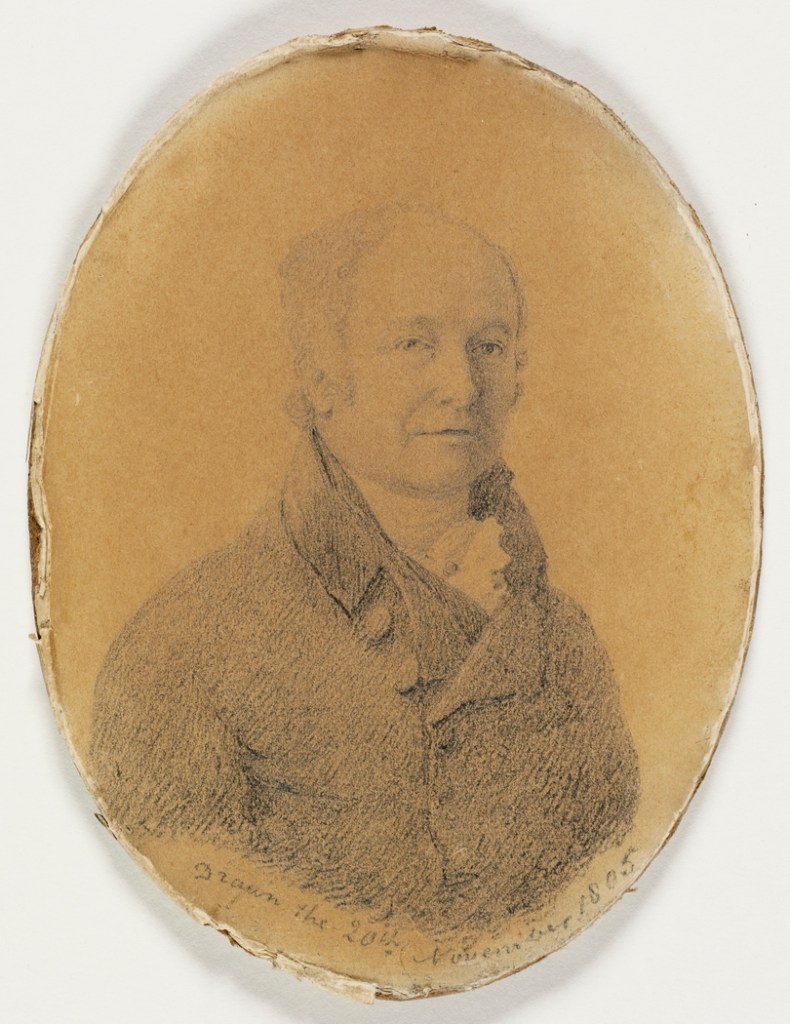
Bligh’s background
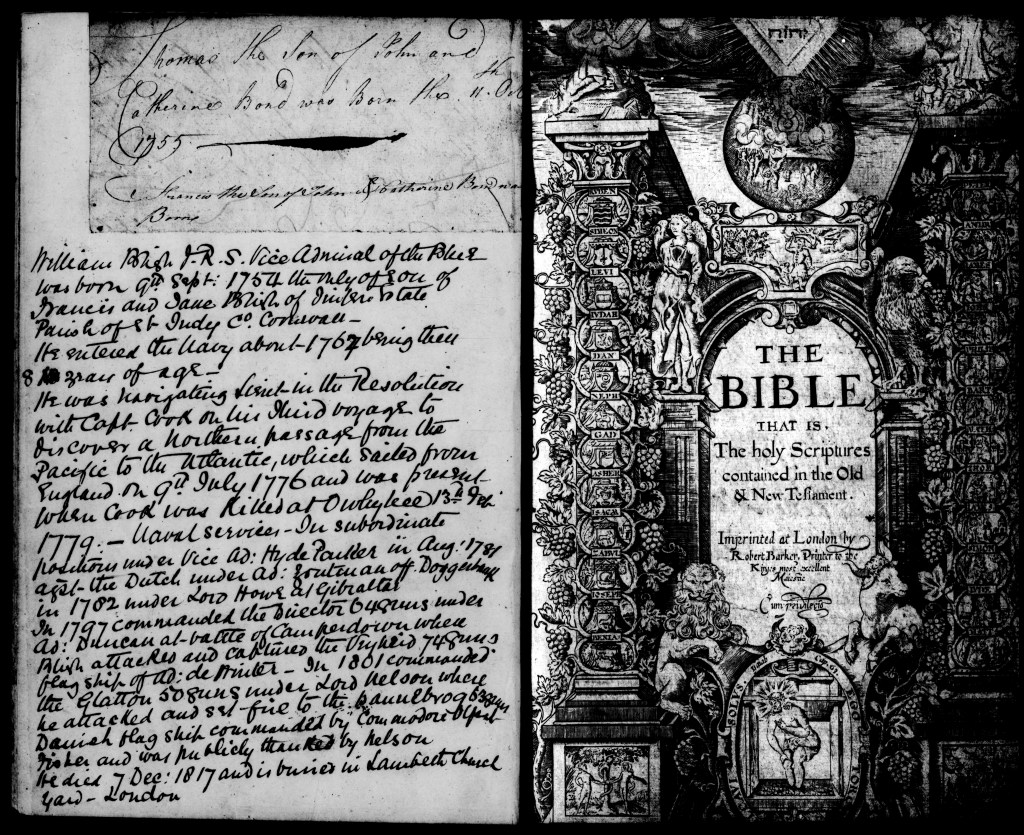
William Bligh was the only son of Francis Bligh, a customs officer, and Jane Pearce nee Balsam. He was born in Cornwall and began his career at sea when he was eight-years-old. One of his first positions was as the captain’s servant on H.M.S. Monmouth. He went on to rise through the naval ranks.
[His] career at sea had a remarkable upward trajectory. By age 22, he had been appointed sailing master (the person in charge of day-to-day management of the ship) of the Resolution, captained by James Cook. After rounding the Cape of Good Hope, the Resolution spent a year exploring the Pacific from the southern islands to the Arctic north. In the Sandwich Islands (now Hawaii), Bligh witnessed Cook being bludgeoned to death on a beach by natives–a shocking event which might have powerfully shaped his own ideas about discipline.
– Famous Trials, ‘The Court-Martial of the Bounty Mutineers: An Account’, https://www.famous-trials.com/bounty/392-story, accessed 29 September 2024.
Husband and father
At the age of 27, Bligh married Elizabeth (Betsy) Betham, who was well-educated and had significant family connections. In an action which hints a little at their relationship, on his travels Bligh collected shells and gave them to Betsy who was a natural historian and a friend of Sir Joseph Banks. She developed a significant shell collection and reputation in this field. Bligh’s career would have kept him far from home a lot of the time, however they did have eight children: six daughters including twins, and twin sons who died as newborns.

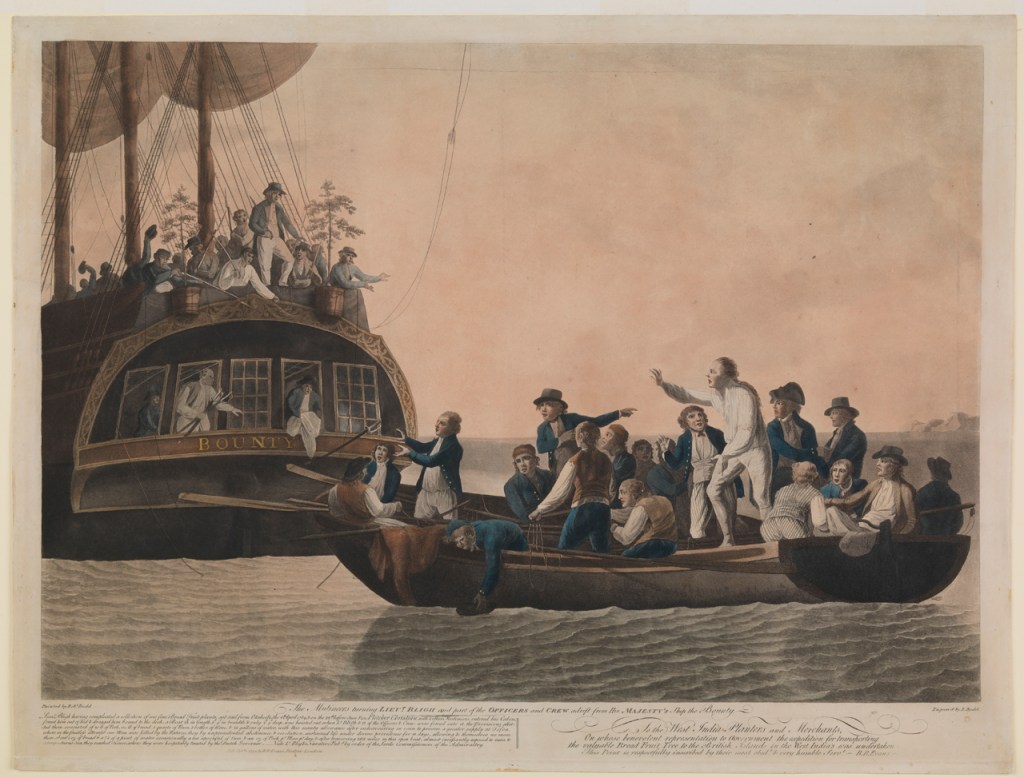
Mutiny on the Bounty
When Bligh was given command of H.M.S. Bounty, the ship’s mission was to collect and transport breadfruit plants from Tahiti to the West Indies. It essentially became a large, floating greenhouse. Bligh described Tahiti as “the Paradise of the World”, and he and his crew spent about five months potting and transferring more than 1,000 breadfruit plants to the ship.
The Bounty‘s journey from there was never going to be easy, not when the crew had comparative freedom on Tahiti. There had also been discontent amongst some before they had even reached Tahiti. Strict discipline, arguments, and an unhappy crew became untenable, and in April 1789, off an island in Tonga, many of Bligh’s crew rebelled in an incident which became infamously known as the mutiny on the Bounty.
Bligh and 18 of his men spent more than 40 days at sea in the ship’s cutter, travelling more than 3,000 nautical miles and eventually landing at Timor. That was a feat in itself. Bligh then found a boat, sailed to Jakarta, and finally found his way back to England aboard another ship. He arrived in March 1790, and in October the same year was court-martialled for losing the Bounty. It was a routine action for any captain who lost their ship, and Bligh was acquitted and indeed promoted.
As for the mutineers, some returned to Tahiti, where they were eventually tracked down and arrested. On their journey to England they were hit by a storm and shipwrecked. Ten of the prisoners survived and were court-martialled. Three of them were acquitted, and six were found guilty and sentenced to death, although three were later pardoned. It was many years before the mutineers who remained at large were heard of again. They were not caught and wound up on Pitcairn Island with their Tahitian wives.
Bligh’s account: Click here to read William Bligh’s full description of what happened aboard the Bounty. You can also listen to part of his account.
Governor of New South Wales
In 1804, Bligh was court-martialled for having acted unreasonably when he arrested an officer for neglect of duty, even though the officer was too sick to be on watch. Bligh was reprimanded, however the following year he was appointed as the fourth Governor of New South Wales, arriving in 1806 with his second daughter Mary whose husband, John Putland, was appointed Bligh’s naval lieutenant.
The situation in the colony at the time was not great, and Bligh was determined to implement reform and improved governance. There were food shortages, minimal infrastructure and trade, flooding in the Hawkesbury region, not enough convict labour, and rampant conflict of interest by those in power. There was also a lack of formal currency, so bartering and other alternatives were being used. One form of currency which proved particularly popular was rum.
The Rum Rebellion
The Governor of New South Wales was in charge of the colony, under instruction from the English Government, and the New South Wales Corp was the regiment who supported the Governor and helped maintain law and order. They had a lot of power.
Many of the men in the New South Wales Corps were recruited from the unemployed in Britain though many were skilled, victims of the Industrial Revolution. New South Wales was a long way from home, and quick promotion, good wages and the opportunity to engage in trade alongside their military duties induced ambitious men to sign up. [Some of the men were also former convicts who had completed their sentences.]
– State Library of New South Wales, ‘From Terra Australis to Australia: The 1808 ‘Rum’ Rebellion’, https://www.sl.nsw.gov.au/stories/terra-australis-australia/1808-rum-rebellion, accessed 2 September 2024.
The New South Wales Corp essentially controlled the economy and reaped the benefits, from land to labour. Many took advantage of the rum currency. They weren’t pleased with Governor Bligh’s new regulations and strong penalties for bartering many items, and neither was John Macarthur whose business interests were impacted. There were other grievances, too and Bligh didn’t have a strong military lawyer (judge-advocate) to support him.
Discontent grew and Macarthur and a number of officers from the Corps stirred up trouble. When Bligh decided against Macarthur in a court case, and not for the first time, it was the last straw and they determined Bligh had to go. A military coup ensued, with Bligh arrested and detained.
For more than a year after his arrest in January 1808 Bligh remained in confinement in Sydney, refusing to promise to sail to England if liberated. In February 1809 he agreed to go if placed in the Porpoise, but when on board he broke his word on the ground that it had been extorted by force. On 17 March he sailed to the Derwent [in Van Diemen’s Land], hoping for the support of Lieutenant-Governor David Collins; but though Collins at first welcomed him he refused to denounce the rebel government and relations soon became strained. Notwithstanding his promise not to meddle in local affairs, Bligh interfered with boats on the river, stirred up local animosities and became such an intolerable nuisance that Collins, finding his conduct ‘unhandsome in several respects’, felt compelled to forbid local boats to approach or to victual the Porpoise. Thus isolated, Bligh stayed until Governor Lachlan Macquarie arrived in Sydney. He returned to Port Jackson on 17 January 1810, but did not finally sail for England until 12 May. This sojourn afforded him time and opportunity to be ‘a great plague’ to his successor, and to earn an equally unfavourable opinion from [the new deputy judge-advocate] Ellis Bent.
– Australian Dictionary of Biography, ‘William Bligh (1754-1817)’, https://adb.anu.edu.au/biography/bligh-william-1797, accessed 2 September 2024.
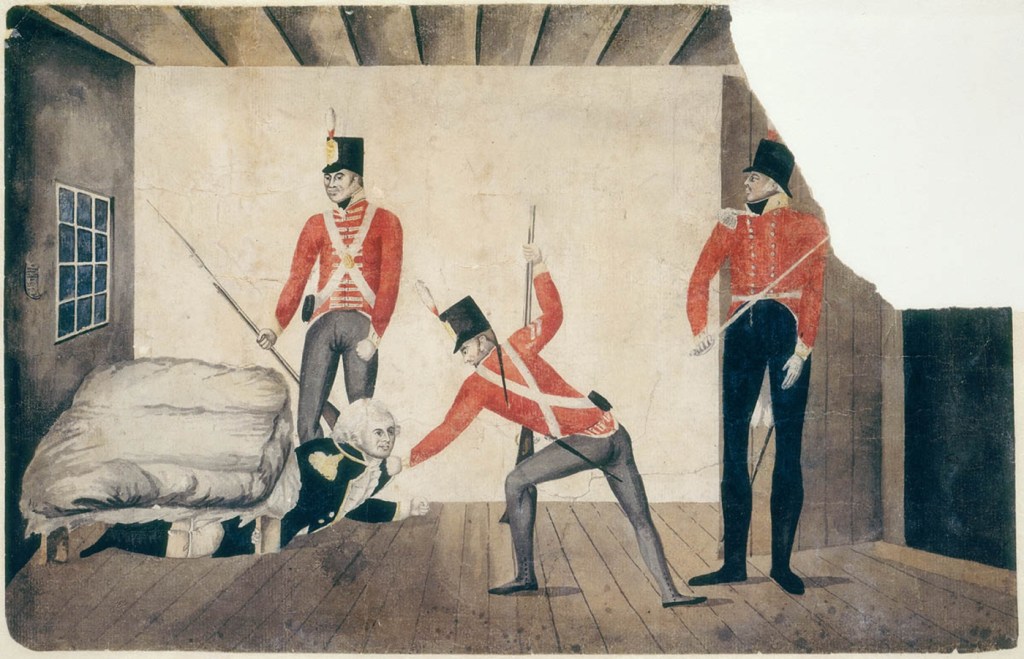
In England in 1810, Bligh was involved in the court-martial of George Johnston, the commander of the New South Wales Corps who had assumed the position of Lieutenant-Governor when Bligh was deposed.
John Macarthur who had been given the role of Colonial Secretary in the immediate aftermath of the mutiny travelled back to England to give evidence. It was determined that Macarthur, a civilian and leading instigator of the mutiny could be tried for treason in the colony of New South Wales, where the events took place, but not in England. However, Macarthur was eventually given permission to return to New South Wales, provided he “should in no way associate in public affairs”. It was not a promise he kept for long.
As for Johnston, he was convicted at the court-martial. Bligh was not completely exonerated, though. The mutiny wasn’t justified, but neither was Bligh’s behaviour, despite his intent being correct.
Following the court-martial, Bligh was promoted. He became Rear-Admiral of the Blue then Vice-Admiral, before eventually retiring. He died on 7 December 1817.
Bligh in popular culture
Storytelling can be fairly liberal with the truth or historically inaccurate. This is possibly the case with William Bligh’s depiction in popular culture, which has generally painted him as a tyrant.
A silent film was released in 1916 and later followed by movies including 1935’s Oscar-nominated Mutiny on the Bounty with Charles Laughton and Clark Gable, a 1962 version featuring Trevor Howard as Bligh and Marlon Brando as Fletcher Christian, and The Bounty in 1984 which starred Anthony Hopkins and Mel Gibson. Each of them gives a skewed version of reality.
Bligh’s daughter Mary is the feature character in an historical fiction novel, That Bligh Girl by Sue Williams. It’s the most recent in a long line of biographies and novels featuring Bligh in some form, and paints a relatively generous although flawed view of him, from his daughter’s perspective. Mary Bligh is also the source of another Australian history connection, as she married Sir Maurice O’Connell, an Irish-born soldier who held numerous roles in the early, growing colony.
Remembered as …
Husband and father. Naval commander and Governor. Hero, villain, or something in between? William Bligh was a talented, though strict navigator. He was appointed Governor at a time which was always going to be difficult. He was no angel, but he made an impact and his name is well and truly a part of history.
William Bligh, ‘Bligh – Hero or Villain?’, Australian National Maritime Museum, 18 August 2019, https://youtu.be/UCHr_uSFDx4.
Selected references
Australian Dictionary of Biography, ‘William Bligh (1754-1817)’, https://adb.anu.edu.au/biography/bligh-william-1797, accessed 2 September 2024.
Admiral William Bligh, drawn by H. A. Barker, 1805, Mitchell Library, State Library of New South Wales, https://collection.sl.nsw.gov.au/digital/7vqmmx2PJy8Qg, accessed 7 September 2024, out of copyright.
File 1: Genealogy of and memoranda written on the front and back fly leaves of the Bligh family Bible, 1611, 1867-1891, Mitchell Library, State Library of New South Wales, https://collection.sl.nsw.gov.au/record/nvgPzgJ1, accessed 7 September 2024, images out of copyright.
Captain Cook Museum Whitby, ‘Mrs. Bligh and her shells’, https://www.cookmuseumwhitby.co.uk/post/mrs-bligh-and-her-shells, accessed 1 October 2024.
Famous Trials, ‘The Court-Martial of the Bounty Mutineers: An Account’, https://www.famous-trials.com/bounty/392-story, accessed 29 September 2024.
Famous Trials, ‘William Bligh’s Narrative of the Mutiny on the Bounty (London: George Nicol, 1790)’, https://www.famous-trials.com/bounty/369-narrative, accessed 29 September 2024.
Bligh, William & Bond, Francis Godolphin & George Mackaness, Fresh light on Bligh : being some unpublished correspondence of Captain William Bligh, R.N., and Lieutenant Francis Godolphin Bond, R.N., with Lieutenant Bond’s manuscript notes made on voyage of H.M.S. “Providence’, 1791-1795 edited with an introduction, notes and commentary by George Mackaness, Review Publications, Dubbo, N.S.W, 1976.
National Museum of Australia, ‘Governor William Bligh is deposed in the Rum Rebellion’, https://www.nma.gov.au/defining-moments/resources/rum-rebellion, accessed 2 September 2024.
Royal Museums Greenwich, ‘What caused Bligh’s crew to lead a mutiny on his ship, the Bounty, in 1789?’, ‘https://www.rmg.co.uk/stories/topics/william-bligh, accessed 2 September 2024.
State Library of New South Wales, ‘From Terra Australis to Australia: The 1808 ‘Rum’ Rebellion’, https://www.sl.nsw.gov.au/stories/terra-australis-australia/1808-rum-rebellion, accessed 2 September 2024.
Huey, Alexander, Portrait of Rear-Admiral William Bligh, 1814, watercolour on ivory, 11.5 x 8.4 cm, National Library of Australia, http://nla.gov.au/nla.obj-136207002, accessed 2 September 2024, image out of copyright.
Dodd, Robert, The Mutineers turning Lieut Bligh and part of the Officers and Crew adrift from His Majesty’s Ship the Bounty [29 April 1789], 1790, print, 465 x 615 mm, National Maritime Museum, Greenwich, London, PAH9205, https://www.rmg.co.uk/collections/objects/rmgc-object-149152, accessed 2 September 2024, image copyright © National Maritime Museum, Greenwich, London, used with a non-commercial license.
National Portrait Gallery, ‘High & Bligh’, https://www.portrait.gov.au/magazines/29/high-bligh, accessed 2 September 2024.
National Portrait Gallery, ‘William Bligh: In their own words’, https://www.portrait.gov.au/words/william-bligh, accessed 7 September 2024.
Australian National Maritime Museum, ‘William Bligh 101 – Who was he and why should we care?’, https://www.sea.museum/2019/06/13/bligh-101, accessed 2 September 2024.
Australian National Maritime Museum, ‘Bad reputation: William Bligh in popular culture’, https://www.sea.museum/2019/07/17/bad-reputation-william-bligh-in-popular-culture, accessed 7 September 2024.
‘William Bligh’s Signet Ring’, Signals, Australian Maritime Museum, volume 82, 1 March 2008, p.42-43, https://issuu.com/anmmuseum/docs/signals_82/45, accessed 1 October 2024.
Riverstone & District Historical Society & Museum, ‘Mary Bligh O’Connell’, https://www.riverstonehistoricalsociety.org.au/blog/?page_id=811, accessed 1 October 2024.
 Untangled Family History
Interesting. I saw a programme on Joseph Banks last week too and he had a lot of influence in the development of New South Wales and also with Matthew Flinders, who was from Licolnshire too. Banks also played a large part in getting the Merion sheep sent to Australia too.
LikeLiked by 1 person
Very interesting. I can just imagine the next conversation between Tim and your dad. lol
LikeLiked by 1 person
Maryland John Putland have associations with St.Marys where I grew up. I guess they were friends with The King family. Like Macarthur, it was the wife of Gov. King who managed their farm day-to-day. I wonder if Anna Josepha King and Elizabeth Macarthur were friends?
LikeLiked by 1 person
[…] letter from early the next year lists George among people Governor Bligh proposed to take with him to England aboard the Porpoise. However, this was when Bligh was arrested […]
LikeLike
Thank you Sarah, for that essay on William Bligh. I have recently discovered that I am related to William Bligh, in fact the exact same distance from him as yourself; his 2x great grandparents, Richard Bligh and Mary Westlake, are my 9x great-grandparents. His reputation in history, only partially deserved, results in my siblings and cousins being only bemused and less than impressed when I inform them of our relationship to this historic figure. Since discovering my Bligh “cousins”, I have read much about William and find myself defending him and being quite proud of his brilliant seamanship and his achievements. Thank you again “Cousin” Sarah.
Elizabeth Fleming
LikeLike
Hi Elizabeth and thanks for commenting. It’s always great to hear from someone who shares an ancestor or ancestral line. I’m, happy you enjoyed the post and my take on William Bligh 🙂
LikeLike