
Sometimes the relationships between people on a family tree can get mixed up and take some serious research and brain power to untangle.
One of these situations happened in connection with my 4x great-grandparents, Susannah Darracott and William Toms who had six children. Two named William died as babies. My 3x great-grandfather Francis Philip (known as Frank) was the eldest surviving child, and the others were Mary Dora (known as Dora), Henry (known as Harry), and Samuel John Revell (known as Jack).
Family letters
Letters written by members of the family are held by the State Library of New South Wales in a manuscript collection called the Toms family correspondence. Family letters can provide some wonderful information you might not get anywhere else. I found details of people and where they lived, their jobs and military service. There was confirmation of some relationships and clues to others.
Many of the letters were written to Frank Toms who was living in Australia. They were from his brother Harry, sister Dora and uncle Philip Toms who were all in England. They mention other family members, some of whom I knew, others I didn’t. The challenge was the recurrence of names that were the same and similar.
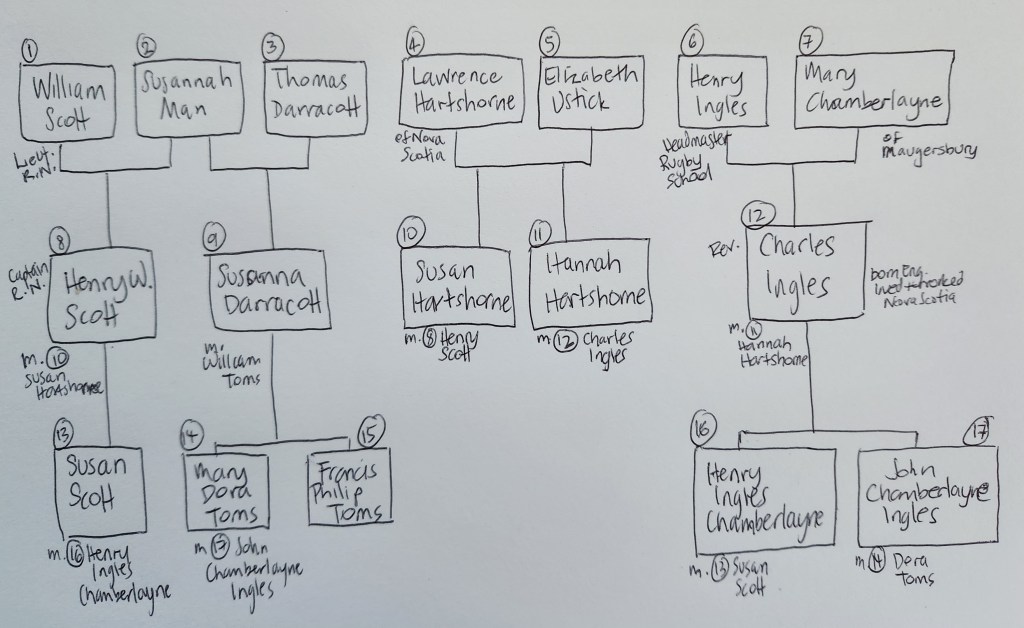
I went down a rabbit hole, but finally untangled connections across three generations, including two brothers who married cousins, and at least five women named Susan or Susannah, and five Williams! There’s a diagram at the end of this post showing how some of the key people fit into my family tree, and I’ve summarised what I know below.
One letter, written to Frank by Harry in December 1860, mentions their Uncle Harry and Aunt Scott. Their names were my starting point.
The Scott connection
Frank Toms’ maternal grandmother was Susannah Man, and she was married twice. Her first marriage was to William Scott, a lieutenant in the navy. They had two sons, William junior and Henry, in the space of two years, before Susannah was widowed at the age of twenty.
Both her sons went on to enter the military. Sadly William junior died in 1802 at the age of eighteen. However, Henry’s career in the Royal Navy took him to Nova Scotia, where he helped establish the Dalhousie Settlement.
Henry married Nova Scotian born Susan Hartshorne, and it’s Henry and Susan who are the Uncle Harry and Aunt Scott mentioned in the letter to Frank Toms. Their daughter Susan Scott was born in Nova Scotia. More about her further on.
Susannah Man’s second marriage took place fifteen years after she was widowed, and was to Thomas Darracott. They had four children, including my 4x great-grandmother, Susanna Darracott, who was born in 1802 and went on to marry William Toms.
The Ingles connection
Susanna and William Toms’ daughter, known as Dora, married John Chamberlayne Ingles, a surgeon in the Navy, in England in 1860. The following year, when the 1861 census was taken, he was recorded aboard the Ariadne, and his birthplace was Sydney in Nova Scotia. That birthplace was repeated in other censuses and sparked my curiosity, sending me down a different rabbit hole, which eventually helped pull it all together.
I found John Ingles’ Nova Scotian baptism record and was able to trace his immediate family connections. His father, Charles Ingles, was a Church of England minister, and his mother was a Nova Scotian named Hannah Hartshorne. Hannah’s father was Lawrence Hartshorne, and her sister Susan Hartshorne married Henry Scott. Charles Ingles and Hannah Hartshorne had several other children, including a son named Henry who married Susan Scott.
Confused? Here’s a quick recap. Dora Toms and Susan Scott were half-first cousins, because they shared a grandmother (Dora’s mother Susanna Darracott and Susan’s father Henry Scott were half-siblings, both being the children of Susannah Man). Dora Toms and Susan Scott married brothers (John Ingles and Henry Ingles). Susan Scott and Henry Ingles were also first cousins (because their mothers were sisters).
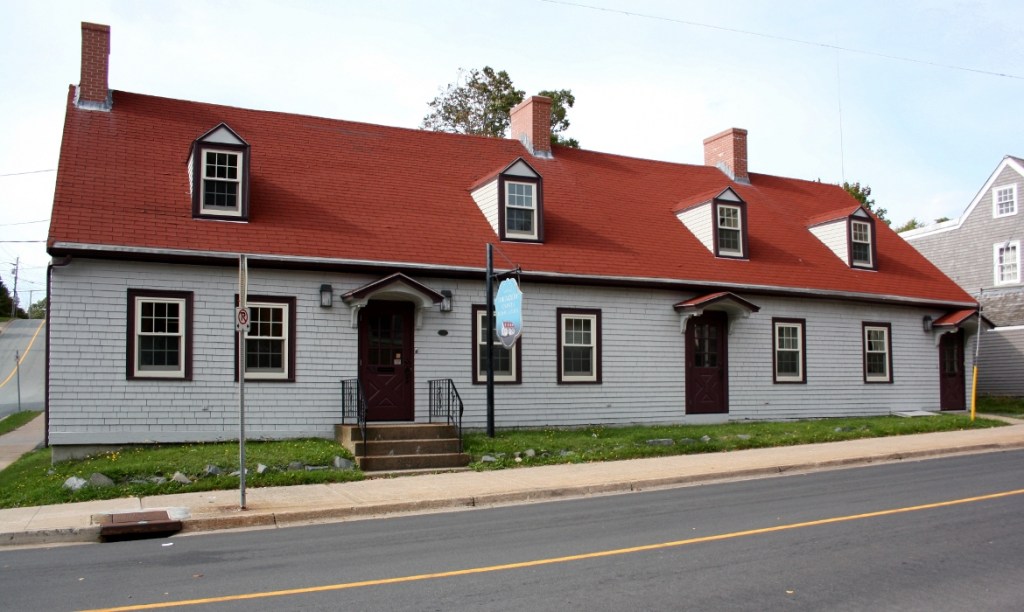
by Stephanie Clay used CC BY-SA 3.0, https://commons.wikimedia.org/w/index.php?curid=21779704.
The Chamberlayne connection
The next part of the rabbit hole relates to Dora’s brother-in-law, Susan Scott’s husband, Henry Ingles. His baptism record names him Henry Ingles, and so do a number of other records. But his name later appears as Henry Ingles Chamberlayne. That was confusing because his brother John’s middle name was Chamberlayne.
Given sometimes a mother’s maiden name is used as a child’s middle name, I decided to trace Reverend Charles Ingles and Hannah Hartshorne a little further. What I found was Charles Ingles was the son of Reverend Henry Ingles and Mary Chamberlayne. Interestingly, Reverend Henry Ingles was the headmaster of Rugby School from 1794-1806, when there was an historic student rebellion.
Mary Chamberlayne was the daughter of Edmund Chamberlayne, who was connected to Maugersbury Manor, in Gloucestershire. It’s through that connection, explored via Burke’s Peerage, I found the clue to Henry Ingles’ name change. In 1874 Henry Ingles inherited Maugersbury from his second cousin, and the inheritance required the change of name to Henry Ingles Chamberlayne.
Connecting them all together
My journey down the rabbit hole certainly helped identify links between siblings and cousins, aunts, uncles, grandparents, and in-laws, and placed them correctly on my family tree. Some of the people are only related to me by marriage, however their descendants are my biological cousins. Their stories and connections are intriguing and have helped untangle the names in my 3x great-grandfather’s letters.
Selected references
Toms Family Correspondence, with Associated Material, 1860-1919, State Library of New South Wales, YRlZ45ln, https://collection.sl.nsw.gov.au/record/YRlZ45ln.
 Untangled Family History
Almost always challenging when cousins marry, especially when two sisters marry two brothers. On my mother’s side there are four generations of Thomas Pitkins. On my father’s side every generation named their sons George, Edward and Henry (after the English monarchy).
Well done untangling the ancestral spider web!
LikeLiked by 1 person
Repeatedly used names can be both an advantage and a disadvantage that’s for sure!
LikeLiked by 1 person
Yes it can be trying when they have the same names. This last week I have solved a problem that has been plaguing me for a few years.
Yesterday was our Family History Society’s 40th birthday and also Mum’s 97th birthday!
LikeLiked by 2 people
[…] Susanna Toms nee Darracott (1802-1882), William’s wife […]
LikeLike
[…] House was the home of my 4x great-grandparents, William Toms and his wife Susanna Darracott. William was a surgeon in Kingsbridge, Devon in England and based his practice out of Barnfield, […]
LikeLike
[…] to his family, was born in 1830 and the oldest surviving son of surgeon William Toms and his wife Susanna nee Darracott. At eighteen, by commission, he became a second lieutenant in the Royal Marines, […]
LikeLike
[…] came from a prominent Plymouth family. She has a double connection to my 4x great-grandmother Susanna Darracott, with both women being related through the Darracott and Man […]
LikeLike