
A buoy sits in the heart of Scapa Flow in the Orkney Islands marking where Able Seaman William Reid, and more than 840 of his crew mates, were killed when their ship sunk during the First World War.
William made the navy his career, and when war began, helping to protect Britain on the high seas took on even greater importance. Participation in a major battle, and a tragic accident, meant the H.M.S. Vanguard and its crew, including William, now have a profound place in history – both wartime and family.
A naval career
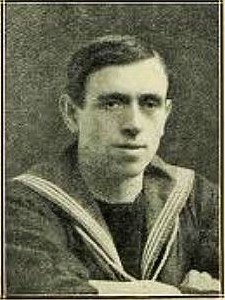
Born in Montrose, on the east coast of Scotland, in 1887, William Reid was the thirteenth of fifteen siblings, and my 2x great-granduncle. Montrose was a busy town, with a wet dock active since the 1840s. Perhaps living there and in the coastal town of Arbroath, is what led William to become an apprentice outfitter, the occupation he gave when he joined the Royal Navy shortly before he turned sixteen.
Beginning as a Boy First Class, and advancing to Boy Second Class within a year, William became an Ordinary Seaman on his eighteenth birthday. By late December 1906, he had been promoted to Able Seaman, the rank he held for the rest of his career.
William’s conduct and character was regularly described through the years as very good. He joined his crew mates in engaging in sporting and other pursuits including, it appears, in the Stokers’ Football Club and the Seaman’s Navy Challenge Cup. William was also “a crack marksman, and was the winner of the Victoria Medal for gunnery in 1913 in the annual competition open to all in the British Naval Service”.
Prelude to war
Before the First World War, the Royal Navy was responsible for patrols of the English Channel and North Sea. This was important to protect trade and other interests, particularly from Germany which was considered a threat.
The navy was thought by some to be under prepared, and was even described by First Lord of the Admiralty, Winston Churchill, as having “more captains of ships than captains of war”. However, the Admiralty was also clearly preparing for war well before it began.
It was during these years that William worked a succession of generally unremarkable postings. Then four months before the First World War began, he was transferred to H.M.S. Vanguard.
Aboard H.M.S. Vanguard
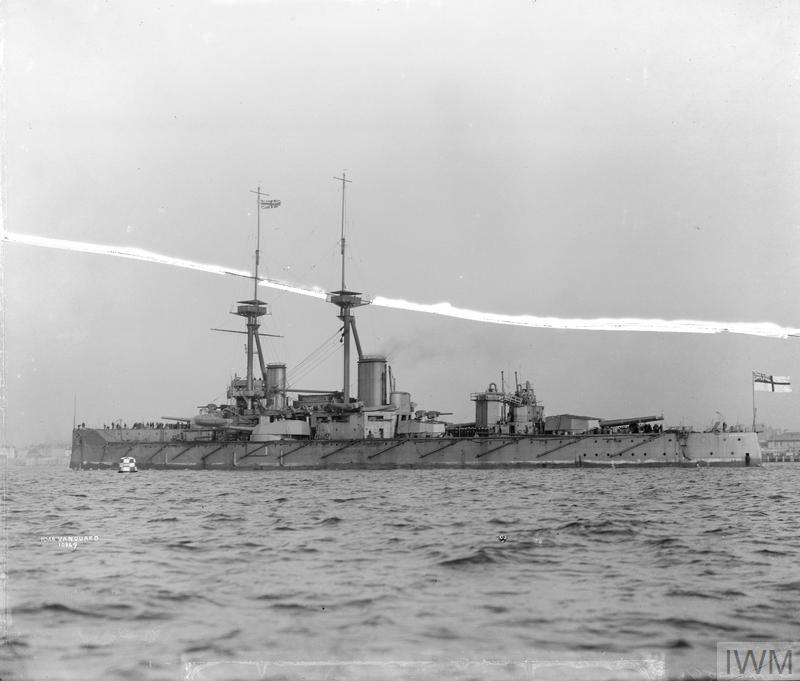
H.M.S. Vanguard was a dreadnought battleship, one of a number built in response to Germany’s growing battle fleet. When war was declared, it became part of the Grand Fleet, based at Scapa Flow in the Orkney Islands.
Aboard the H.M.S. Vanguard, William would have spent much of his time patrolling the North Sea, and taking part in gunnery shoots and tactical exercises. The changed atmosphere was immediately noticeable in the expectations of work aboard ship. A sailor who served on H.M.S. Vanguard described being at battle stations continually, with no time for maintenance like painting and washing the ship as they had before the war.
The Battle of Jutland
H.M.S. Vanguard’s only battle of the war came in the middle of 1916, when William was one of more than 100,000 men in the Battle of Jutland near the north of Denmark. Germany had unsuccessfully attempted to overwhelm the British navy three times that year. Then on the 31st of May they made their fourth attempt in what became the most significant naval battle of the war. 150 British ships and 99 German ships fought over a period of approximately twelve hours, with heavy losses and both sides claiming victory.
H.M.S. Vanguard was fortunate not to sustain any casualties, though low visibility and night action conditions were described as a severe test. The ship’s company was mentioned in despatches, and William was one of those those highly commended for services rendered in action. He was reported as receiving a Distinguished Service Medal. During the battle, the British had maintained their blockade well enough that naval conflict thereafter became focused on submarine warfare.
A wartime tragedy
A year later, shortly before midnight on the 9th of July 1917, tragedy hit H.M.S. Vanguard while at anchor in the harbour at Scapa Flow. The ship’s company, described as being contented, had spent part of their day on ‘Abandon Ship’ exercises. Later, some of the men visited another ship for an evening’s entertainment. However, William was amongst the majority either asleep, or on night duty, when a series of explosions were felt and heard throughout the harbour. H.M.S. Vanguard and those aboard were lost within seconds.
A witness reported seeing a ship appear “to lose its true outline and quiver”, lift up, be engulfed in smoke and flames, then explode. The resulting devastation was visible for miles with burning oil, smoke, and wreckage, both at sea and on the nearby island of Flotta, where the heather burned. Only three men were found alive, one of whom later died, and the bodies of most of the dead, including William, were not recovered.
Like so many others, William’s parents, James and Isabella Reid, would have received an official telegram advising them of their son’s death. It must have been incredibly difficult, especially knowing he died as the result of such a disastrous accident. As was common for grieving families during the war, they would have also had a lack of closure, being unable to mourn him at a funeral.
William’s death was reported in several newspapers in his home county, highlighting his long service and his parents as prominent residents. He was mentioned in the newspaper again the following year, when it was reported his mother had accepted the Russian Medal of St George, awarded to him posthumously through the Admiralty, in recognition of services in the Battle of Jutland.

The tragic loss of H.M.S. Vanguard with most of its crew was unusual in its circumstances, even though it was wartime, and the press wrote much about it over the days and weeks that followed. A poem, The Vanguard by David Horne, was printed in the newspaper, joining other wartime poems on the themes of death and grief written by the likes of Siegfried Sassoon and Wilfrid Owen. Another poem, The Loss of the Vanguard by W.V. Bernard, was printed in the order of service for the official memorial service. Perhaps William’s family kept a copy of one or both of the poems in remembrance of him.

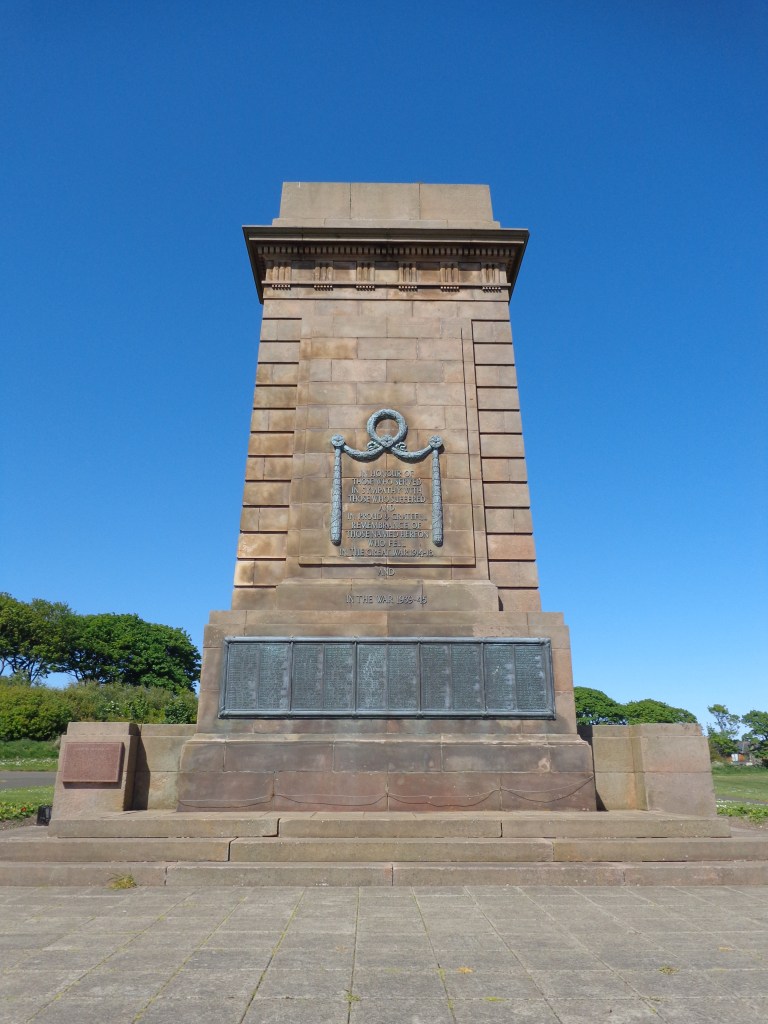
In addition to family memories, William’s life and service are remembered on the war memorial in Arbroath, and in a photograph and short biography printed in the Roll of Honour, Arbroath & District 1914-1919. Other memorials commemorating the H.M.S. Vanguard and its crew exist on the Orkney Islands, and at Chatham, Plymouth, and Portsmouth.
In recent years, a community project online has also been honouring the memory of the sailors of H.M.S. Vanguard by searching for photographs and information about of each of the ship’s casualties. William is one of those included.
The fate of H.M.S. Vanguard
Despite suggestions enemy attack or sabotage may have been the cause, an investigation into the sinking of H.M.S. Vanguard determined the cause was accidental spontaneous ignition or deterioration of cordite, an artillery propellant, in the magazine store.
The site where the shipwreck lies is now designated as an official Commonwealth War Grave and safeguarded by the Protection of Military Remains Act. An official shipwreck survey, coinciding with the centenary of H.M.S. Vanguard’s loss, highlighted its historical significance.
William Reid’s naval and wartime experience reflect that of many others who served in the First World War. His family, likely proud and anxious for him, ultimately suffered the death of their son and brother. With the tragic circumstances of the sinking of the H.M.S. Vanguard, over the last 100 years William and the rest of the ship’s company have been commemorated in both traditional and new ways for their contribution and loss.

Selected references
British Battleships of the First World War (Q 40389), H.M.S. Vanguard on completion. Copyright: © IWM. Original Source: http://www.iwm.org.uk/collections/item/object/205022604, image used under IWM Non-Commercial Licence.
Commonwealth War Graves Commission, ‘Able Seaman William Reid’, https://www.cwgc.org/find-records/find-war-dead/casualty-details/3053484/william-reid/, accessed 14 April 2024.
Emily Turton et al, HMS Vanguard 100 Survey 2016-2017, University of Dundee, Scotland, 2018, https://doi.org.10.20933/100001113.
Imperial War Museum, ‘The Naval Race Between Britain and Germany Before the First World War’, https://www.iwm.org.uk/history/the-naval-race-between-britain-and-germany-before-the-first-world-war, accessed 28 August 2021.
Imperial War Museum, ‘Voices of the First World War: War at Sea’, https://www.iwm.org.uk/history/voices-of-the-first-world-war-war-at-sea, accessed 28 August 2021.
Jeremy Black, ‘Jutland’s Place in History’, Naval History, vol. 30, no. 3, p. 16-21.
Joy Damousi, ‘Mourning Practices’, in Jay Winter, ed., The Cambridge History of the First World War: Volume III – Civil Society, Cambridge University Press, Cambridge, 2014, pp. 358-384.
Matthew S Seligmann, ‘A Service Ready for Total War? The State of the Royal Navy in July 1914’, The English Historical Review, vol. 133, no. 560, pp. 99-122, https://doi.org/10.1093/ehr/cey060.
Montrose Port Authority, ‘Start of a Grand Plan’, https://montroseport.co.uk/2019/05/22/start-of-a-grand-plan/, accessed 29 August 2021.
Photographs of Arbroath War Memorial, 2016, original held in private collection.
Photograph of HMS Vanguard Stokers Football Club, c1915, original held by Vanguard Crew Photos, https://www.vanguardcrewphotos.org/, accessed 2 September 2021.
Photograph of HMS Vanguard Winners of Seamen’s Navy Challenge Cup, c1915, original held by Vanguard Crew Photos, https://www.vanguardcrewphotos.org/, accessed 2 September 2021.
Service record of William Reid, UK, Royal Navy Registers of Seaman’s Services, 1848-1939, The National Archives, England, ADM 188/400.
The Battle of Jutland – Centenary Initiative, ‘Understanding the Battle’, https://www.jutland1916.com/understanding-the-battle/, accessed 5 September 2021.
‘The Vanguard’, The Orkney Herald, 18 July 1917, p. 3.
Tom Muir, ‘Death of a Dreadnought’, MHQ: The Quarterly Journal of Military History, vol. 30, no. 4, pp. 26-28.
Transcription of the Report of the Court of Inquiry into the Circumstances Attending the Loss of H.M.S. Vanguard on the 9th July 1917, 8 August 1917, Admiralty: Historical Section: Records used for Official History, First World War, The National Archives of the UK, Kew, Surrey, England, ADM 137/3681, The World War I Document Archive http://www.gwpda.org/naval/a1373681.htm, accessed 6 September 2021.
Vanguard Crew Photos, https://www.vanguardcrewphotos.org/, accessed 2 September 2021.
‘The Vanguard’, Orkney Herald, 18 July 1917, p. 3.
William Schleihauf, ‘Disaster in Harbour: The Loss of HMS Vanguard’, The Northern Mariner, vol. X, no. 3, pp. 57-89.
 Untangled Family History
I liked the poem. One of my 2nd cousins was involved in the Dunkirk evacuation and he wrote a poem too. I wrote about that in my local FHS magazine.
So sad to think that the sinking of the Vanguard was an accident.
I saw a programme recently about Montrose or Morton and there is a statue of a dog there. The Norwegian Navy was evacuated after Germany occupied Norway and one of the ships had the dog as a mascot..
LikeLike
Yes there’s a statue of Bamse the St Bernard in in Montrose http://www.bamsemontrose.co.uk/
LikeLike
Thanks for that. I have finished my piece on railway ancestors.
Stephen
LikeLike
[…] rendered in action. William died aged 29 on 9 July 1917, killed by an internal explosion aboard HMS Vanguard which was anchored in Scapa Flow, off the Orkney […]
LikeLike
[…] As well as these direct ancestors, other relatives also served during world wars and other conflicts. They include two 2x great-granduncles and one great-granduncle who died during World War I, two of them in France and one aboard ship. […]
LikeLike
[…] walked along the waterside, and ate an Arbroath Smokie lunch. And I found the war memorial where my 2x great-granduncle is remembered, the houses where his family lived, and the Ogilvie Place house where his parents, my […]
LikeLike
[…] previously shared the story of my 2x great-granduncle, William Reid and the tragedy of H.M.S. Vanguard. This week the Royal Navy officially announced they had recovered the bell, ship’s badge, and […]
LikeLike