
Railway occupations are strong in one branch of my family. It seems to have begun with my 3x great-grandfather, James Reid.
James was born in Old Machar, Aberdeen in 1844. His father, also named James Reid (1801-1868), was a salmon fisherman originally from Maryculter in Kincardineshire, and his mother, Janet Pyper (1811-1883) was from Nigg, also in Kincardineshire.
The railway came to Aberdeen when James was a child. As the son of a fisherman, perhaps the excitement of this new transport encouraged young James to choose the railway as an occupation. Or perhaps it was a job with better pay and future prospects.
Scottish railway companies
There were numerous railway companies. In the early years, two of the well-known and competing railways in Scotland were the Caledonian and North British. Both were established in the mid 1840s.
There was strong competition between companies in Scotland and across the length and breadth of Britain. They regularly amalgamated, or absorbed each other, forming new companies, building new lines, and operating new routes.
A railway career
There was a standard career path when you worked for the railway, and a form of traineeship for the jobs. A boy would start as an engine cleaner when he was about fourteen years old. He would keep the trains clean, and do other odd jobs in the railway shed. It would have been messy and manual labour. After a year, and providing he passed an examination, he could become what was known as a passed cleaner.
A passed cleaner could work as a fireman on trains in limited circumstances, like yard shunting and on local goods trains. If he wanted to be promoted to a full-time fireman, a passed cleaner needed to attend unpaid training in his own time. As a full-time fireman, a man could gradually expand and increase work from yard and local goods trains, to passenger trains and longer freight routes.
As was common in other occupations, seniority and length of service was important for promotion. With more training and another examination, men would eventually become passed firemen. It often took about ten years to achieve that position. If they were lucky, when they were in their thirties or forties they might become an engine driver.
From Aberdeen to Arbroath
James would have worked his way through the ranks. Tracing him via the census, his marriage, and the birth registrations for his fifteen children, shows the course of his career appointments. Records show he was a fireman with the Caledonian Railway by the time he married in 1869, and an engine driver by 1874.
There were several stations he might have worked out of in Aberdeen. Guild Street Station was the earliest in existence. Aberdeen Joint Station opened in 1867 and was about fifteen minutes walk from where James lived in Holburn Street, not far from the junction with Union Street. Holburn Street station was even closer to home.
It’s likely job transfers offering the possibility of a better lifestyle for his growing family led James to move them south from Aberdeen. By 1878 they were living in Inverbervie (Bervie), and by 1883 they’d moved to Montrose. There was one final move. By 1890 the Reid family was living in Arbroath, where James would have worked on the Arbroath and Forfar railway lines.
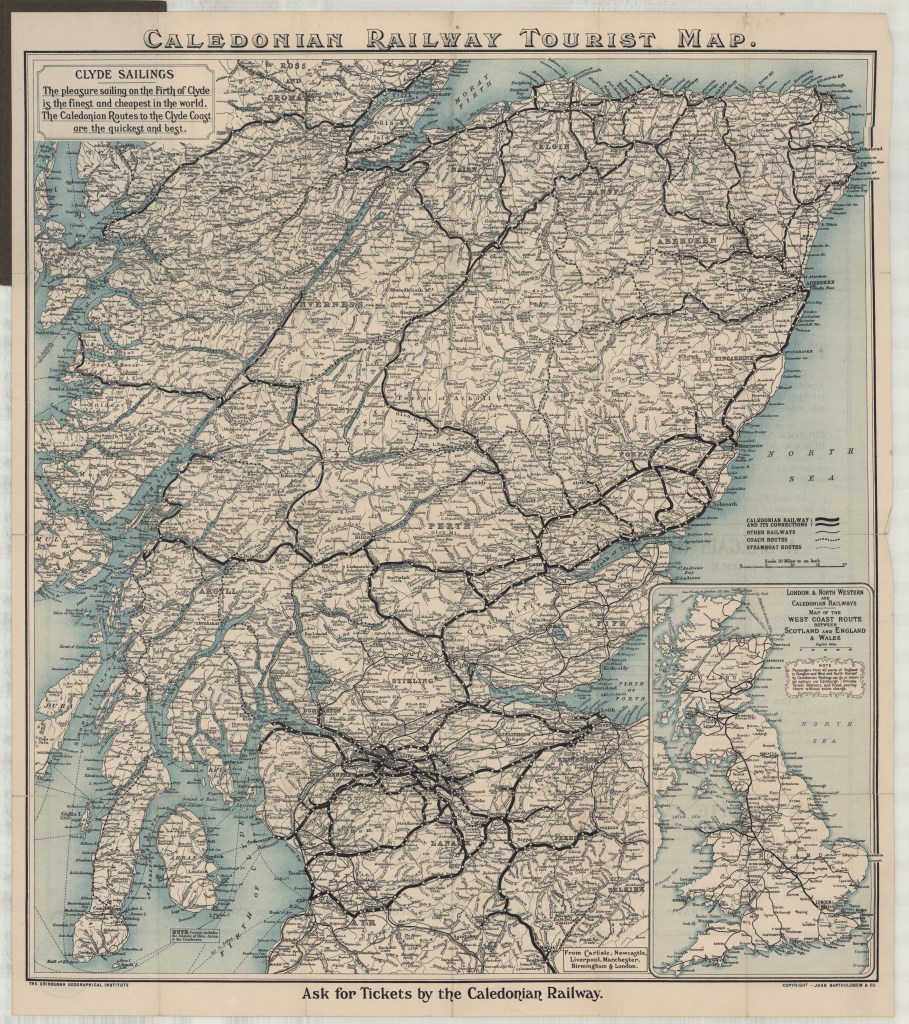
Caledonian Railway tourist map, Caledonian Railway, 1900, 43 x 40 cm, National Library of Scotland, Map.s.234.42, image used CC BY 4.0 NLS.
A family affair
At least three of James’ sons also worked for the railway. Eldest son James (b. 1870) was a railway engine fireman in Scotland, before he moved with his family to South Africa where he worked as an engine driver in the mines. Henry (b. 1880) also migrated to South Africa and worked as a driver in the mines. Robert (b. 1878) was an engine stoker in Scotland. He later moved to Canada, however it’s unknown whether he worked for the railway there.
Having begun his railway career around 1860, and become an engine driver about fourteen years later, James Reid drove trains until his retirement. By the time that occurred sometime between 1910 to 1920, he would have been a railwayman for more than fifty years, all of them seemingly with the Caledonian Railway.

Selected references
Caledonian Railway Association. https://crassoc.org.uk/, accessed 22 June 2024.
Traindriver.org. ‘Historical Background’. https://www.traindriver.org/historical-background.html, accessed 29 November 2021.
Great North of Scotland Railway Association. http://www.gnsra.org.uk/, accessed 25 June 2024.
North British Railway Study Group. https://www.nbrstudygroup.co.uk/, accessed 5 July 2024.
Ferguson, Niall, The Arbroath & Forfar Railway, Stenlake Publishing, Catrine, 2000.
Visit Aberdeen. ‘Aberdeen History Trail: The City Through Its Historical Times’. https://www.visitabdn.com/assets/Aberdeen-History-Trail.pdf, accessed 29 November 2021.
 Untangled Family History
Interesting. I too have some railway ancestors so you can look forward to that next week. I am just finishing it. I have a waercolour from several years ago if I can find it.
LikeLiked by 1 person
[…] junior was born in Aberdeen, and eventually followed in his father’s footsteps on the railway, becoming a railway engine fireman. James married Jane Bowman Ferrier in Arbroath in 1893 and they […]
LikeLike
My name is Craig Reid James Reid is my great grandfather. His youngest son Hector is my grandfather. His son Barry is my father. James and his wife Jane Bowman Ferrier, and their son Hector are buried in Benoni Cemetery,Benoni, Gauteng, South Africa.
LikeLike
Hello Craig! Thanks for commenting. It’s lovely to hear from a Reid cousin. I’d love to learn more about your branch of the family.
LikeLike