
This post is rather longer than some, but I hope you will stick with it and enjoy reading about, and seeing photos of, a first-hand experience of working in Antarctica twenty years ago.
Not many people get to visit Antarctica, but my Dad did. He spent four weeks there for work in late 2004, and had many unique experiences. He was a geodetic surveyor (making very high precision measurement of the earth’s surface) invited to work with colleagues from New Zealand and the USA at McMurdo Station during the southern hemisphere summer.


New Zealand to Antarctica
Travelling to Antarctica and getting around the massive continent was mostly accomplished by air. It all started with a C17 Globemaster plane which flew from New Zealand to Antarctica.
[The Globemaster] is faster and more comfortable with proper air-conditioning, and rumour has it, maybe even proper seats …. Even so, it will be a sweaty embarkation as it is mandatory to wear the cold weather kit for the flight and waiting around for check in … will be uncomfortable to say the least, as it is quite warm at the moment.
…. [We] had a 40-minute Antarctic safety indoctrination and eventually … were bused out to the C17 waiting on the airstrip …. Eventually … we are dragged into the air by the four jet engines (we are all wearing earplugs by now) and settle into a very smooth ride for just on 5 hours. The plane is a big improvement on the Hercules, which can take up to 10 hours, is noisier and has much less space. I am able to stretch my legs to full length towards the cargo in the centre of the plane and can even stand up. There is even a small but civilised toilet that can be accessed by dodging under the chains holding down the cargo. I sit facing a building-sized container that is labelled as weighing about 9 tons. Judging by that I think there is probably 40 or more tons of cargo lashed down the centre of the plane ….
About 4 hours into the flight, while returning from the toilet I looked out the small window in the emergency hatch (there are no other windows) and see sea ice way down below, then a few icebergs and eventually snow covered mountains as we come down the coast – my first view of Antarctica from 31,000 feet (about 6 km).
…. [We] land at McMurdo on the sea ice runway – a very smooth landing. After 10 minutes we walk out onto the ice and into the cold (about minus 15°C) and we know why the cold weather clothing was insisted on. We are hurried straight onto a big-wheeled bus for a drive of a few km across the ice to McMurdo base on the shore.

Flying in a ‘Twatter’
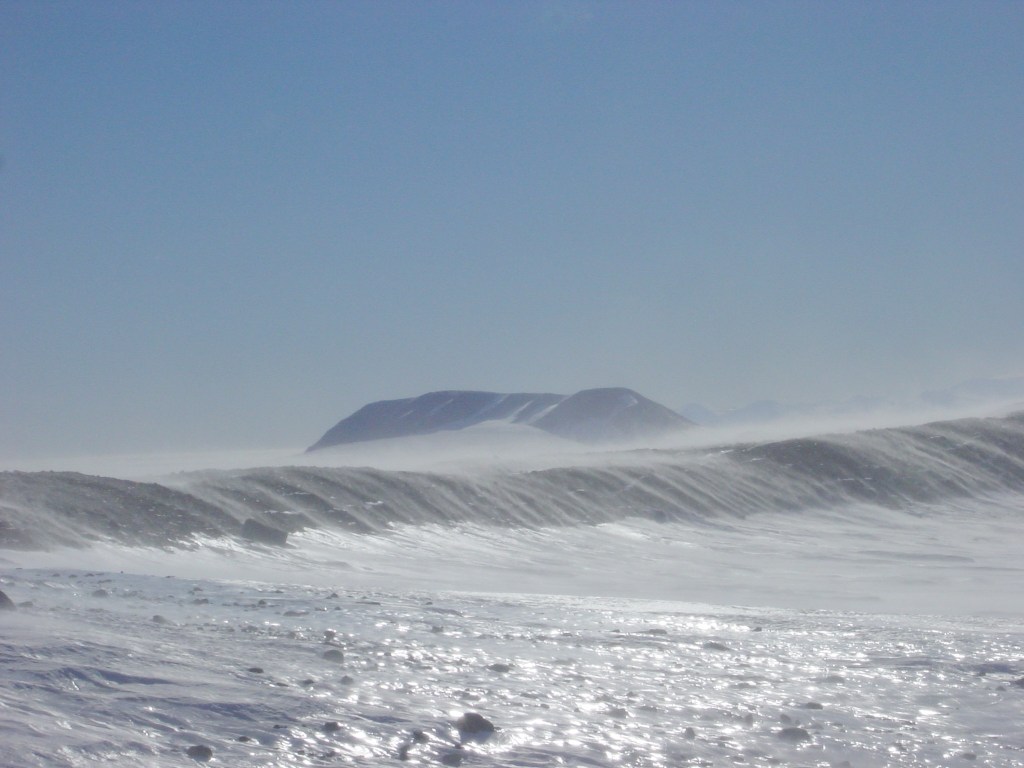
While working out of McMurdo, a fixed wing Twin Otter plane was used for longer trips and was known colloquially as a ‘Twatter’. Dad flew on the Twatter to Lone Wolf Nunatak, which was the furthest south he got in Antarctica. A Nunatak is a largish rock outcrop amidst the ice and snow, a bit like a small island in the sea, and at the time winds were gusting at around 90 kilometres per hour, which made it quite “interesting” to land and take off in particular.


The two-hour flight south of McMurdo (about 350 km) was incredibly scenic with glaciers, mountains and snowfields as far as the eye can see from an altitude of about 13,000 feet. Even at this height we barely clear some of the peaks and are below the highest….There is no way the photos can indicate the scale and grandeur. The cliffs look like just small drops, but they are probably many, many hundreds of metres high.
Fortunately I had been warned about the heated, but unpressurised cabins of the Twin Otter. As we were flying at about 13-14,000 feet without additional oxygen, every now and then the lungs would ask for a bit more and I would find myself mildly gasping a bit for a few seconds. Nothing uncomfortable, just as if I had run up a flight of stairs or something.
As we approach Lone Wolf …. The plane lowers and turns into the wind to land and such is its intensity that this fixed wing aircraft virtually hovers as it just drops onto the snow and ice to the south of the Nunatak (the plane has skis, not wheels). The pilot then taxis up as close as possible to the Nunatak, at times being pushed backwards by the wind.
…. As the survey mark and equipment is near the edge of a cliff to the north, there is some debate about the safety of even leaving the plane. Fortunately there is compacted snow across one area leading to the rock, so we don’t have to risk going across the “blue ice” (in which case we would probably become human kites skidding to our doom). Nevertheless it is difficult to stand in the wind and very easy to be blown over by it.
We manage to get to the station and remove vital equipment containing data, which is all we can do, as despite extreme efforts in preventing it, the equipment box is full of snow and the solar panels have been destroyed. An 80 kg boulder that the solar panel frame was anchored to, had been moved several metres by the wind that destroyed the solar panels and high strength stranded steel “rope” was snapped clean off. The message is clear, if the Antarctic weather wants to get you it will.
We retreat to the plane which needs only about 20 metres to take off into the wind, just like releasing a kite into a strong wind. With the tail wind the return journey is only about one and a quarter hours and we land at McMurdo where all is calm again. It is amazing what this continent can do in relatively short distance or time.
…. I am continually amazed at how these small aircraft take off and land on the most unlikely bits of ice and snow, but it certainly makes our job easier, because otherwise we would be doing a lot of carrying of heavy gear, over long distances, over awkward terrain (ice, snow and rock).


A close call
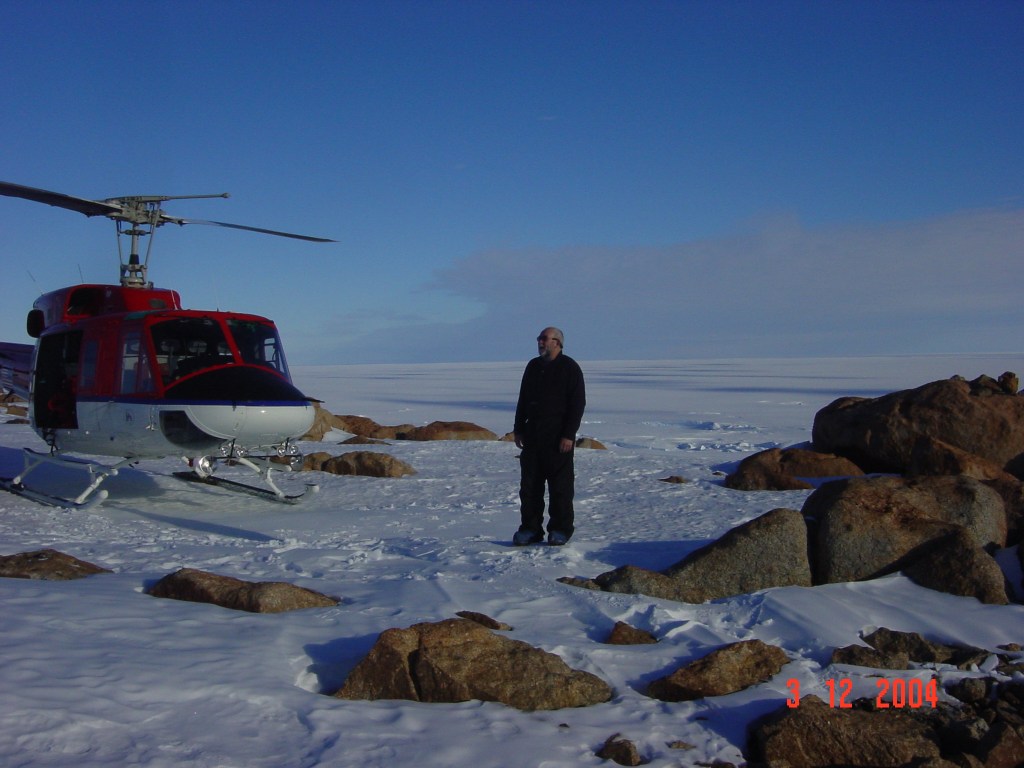
Helicopters were used for other shorter trips out and back from the base. Those trips were more common, but not necessarily any less “interesting”.
After a day of waiting and preparing we finally depart by helicopter for Brosnahan and Conway Range, about 200km SSW of McMurdo. At Brosnahan the snow and rocks rising [from] the middle of the sea ice, combined with what I thought was mild temperature, made it seem like a day at the beach. I had discarded my jacket, hat and gloves and was enjoying the warmth until the chopper pilot pointed out that was minus 13 degrees [Celsius].
Conway is higher and hence colder, but was still quite calm and pleasant. It did however present some unexpected excitement. This east-west ridge has a moderately steep drop to the glacier on the southern side and a gradual snow/ice slope to the glacier on the northern side. The top is strewn with rock outcrops and boulders that make it difficult going, particularly as the helicopter could only land about 200 metres along the ridge from the marks (doesn’t sound far but when wearing the cold weather gear and stepping over rocks and into snow drifts while manhandling heavy equipment, it can be quite exhausting). Anyway, we generally skirted the rocks by walking along the edge of the rocks on the northern side. I even demonstrated Aussie ingenuity by attaching a rope to one of the heavy boxes and dragging it like a sled from the helicopter to the marks.
Later, towards the end of the evening (i.e. about 2 am) we noticed something a bit funny only about 20 metres from the chopper, where the pilot had gone for a bit of a walk along the similar path. About 30 cm in front of where he turned around there was a hole about 30 cm diameter in the snow/ice and it looked uncomfortably deep. A large rock dropped into the hole could still be heard falling after 5 or more seconds – so this was no ordinary hole. We proceeded to bombard the vicinity with quite large rocks and the top layer of snow collapsed showing a very deep crevasse.
On returning the equipment to the helicopter when the observations were complete, we noticed on close inspection (we were getting paranoid now – but with good reason) that there were a few hollows in the snow beside the rocks next to the helicopter that also seemed to lead to an ugly depth. As we were about to leave we noticed a footprint (mine I think from towing the box) only about a metre from the rocks, that had through the time we were there, continued to sink and now also exposed the apparently extensive crevasse! It appears that the northern side of the ridge is probably not a gradual slope at all, but a fairly major cliff (perhaps a couple of hundred metres high) and the slope is part of the glacier that is pulling away from the cliff, but bridged by snow and ice. So it seems we parked the helicopter on, and were carrying heavy loads across, a major crevasse.
Fortunately all concerned survived this experience with quite the story to tell! Antarctica provided Dad with many memorable moments, and I’m glad he kept a record of them.


Flying home
When leaving Antarctica, the temperature was warmer, which apparently means it wasn’t safe for the Globemaster to land on the ice runway. So a smaller plane, a Hercules C130 was used. Getting to the Hercules meant a thirty-minute trip on one of the world’s five special glacier buses, ‘Ivan the Terra Bus’, to reach the ice runway, also known as Williams field.
After a 3 hour wait standing on the ice (a great chance to absorb the last of that crisp Antarctic air) we finally board the USAF (New York Air Guard) C130 Hercules. It seems like a toy after the big C17 we came down on. The C17 was a jet, whereas the C130 is a 4 propeller job, and it has skis, which means it will go even slower – an 8 hour trip packed like sardines amongst the cargo. We sit on netting seats in two rows facing each other, literally with our knees interlaced. If one moves, everyone moves. The crowded conditions are not helped by the fact that we must all wear our Antarctic clothing which not only takes up valuable space, but also becomes unbearably hot once the plane takes off and starts heating its interior.
…. As the flight continued on its slow and extremely noisy way (we all use ear plugs) people gradually manage to ease the discomfit to some extent. Some periodically stand on their “seat” and others (like me) clamber over the people and luggage and spend several hours standing (Oh what joy) in a small space amongst the lashed down cargo. For me this happens to be right beside the door used, in other situations, by paratroopers and I actually spend some time leaning against this door, but only after ensuring that there is no way it might open. It also means I get to watch through the small window and see the sky start to darken for the first time in a month.
We eventually land at Christchurch [in New Zealand] at about 10:30 pm. As the aircraft doors open we are amazed at the smell of moisture and plant life in the air. It has been completely absent for the last month. And as I later walked along the lawn to the Antarctic Centre, I realised how wonderful it is to walk (spring?) across the grass compared to a month of rock and uncertain snow and ice.


Spending time in Antarctica isn’t something many people get to do, and this is only part of a much bigger story. It was an amazing four-week experience. Just imagine what it must be like for those who spend a whole season, or longer! It’s been twenty years since Dad’s Antarctic experience and revisiting it has been enjoyable for him and enlightening for me.
Selected references
All quotes and photographs in this blog post are from a private collection. They must not be used, in part or whole, without permission.
National Geographic, ‘Antarctica’, https://education.nationalgeographic.org/resource/antarctica/, accessed 15 June 2024.
U.S. National Science Foundation, ‘McMurdo Station’, https://www.nsf.gov/geo/opp/support/mcmurdo.jsp, accessed 15 June 2024.
Australian Antarctic Program, ‘Scientific Observatories’, https://www.antarctica.gov.au/, accessed 15 June 2024.
Intergovernmental Committee on Surveying and Mapping (ICSM), ‘What Surveyors Do’, https://www.icsm.gov.au/education/fundamentals-land-ownership-land-boundaries-and-surveying/surveyors-and-surveying, accessed 15 June 2024.
Australian Antarctic Program, ‘C-17A Globemaster III’, https://www.antarctica.gov.au/antarctic-operations/travel-and-logistics/aviation/intercontinental-operations/c17/, accessed 15 June 2024.
Australian Antarctic Program, ‘DHC-6 Twin Otter’, https://www.antarctica.gov.au/antarctic-operations/travel-and-logistics/aviation/intracontinental-operations/dhc-6-twin-otter/, accessed 15 June 2024.
Australian Antarctic Data Centre, ‘Lonewolf Nunataks’, https://data.aad.gov.au/aadc/gaz/display_name.cfm?gaz_id=1871, accessed 15 June 2024.
Australian Antarctic Data Centre, ‘Conway Range’, https://data.aad.gov.au/aadc/gaz/display_name.cfm?gaz_id=2240, accessed 15 June 2024.
Australian Antarctic Program, ‘Fixed Wing Aircraft’, https://www.antarctica.gov.au/about-antarctica/history/transportation/aviation/1955-69/, accessed 15 June 2024.
United States Antarctic Program, ‘Ivan the Terra Bus’, https://photolibrary.usap.gov/PhotoDetails.aspx?filename=ivan-terra-bus-closeup.jpg, accessed 15 June 2024.
Skybrary, ‘Williams Field, https://skybrary.aero/airports/nzwd, accessed 15 June 2024.
 Untangled Family History

It was good that he kept the writings from that time. Also good photos.
LikeLiked by 1 person
Thanks. This month should be good. Planes, trains and automobiles, and boats. Plenty of inspiration. Lots of choices.
LikeLiked by 1 person