
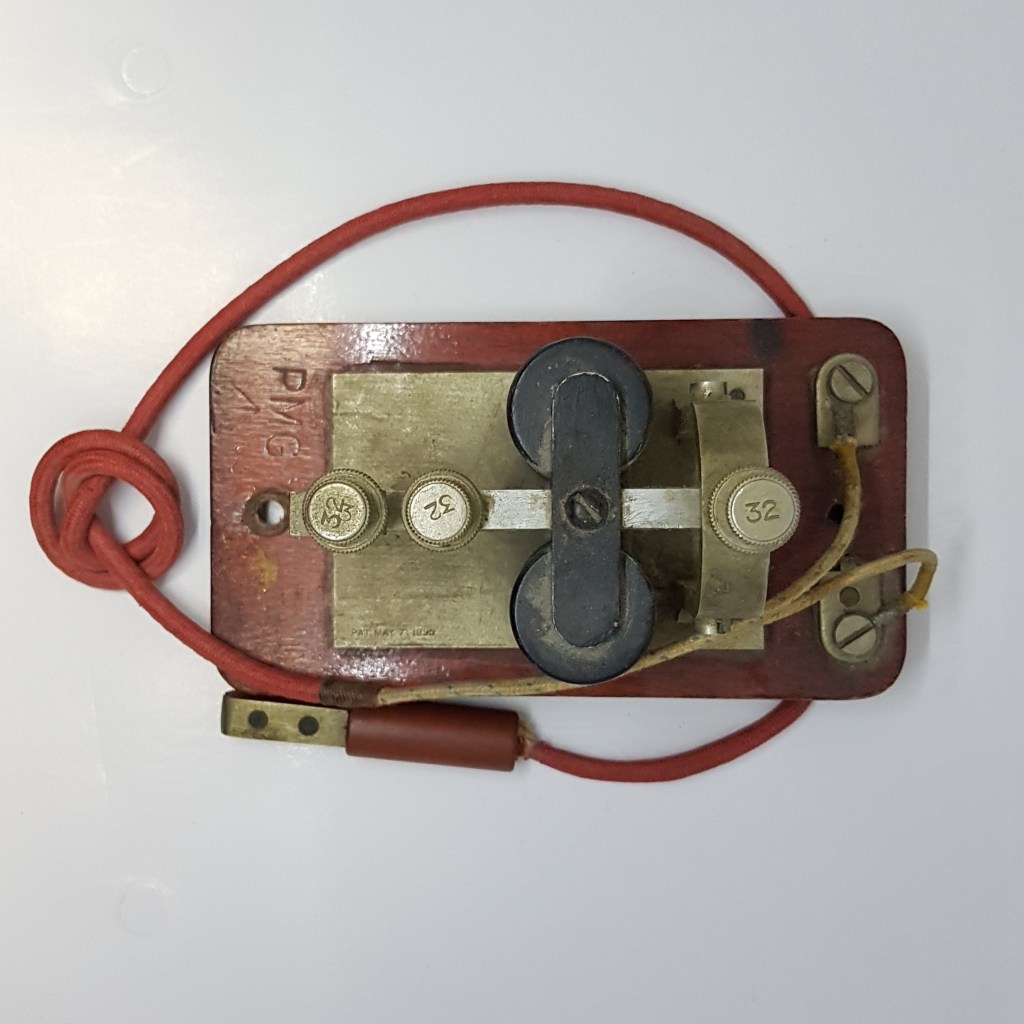
A simple definition of technology is using scientific knowledge for practical purposes. An historic piece of technology which holds significance in my family is Simplex Auto telegraph key number 585, which was owned by my grandfather, who was a telegraphist.
Investigating the inscribed name, serial number and design of the nickel plate on the telegraph key indicates it is a second model dating from around 1923-1925. Further investigation into this technology, how it works, and its place in Australian history, helps understand more of my grandfather’s occupation.
History of the telegraph
The Simplex Auto was invented by Leopold Gilbert Cohen in the early 1920s, and he was credited with their manufacture, in partnership with Carl Juckert, in Melbourne until World War Two. This particular piece of technology became well-used across Australia from 1923, when it was adopted by the Commonwealth Government, and was especially popular in the Post Master General’s (P.M.G.) Department.
Telegraph keys, known colloquially as a bug, or in Australia as a jigger, are used to send messages in Morse code. They’re portable, small enough to be held in one hand, and need to be connected by wire to a battery, and a remote sounder of approximately the same size to receive messages. An operator presses a metal lever which creates an electrical circuit and transmits current on a telegraph line, which is broken by releasing the lever. Short and long pulsed currents represent the dots and dashes of Morse code. Thus messages can be sent and received anywhere the telegraph line is connected.

Photograph of Simplex Auto telegraph key number 585, 2021, original held in private collection.
Photograph of a sounder, 2021, original held in private collection.
The telegraph meant it was possible for communication between the colonies and the rest of the world to take minutes or hours instead of weeks or months. A significant milestone in making this possible was the 1872 completion of the Overland Telegraph using 36,000 telegraph poles and 11 repeater stations. This connected Port Augusta with Darwin, where the British Australian Telegraph Company had already connected Darwin to Java by underwater cable the year before. It enabled messages to be sent internationally via telegraph for the first time.
Telegrams and telegraphists
Messages were translated into Morse code, transmitted via the telegraph, then received, translated and transcribed as a telegram which was delivered to its nominated recipient. Quite a contrast to today’s mobile phones and internet! It’s difficult to imagine such barriers to communication existed only 150 years ago, and that telegrams were considered the most popular method of fast communication.
Telegraphists were in demand and telegrams ubiquitous until around the 1970s. The P.M.G. was responsible for official telegraphs in Australia and employed an extensive number of telegraphists, including my grandfather. In the Sydney Chief Telegraph Office alone there were up to 500 telegraphists on duty for each shift in ‘The Room’.
![General Post Office, George Street Sydney, 1940s (01/01/1940 - 31/12/1949),
[A-00033484], City of Sydney Archives, https://archives.cityofsydney.nsw.gov.au/nodes/view/597544, accessed 12 Jan 2024.](https://untangledfamilyhistory.com/wp-content/uploads/2024/01/087358.tif.jpg?w=1024)
[A-00033484], City of Sydney Archives, https://archives.cityofsydney.nsw.gov.au/nodes/view/597544, accessed 12 Jan 2024.
The end of an era
A gradual phasing out of Morse code began in 1959, replaced by the Teleprinter Reperforator Switching System (TRESS). Although telegrams were still sent through other means, the final Morse code message was sent in Australia in 1963, at which time ‘A Farewell to Morse’ was held at Sydney Town Hall.
Although their occupation had evolved to something new, outside of work former telegraphists set out to preserve and share Morse code and telegraphy skills, and met together regularly with official business of their meetings held entirely in Morse code. And as time passed, in keeping with Morsecodian tradition, at the funeral of a telegraphist the eulogy would end with a Silent Key, the transmission in Morse code of a message that he had died and his key would now remain silent. Quite an emotional experience.
Simplex Auto 585 is now a family heirloom, occasionally brought out to explain Morse code and demonstrate historical communications. Just as Morsecodian fraternities have advocated for ongoing knowledge of Morse code and Australian history, keeping this jigger in the family helps preserve memories and family history.
‘The Wire, Stories of Morse Code’, featuring The Morsecodians Fraternity of Western Australia, City of Melville, produced by Barking Wolf, 2017, https://youtu.be/bPAA-oy1PB8, accessed 15 March 2024.
Selected references
Australian Telegraph Office. ‘Leo G. Cohen Inventor of the Simplex Auto’. https://australiantelegraph.files.wordpress.com/2021/09/leopold-g-cohen-inventor-of-the-simplex-auto-1-1.pdf, accessed 25 November 2021.
Australian Telegraph Office. ‘The Simplex Auto’. https://australiantelegraph.files.wordpress.com/2021/11/the-simplex-auto-.pdf, accessed 25 November 2021.
Australian Telegraph Office. ‘Telegraphy in Australia’. https://australiantelegraph.files.wordpress.com/2021/10/telegraphy-in-austalia.pdf, accessed 25 November 2021.
Cohen, Leopold G., ‘Simplex Auto telegraph key number 585’, c1923-1925, original held in private collection.
Lovelock, Max, A Farewell to Morse, unpublished, held in private collection.
Museums Victoria Collections. ‘Telegraph Key & Relay – Victorian Telegraph Service, Melbourne, Victoria, 1860s’. https://collections.museumsvictoria.com.au/items/413884, accessed 25 November 2021.
National Museum of Australia. ‘Overland Telegraph’. https://www.nma.gov.au/defining-moments/resources/overland-telegraph, accessed 25 November 2021.
Radiomuseum. ‘Simplex Auto 5th Model’. https://www.radiomuseum.org/r/cohen_simplex_auto_5th_model.html, accessed 25 November 2021.
 Untangled Family History
I loved your blog post about the Telegraph connection. My family spent 100 years in the telegraph industry. Was it only your grandfather who worked as a telegrapher? You might like a couple of my recent posts in 52 Ancestors.
https://polynose.com/2024/02/07/week-6-earning-a-living-a-family-of-dots-dashes/
or
https://polynose.com/2024/01/22/week-4-witness-to-history-air-bb-for-the-flying-flapper/
LikeLike
Thank you! My grandfather was the only telegraphist in the family, though there were some related communications occupations. Thanks for sharing your ancestors’ stories, too. There are so many wonderful stories connected to this subject.
LikeLiked by 1 person
[…] tiny badge, which I think is probably rather rare, is from when my grandfather travelled as a telegraphist with the Australian Post Office entourage for Queen Elizabeth II’s Royal Tour of Australia in […]
LikeLike
[…] grandfather was Telegraph Officer in Charge at the Chief Telegraph Office (C.T.O.) in Sydney, and played a crucial role in helping […]
LikeLike