
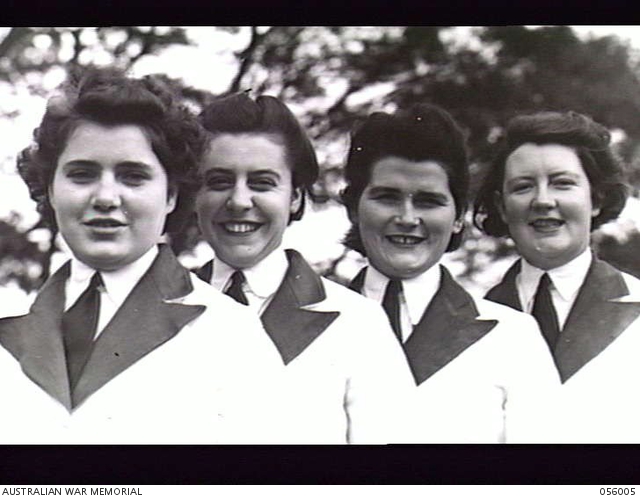
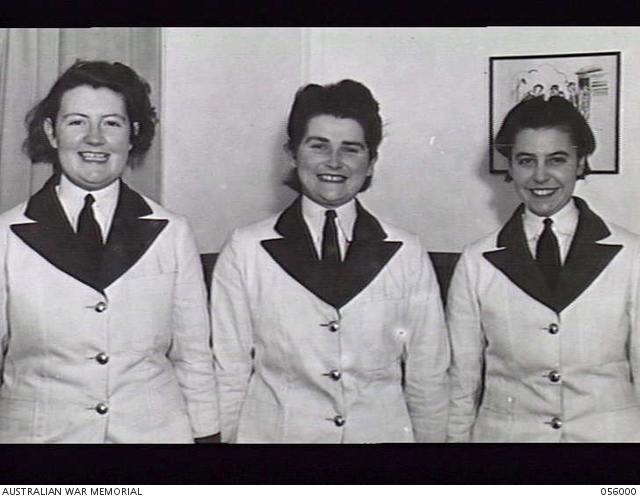
While looking for information about the military unit my grandmother served with in World War Two, the Women’s Royal Australian Naval Service (WRANS), I unexpectedly came across her in two photos in the collections of the Australian War Memorial.
My grandmother, Margaret, joined the WRANS as a stewardess in June 1943. She told her daughter about serving as stewardess for Mrs Eleanor Roosevelt, wife of President F. D. Roosevelt. It was when Mrs Roosevelt visited in September 1943, in her role as president of the American Red Cross.
This story is corroborated by my grandmother’s service record which says she was “lent to duty at Government House Canberra leaving Melbourne by train 2nd Sept”. The dates coincide with Mrs Roosevelt’s time in Canberra.
It was while browsing photos of the WRANS that I recognised my grandmother, and was thrilled to find something showing her ‘at work’. The two group photos show her dressed in the WRANS stewardess uniform and were taken at HMAS Cerberus in August 1943, just two months after she enlisted, and close to her twentieth birthday.
This is the kind of discovery that’s a reminder to search and browse, and to look for familiar people in photos, not just search for names.
The WRANS
It was due to the determination of Florence Violet McKenzie that the Women’s Royal Australian Naval Service, the WRANS, was first formed as the women’s branch of the Royal Australian Navy in 1941. It began when she convinced the navy to accept fourteen of the women telegraphists she’d trained at her Women’s Emergency Signalling Corps.
The small group soon expanded, although there were only ever 3,000 WRANS at any given time. They worked in a diverse range of roles from positions as office orderlies, transport drivers, harbour messengers, and stewardesses, to those in radio telegraphy plotting, ciphers, allied intelligence, and much more.
The WRANS were disbanded in the middle of 1948, but re-established in 1951, becoming a permanent part of the navy at the end of 1959. Then in the 1980s the WRANS were integrated into the broader Royal Australian Navy, and completely disbanded in 1984 when the Sex Discrimination Act was introduced.
Selected references
Group portrait of Stewardesses (STD) of the Women’s Royal Australian Naval Service (WRANS), Ronald Keith Monro, black and white photograph, 26 August 1943, Australian War Memorial, 056005, image in the public domain.
Group portrait of three WRANS Stewardesses (Wran STD), Ronald Keith Monro, black and white photograph, 26 August 1943, Australian War Memorial, 056000, image in the public domain.
‘Crowded Incidents of Mrs Roosevelt’s Visit’, The Canberra Times, http://nla.gov.au/nla.news-article2647994, accessed 8 April 2026.
The Women’s Royal Australian Naval Service (WRANS), Royal Australian Navy, https://www.navy.gov.au/about-navy/history/history-milestones/womens-royal-australian-naval-service-wrans, accessed 4 April 2026.
Women’s Royal Australian Naval Service (WRANS), Australian War Memorial, https://www.awm.gov.au/learn/understanding-military-structure/ran/wrans, accessed 4 April 2026.
Women’s Royal Australian Naval Service, The Australian Women’s Register, https://www.womenaustralia.info/entries/womens-royal-australian-naval-service-wrans/, accessed 4 April 2026.
Patsy Adam-Smith, Australian Women at War, Thomas Nelson Australia, Melbourne, 1984.
Florence Violet McKenzie (1890-1982), Australian Dictionary of Biography, https://adb.anu.edu.au/biography/mckenzie-florence-violet-15485, accessed 8 April 1974.
Women in the Navy, Royal Australian Navy, 1950s, https://youtu.be/v3cbVywPMo8.
The First WRANS, Australian War Memorial, https://wm.awm.gov.au/read/first-wrans, accessed 8 April 2026.
 Untangled Family History