
There are always challenges in family history research and one of my ongoing ones relates to my 5x great-grandfather, Peter Sampson. He’s one of those ancestors who’s been hard to pin down, and to confirm whether I’ve found the right man and correct records.
In searching for answers I came across the will of Peter Sampson Esquire, also known as Captain Peter Sampson. I believe this Peter Sampson is my direct ancestor, although some of the clues create ambiguity.
This post explores some of what I’ve found. It’s intriguing and leaves me with more to investigate.
Huguenot heritage and connections
Peter (Pierre) Sampson, was of Huguenot heritage, and baptised at St Martin Orgar French Huguenot Church in London in 1758. He was the son of William (Guillaume) Sampson and his wife Elizabeth, nee De Visme.
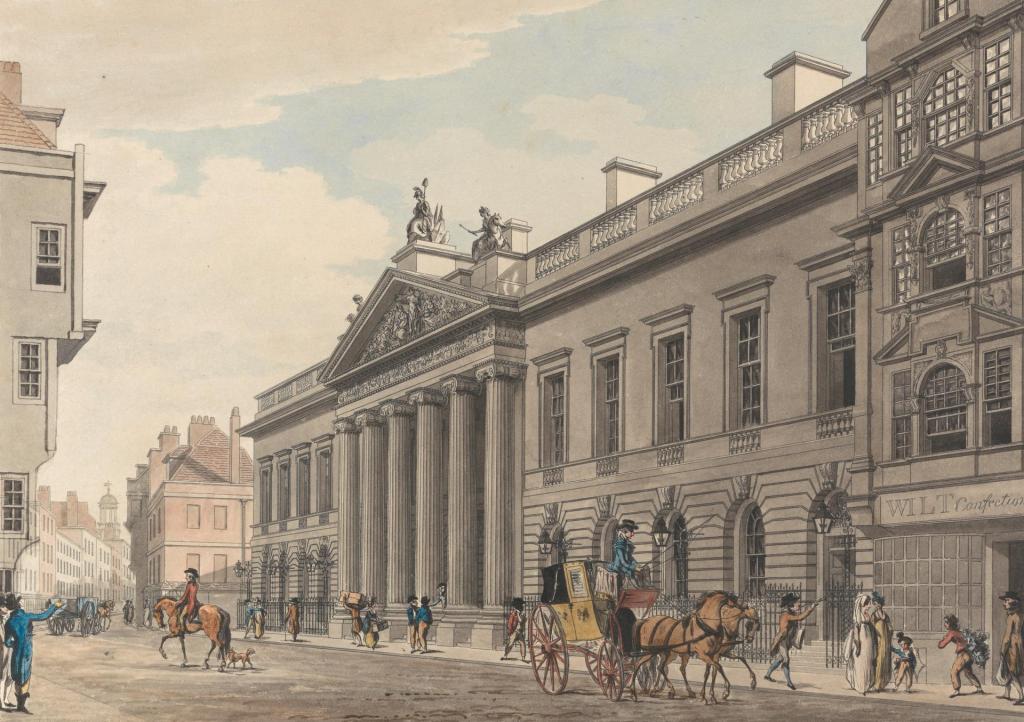
I believe it’s this Peter who captained ships for the East India Company (EIC). His regular destination seems to have been Asia, and two ships he commanded for the EIC were the Dutton and the Dover Castle.
I’ve identified a daughter for Peter named Maria, who the 1841 census records as being born in “foreign parts”. That could also mean Peter married outside England. According to The Monthly Magazine, his wife Eliza died in childbirth in 1800. Peter himself died nine years later. By that time daughter Maria had married Joseph Toulmin, an event that took place in 1804 when she was 21.
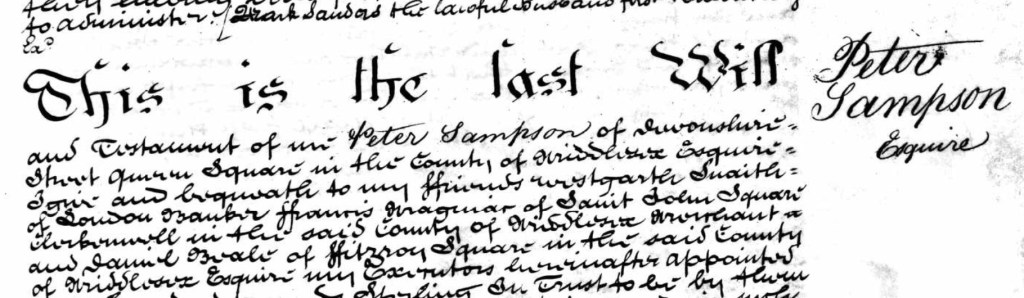
The date of probate for Peter’s will is 9 October 1809, and the will provides a lot of information which I’ve been using in research, trying to confirm or disprove facts. The trouble with wills is they often give you only part of the picture. However, this one is quite detailed and I’ve been slowly working on how those mentioned are connected to Peter and what happened to them.
Probate and bequests
Peter Sampson appointed three friends as his executors: Westgarth Snaith, Francis Magniac, and Daniel Beale. They were also designated as guardians of his three daughters “during their minorities”.
Peter appears to have been a man of some means, likely accumulated through captaining EIC ships. His bequests provide helpful information, some of which I’m still exploring.
There was an annuity left for his brother James Sampson of Calcutta, another annuity to a woman in Sevenoaks for her “attention” to his children—I think she may have been their governess, companion or something similar. Two hundred pounds was also left in trust “for the advancement of Thomas Nelson late of Dunbar in North Britain but now a cadet in Woolwich”, one thousand pounds to Thomas’ three sisters, and similar amounts to each of five daughters of his friends and executors. All of the bequests seem quite generous.
Peter left the residue of his estate in trust for his three daughters who were named in the will as Harriet, Eliza and Helen Sampson, subject to multiple stipulations. They included that the trustees and executors could, for the benefit of the daughters, invest any surplus after annual income in the stock of public funds, and that any future husband of the daughters could not have power or control of the money.
Perhaps most importantly, the will stipulated that if any of Peter’s daughters married before they were 21 without the consent of their guardian/s they would “forfeit and lose all benefit under [the] will”. This could be why my ancestor Harriet Sampson found herself in dire straits almost ten years later. It’s probable her 1812 marriage was without consent and before she reached her majority—she was baptised in 1796 and likely born about the same time, meaning she was probably only sixteen when she married in 1812. Maybe her share was simply lost through poor management or other choices, too.
Three Sampson daughters
The three daughters named in Peter’s will appear to have gone on to have quite different lives.
Assuming I’ve identified the correct Peter Sampson, the first named daughter was my 4x great-grandmother, Harriet Sampson. She married James Sleigh in 1812, had two sons, found herself living in poverty, was arrested and transported to Australia. She married again, to George Kennewell and had many more children before her death in 1849.
Eliza Sampson married Abraham Henry Lane in 1823. One of the witnesses to the marriage was Daniel Beale, one of her guardians. Abraham Lane, who was commonly known as Henry, was a Lieutenant Colonel in the 12th Lancers who had previously fought for the US Confederate Army. He died in Frankfurt, part of modern day Germany, in 1830. Eliza didn’t re-marry and died in 1875.
Helen Sampson, who was only nine when her father died, married at the age of 24. Her husband was Hollingworth Magniac, one of Francis Magniac’s sons. Hollingworth had spent time in Canton, and was thirteen years older than her. Helen and Hollingworth had seven children together before Helen died in 1858 aged 58.
Peter’s other daughter, Maria, was older and well settled, which is likely why she wasn’t named and left a bequest. Although it’s surprising given the bequests he left to others who were not family members.
Executors of the will
The executors of Peter’s will seem to have been close associates. Westgarth Snaith was a London banker. Francis Magniac was a merchant described as a “French Huguenot goldsmith and highly skilled maker of complicated clocks and automata”. He exported his work to China and deployed his sons to manage business there. Daniel Beale was a merchant who worked for the EIC and in association with members of the Magniac family.
Following Peter’s death, Snaith, Magniac and Beale went into business together. It makes me wonder if conflict of interest might have been involved, especially when you consider the marriage between one of Peter’s daughters and the son of one of his executors.
My hypothesis
I think it’s highly probable Captain Peter Sampson is my direct ancestor. I also think it’s possible he was married more than once, and that when he died the only children he still needed to support were the three daughters named in his will, who were underage and unmarried.
At least one of his associates being from the French Huguenot community is another reason to believe this is the correct man, given his own Huguenot heritage. It’s certainly a strong coincidence.
For now, I’ll keep digging, because I’m sure there’s more to discover about Captain Peter Sampson, and hope I can prove more conclusively that I’ve identified the correct Peter.
If you have any clues or insight about Peter Sampson and his family, please get in touch.
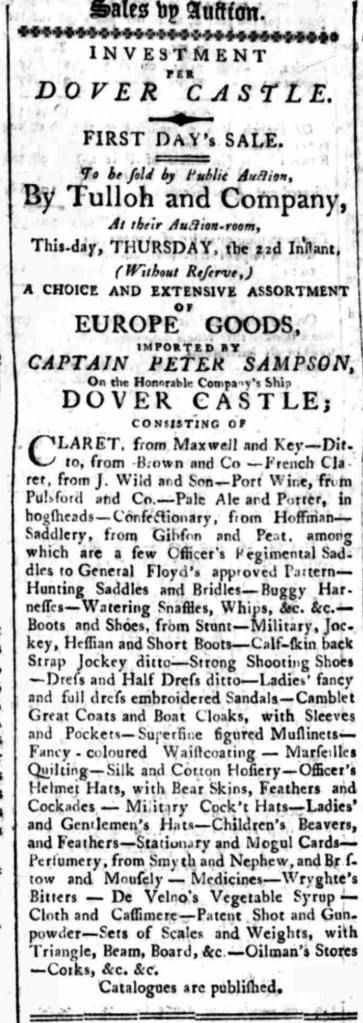
Advertisement describing goods imported by Captain Peter Sampson: ‘Sales by Auction. Investment per Dover Castle.’, Calcutta Gazette, 22 October 1801, p. 12.
Selected references
Will of Peter Sampson Esquire, died 10 September 1809, England & Wales, Prerogative Court of Canterbury Wills, 1384-1858, prob. 11/1504.
Great Britain. India Office List of marine records of the late East India Company, and of subsequent date, preserved in the Record department of the India Office, London (London: India Office, 1896), p. 66, 68, 77, 81.
East India Company, Proceedings relative to ships tendered for the service of the United East India Company, from the Second July, 1806, to the Twenty-seventh September, 1809, with an Appendix, London, 1809.
‘Sales by Auction. Investment per Dover Castle.’, Calcutta Gazette, 22 October 1801, p. 12.
‘Married’, Sun (London), 11 April 1804, p. 4.
‘Died’, Pilot (London), 13 September 1809, p. 4.
‘Married’, Star (London), 17 November 1823, p. 12.
‘Married’, Evening Mail, 19 January 1824, p. 18.
 Untangled Family History