
Thomas Hodge, my 3x great-grandfather, arrived in New South Wales as a convict. One of the younger sons of Peter Hodge and Fanny Horn, Thomas was born in Bath in 1815 and was working as a blacksmith’s labourer when he was arrested for housebreaking.
Arrest
In the early hours of a Monday morning in July 1835, Thomas and two brothers named Richard and George Gough were caught as they entered a garden in Twerton, near Bath. The owner of the house and his son were present in the garden, and after an altercation took them into custody. The men were reported as having crowbars and other implements for housebreaking, as well as property stolen from a house in nearby Widcombe on Sunday night.
Trial
At the Somerset Assizes in Bridgwater, Thomas and the Gough brothers were indicted for breaking and entering the house in Widcombe. Thomas had in his possession a jacket, and Richard Gough had a pair of trousers, both of which were proven to belong to the owner of the house. Evidence was given that Thomas and Richard also had former convictions — Thomas’ was in 1833 and had resulted in 18 months imprisonment.
Thomas Hodge and Richard Gough were found guilty of housebreaking and stealing wearing apparel. George Gough was found guilty of stealing a large quantity of beef from elsewhere. All three men were sentenced to three months imprisonment and transportation for life.
Convict records describe Thomas as being five feet and six-and-a-half inches tall, with a fair complexion, light brown hair and hazel grey eyes. He had a mole on his left cheek, another on the right side of his neck, and a scar on the back of the little finger of his right hand.
Transportation
Thomas was 21 when he arrived in Sydney in October 1836, after a four-month journey aboard the Lady Kennaway.
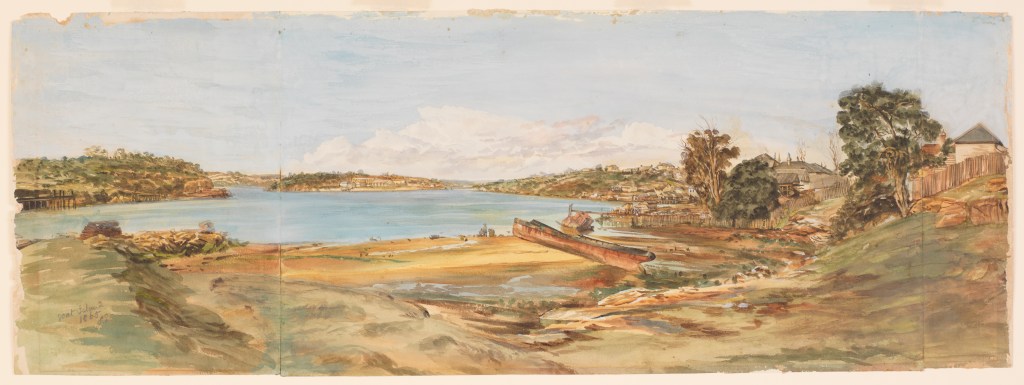
One of his first assignments was on Goat Island. At the time, the water police station was being transferred to Goat Island, and in January 1837 convicts were put to work on a “wet ditch” to create two separate Islands, the small one housing the water police and the larger being the location of a barracks and powder magazine. Thomas appears at Goat Island on the convict muster of 1837.
Later Thomas was sent to work for the Chisholms at Kippilaw, near Goulburn. James Chisholm’s reputation was as “a kind employer to both his convict laborers and free settlers whom he employed on his lands. A story is told that he once gave his gloves to a convict at the Kippilaw property to protect his hands on a very cold day.”
Thomas remained in the Goulburn region for the majority of his life, living for a long time at Mummel. In 1844 he received his ticket of leave and married Sophia Willard, a widow with a young child. He and Sophia had ten children together, including my 2x great-grandfather Abraham. Thomas was given a conditional pardon in 1852, eight years before Abraham was born.
Sophia is recorded as the informant of Thomas’ death at the age of 85, which was registered in Nyngan in June 1900, although she was listed as living at Mummel. Why were Thomas and Sophia so far from home? I think it’s probable they’d been visiting their son Abraham, who was living and working in the area at the time, and whose youngest son was born the year before.
Selected references
[no title], Bath Chronicle and Weekly Gazette, 9 July 1835, p. 6.
‘Somerset Assizes’, Dorset County Chronicle and Somersetshire Gazette, 13 August 1835, p. 33.
‘Somsersetshire Assizes: Transportation for Life’, Bristol Mirror , 15 August 1835, p. 57.
‘Somerset Assizes’, The Western Flying Post, Sherborne and Yeovil Mercury, 17 August 1835, p. 9.
James Wilson, Medical and surgical journal of His Majesty’s convict ship Lady Kennaway, 21 April – 21 October 1836, UK, Royal Navy Medical Journals, 1817-1857, The National Archives, Kew, Surrey, England, ADM 101/41/6, Ancestry.com, accessed 18 December 2024.
Thomas Hodge, Lady Kennaway, 1836, New South Wales, Australia, Tickets of Leave, 1824-1867, NSW State Archives, 44/2799 Ancestry.com, 1 February 2026.
Thomas Hodge, Lady Kennaway, 1836, Conditional Pardon, NSW, Australia, Convict Registers of Conditional and Absolute Pardons, 1791-1867, NSW State Archives, 52/54, Ancestry.com, accessed 1 February 2026.
About, Kippilaw Homestead, https://kippilaw.com.au/about/, accessed 1 February 2026.
Kerr, James Semple, Goat Island: An Investigation for the Maritime Services Board of NSW, The National Trust of Australia and the Maritime Services Board of NSW, Sydney, 2000, pp. 14-15.
 Untangled Family History
My ancestors GeorgeM9rgan robbed a pub at night was caught with the money the next day, spent years on the hulk then was finally transported to NSW
LikeLike
My ancestor George Morgan robbed a pub at night, was caught with the money the next day, spent years on the hulks then was finally transported to NSW in 1802.
LikeLike
[…] last of my convict ancestors to arrive was Thomas Hodge. He was a blacksmith from Bath who was convicted of housebreaking and transported aboard the Lady […]
LikeLike
[…] on the Queen Victoria, arriving in 1841. After George’s death in 1843, Sophia married convict Thomas Hodge. Sophia’s younger brother George also immigrated, I believe via Tasmania, as did their oldest […]
LikeLike