
My great-grandmother’s second husband, Dagworth Edward Tunks, known as Doug, was a bugler in World War One. His bugle is now owned by my Dad, and younger members of the family occasionally try it out. It’s quite difficult to be musical with an instrument like a bugle without any training or practice!
Doug Tunks served as a Private and bugler in the Australian Imperial Force in World War One. He was a 21-year-old railway porter when he enlisted in 1916, originally joining the 36th Battalion. He spent most of his time in England, arriving there in October 1916, and being stationed at Bulford, near Salisbury, from March 1917.
He was transferred to the 1st Australian Dermatological Hospital (A.D.H.) in July 1917 and on discharge in 1918, his service record lists him as Bugler Tunks of the 1st A.D.H.. He appears to have struggled with military discipline, being charged and penalised more than once for offences such as failing to “blow markers” and neglecting to sound the bell for “Officers’ Mess”.
Doug’s bugle is a bit battered, and no longer has its cords. It’s brass and doesn’t have a visible Broad Arrow mark signifying its purchase by the army, however it weighs just over 600 grams and does appear to be a genuine military bugle.
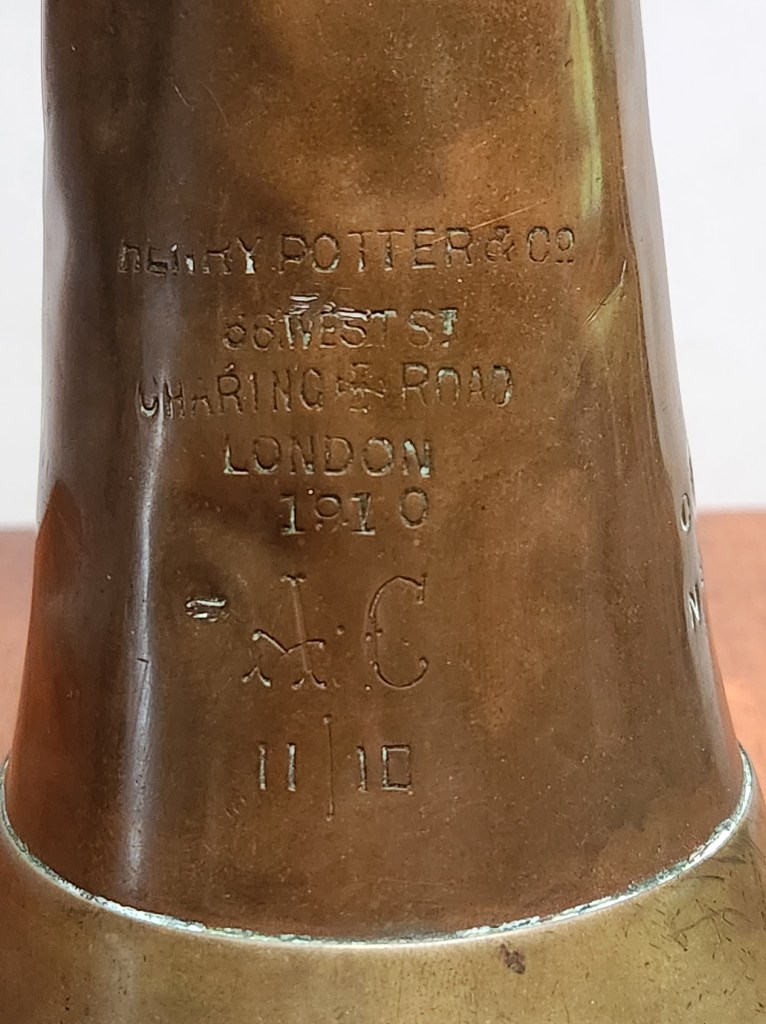
It’s stamped with the maker’s mark: HENRY POTTER & CO, 66 WEST STREET, CHARING X ROAD, LONDON, 1910. Henry Potter & Co, are a renowned musical instrument manufacturing company established in 1810. From 1860, and right up to World War One, they were based in London’s Charing Cross. Today they’re located in Aldershot.
Other marks on the bugle suggest it may have been originally owned by someone else, so it may or may not be the one Doug played during the War. There’s A.C 11 | 10 directly under the maker’s mark, and CMF 2 NSW 12 on the side of the bell. CMF stands for Citizen Military Forces which was the local militia, part of Australia’s first national service scheme which began in 1911. A similar bugle by the same maker and from the same time period is held in the Australian War Memorial’s collections.

History of military bugles
Bugles were traditionally used to instruct soldiers during battle, or at rest, with tunes providing orders and directions. In use by the British military from the 1760s, by 1914 alternative communication methods meant they were by then mostly for camp and ceremonial use. These days they are perhaps best known for playing The Last Post and other calls at commemorative services. Listen to some bugle calls below.
Selected references
Service record of Dagworth Edward Tunks, Australian Imperial Force Personnel Dossiers, 1914-1920, National Archives of Australia, B2455, Tunks, Dagworth Edward.
About, Henry Potter & Co., https://www.henrypotter.co.uk/about.htm, accessed 1 December 2025.
Bugles: Commemorative Replicas, Australian War Memorial, https://www.awm.gov.au/encyclopedia/bugles, accessed 15 November 2025.
Australian Army Bugle, Collections WA, cwa-org-32-99-166, https://collectionswa.net.au/items/f7caad8c-cbc5-4e34-b8c6-01065d4f1c2c, accessed 16 November 2025.
Bugles – Last Post – Here they come–A day to remember, Anzac Portal, https://anzacportal.dva.gov.au/resources/bugles-last-post-here-they-come-day-remember, accessed 15 November 2025.
Ceremonial music and bugle calls, Australian War Memorial, https://www.awm.gov.au/collection/C281471, accessed 16 November 2025.
Music for Remembrance Day or a commemorative event, Anzac Portal, https://anzacportal.dva.gov.au/commemoration/event-planning/music, accessed 16 November 2025.
How to play a bugle, Steve the Musician, 18 April 2020, https://youtu.be/G29e5yb_UZ8?si=jeyJB0f1dzcqYzRa.
 Untangled Family History