
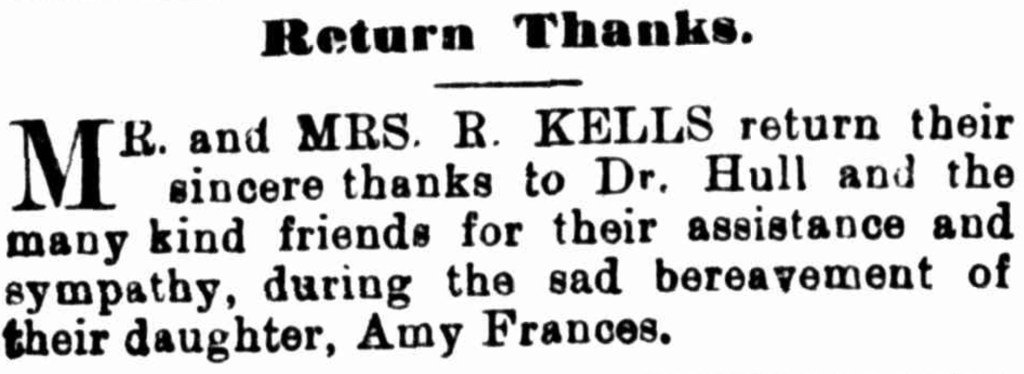
My great-grandaunt, Amy Frances Kells, was just one month short of her eighteenth birthday when she died in 1909, from the effects of burns received when her clothing accidentally caught fire. The incident which took place at her family’s home in Tomerong, must have been traumatic for the whole family, and was reported widely in newspapers.

A tragic accident
Edith Kells, Amy’s older sister and my great-grandmother, said they were in the kitchen in the middle of the day, Amy with her back to the fire, when she told her sister she was standing too close to it. Shortly after, Amy’s dress caught alight.
Screams alerted their father Robert as Amy ran outside, probably to avoid fire spreading to the house. Robert dragged her to the ground, and smothered the flames with blankets. After cutting off her clothes, Amy was assisted back to the house, where she was covered with oil and put to bed to await the doctor. Sadly, there was nothing to be done, and Amy died later that night.
The doctor who attended her in the late afternoon, Walter Hull, reported that he’d administered morphine to Amy, who was “quite conscious and sensible”, but had severe burns over much of her body and was suffering severe shock. District coroner and local journalist, C. J. B. Watson, ruled this was the cause of Amy’s death.
Both the doctor and coroner drew attention to the flannelette material of Amy’s under-dress, and condemned its use for clothing due to the danger it posed.
Doctor Hull said he thought “it probable that had she been wearing less inflammable clothing she would have escaped lightly….[and had never seen] a case where flannelette was being worn which did not end in the same way”.
Coroner Watson said he was “of the opinion that the dangerous character of the material known as flannelette, as plainly indicated by the medical testimony in this case, should be made better known that it appears to be.”
History of flannelette
Flannelette has its origins in sixteenth or seventeenth century Wales, when farmers made flannel from leftover wool. Flannel was warm and varied in texture from coarse to soft depending on the wool it was made from.
A brushed cotton imitation of flannel, flannelette contained no wool and an 1899 newspaper said testing showed it was “loaded with chloride of lime, a chemical which has a cauterising effect on the skin, and in course of time may either destroy the epidermis or create nasty sores”.
With the deaths of hundreds of people every year being attributed to their flannelette clothing catching fire, there were calls for laws to rule “that no combustible flannelette should be sold”.
Newspapers put a spotlight on the dangers, pointing out that flannelette was inexpensive and comfortable, but although the risks were fewer in the city where gas cooking was more popular, in the country open fires were more the norm and the danger often prevailed.
Tragically any changes to the manufacturing and management of flannelette would all be too late for Amy, and many others.
Select references
‘Tomerong. Sad Burning Fatality. The Danger of Flannelette.’, Shoalhaven Telegraph, 4 August 1909, p. 11, http://nla.gov.au/nla.news-article127429341, accessed 28 September 2025.
‘Fatal Burning Accident. Danger of Flannelette.’, The Sydney Morning Herald, 3 August 1909, p. 7, http://nla.gov.au/nla.news-article15078396, accessed 28 September 2025.
‘A Girl Burned to Death’, Evening News, 3 August 1909, p. 6, http://nla.gov.au/nla.news-article114762464, accessed 28 September 2025.
‘Return Thanks’, Shoalhaven Telegraph, 11 August 1909, p. 2, http://nla.gov.au/nla.news-article127429487, accessed 28 September 2025.
Entry for Amy Francis [Frances] Kells, 31 July 1909, Registers of Coroners’ Inquests and Magisterial Inquiries, 1834–1942, State Archives NSW; Series: 2764; Item: X2088; Roll: 343, State Records Authority of New South Wales, Kingswood, New South Wales, Australia.
‘Flannel Fabric: History, Types, How It’s Made’, American Textile History Museum, https://www.athm.org/fabric/flannel/, accessed 28 September 2025.
‘Welsh Flannel’, Felin Fach, https://www.felinfach.com/pages/welsh-flannel, accessed 28 September 2025.
‘Flannelette’, Bega Standard, 14 February 1899, p. 4, http://nla.gov.au/nla.news-article287512292, accessed 28 September 2025.
‘Flannelette’, Sunday Sun, 16 December 1906, p. 12, http://nla.gov.au/nla.news-article231870043, accessed 28 September 2025.
‘Flannelette’, Evening News, 11 March 1909, p. 4, http://nla.gov.au/nla.news-article113353449, accessed 28 September 2025.
‘Flannelette’, Leader, 12 October 1912, p. 30, http://nla.gov.au/nla.news-article198119746, accessed 28 September 2025.
 Untangled Family History