
John Fettis Hampton, my great-granduncle, enlisted in the Black Watch in November 1911 just weeks before his sixteenth birthday. It was a choice that eventually led to his death aged 22, three months before the end of World War One.
John was the fourth of seven surviving children born to David and Margaret Hampton. Being from a large family, and apprenticed as a painter, John was likely seeking a way to supplement supporting himself and his family as he grew older.
Joining the Black Watch
The headquarters of the C (Montrose) Company of the 5th (Angus & Dundee) Battalion of the Black Watch was based at Mill Street in Montrose, just a few minutes walk from the Hampton family home in King Street.
As a Private in this Territorial Force Battalion, John would have expected to serve at home, and only in a part-time capacity. That all changed when war was declared on 28 July 1914, when he was at an annual training camp.
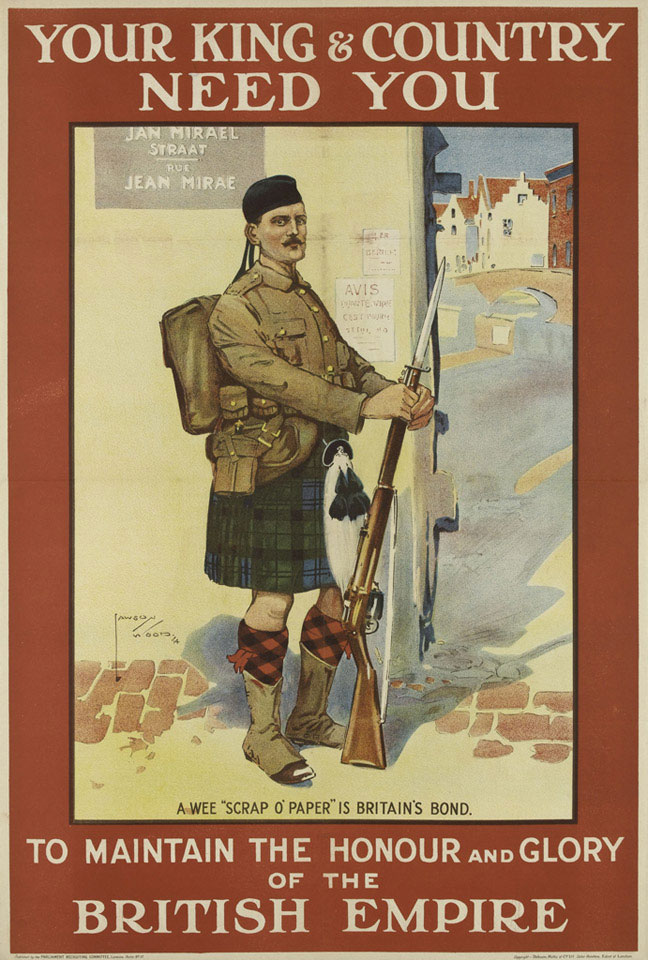
C Company left Montrose on 5 August 1914, travelling to Broughty Ferry. John was one of many who responded to the call for volunteers to serve overseas, and was part of the first Scottish Battalion of the Territorial Force to go abroad.
“On 29 October 1914, they entrained at Broughty Ferry and Dundee and were transported to Southampton Common where they encamped before sailing aboard the SS Architect from Southampton Harbour on the evening of 1 November 1914 …. The ship had just brought cattle to Southampton from Ireland and the battalion was put aboard without the ship being cleaned. They sailed over night in complete darkness for fear of being sunk by U-Boats and arrived the following morning at Le Havre, where they disembarked. Then began the long rail journey in cattle trucks to St. Omer.”
– Description shared by a descendant of one of the Black Watch soldiers
Christmas at the front
John and his fellow soldiers arrived in France less than two months before Christmas. In early December the town they were stationed in was visited by King George V, the Prince of Wales, and French President, and it was reported the soldiers lined the streets. At night they were digging trenches, being wary of snipers, and close enough to German soldiers to hear them doing the same.
At home during that first Christmas of the war, the families of Montrose soldiers and sailors were treated to an afternoon of entertainment at the Picture Palace. It was decorated, and there were musical performances, speeches, tea and refreshments, and a “cinematographic exhibition preceded by a lantern slide of His Majesty the King and the singing of the National Anthem …. A toy or other useful gift, a tin of sweets containing a new penny, and a cake were presented to each child, the gift-making being undertaken by two gentlemen who represented Santa Claus.”
Provost Thomson was able to share a message received via postcard from the Montrose Company of the 5th Black Watch, which included John. It read – “Wishing you all in Montrose a happy Christmas and New Year”.
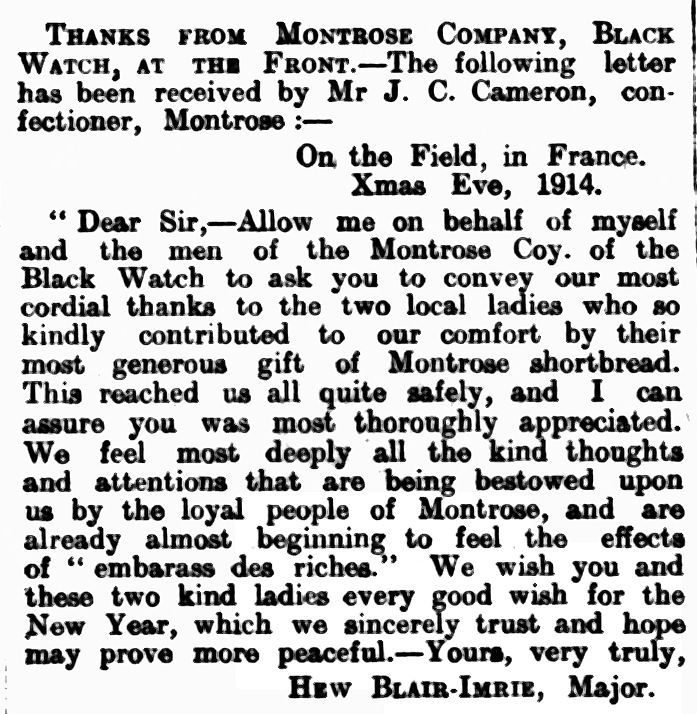
Overseas, the 5th spent Christmas in the trenches, and the men of C Company received a Christmas gift of shortbread from home. Letters shared in newspapers at home described how on “Christmas Day the Germans were out on top of their trenches, and our boys were over shaking hands and exchanging souvenirs with them.”
In the days following Christmas, C Company also received a New Year present from the Montrose Women’s Patriotic Association, including socks, mufflers, mittens, underwear, and cigarettes. They were much appreciated and needed, the soldiers being up to their knees in mud in the trenches.
Serving overseas
The 5th were attached to the 8th Division, 24th Infantry Brigade at La Bassee and took part in actions at Neuve Chapelle, Aubers Ridge, and Loos in 1915.
John returned to Montrose to attend the 29 December 1915 funeral of his father, who died on 2 December. Major Millar, a long-time friend of John’s father David, had sought permission from their General to give John leave, and it was granted.
In March 1916, due to casualties the 5th merged with the 4th (City of Dundee) Battalion, to form the 4/5th (Angus & Dundee) Battalion, the 4th having been almost wiped out at Loos the previous year. The men of the 5th became C and D Companies in the new Battalion.
A few months later, in August 1916, the 4/5th Battalion underwent special training and moved south to to join the Battle of the Somme. They took part in actions in September at Ancre and Beaucourt Road, October at Schwaben Redoubt, and November at St Pierre Divion, before moving to Flanders. There they remained in or near Ypres for thirteen months.
The Battalion was involved in the Passchendale offensive at the 3rd Battle of Ypres on 31 July 1917. Their withdrawal on the morning of 6 August was recorded.
By this time the 4/5th was reduced to a mere handful; so heavy indeed had been the losses that C Company only numbered one officer and six men, while the others were almost in the same condition. The behaviour of the men in the action had been magnificent; few remained, but those who did knew that they had done great work.
– Wauchope, Major General A. G. (editor), A History of the Black Watch (Royal Highlanders) in the Great War, 1914-1918, volume 2, The Medici Society Limited, London, 1926, p. 86.
Despite the decimation of the Battalion, the army was so short of men the 4/5th had to help in relieving other battalions. In action at the end of September or beginning of October 1917, John was gassed and wounded, although he seems to have returned to his unit fairly quickly.
October and November were the worst months experienced by the Battalion during the whole period spent in the neighbourhood of Ypres….Gas shells were now being used by the enemy in large quantities, and losses from these, and other causes, were many….After one tour in the front area the 4/5th sent back 200 casualties suffering from gas, and, in addition, nearly the whole Battalion seemed affected by it.
– Wauchope, Major General A. G. (editor), A History of the Black Watch (Royal Highlanders) in the Great War, 1914-1918, volume 2, The Medici Society Limited, London, 1926, p. 88.
In March 1918, the Battalion was also badly affected during the German Spring Offensive, and subsequently absorbed the 9th (Service) Battalion, Black Watch.
On the evening of the 30th [March] the Division was relieved and the 4/5th proceeded the same night to Villers Bretonneux. The strength of the Battalion was one officer and 30 other ranks….During this retirement it was difficult to keep any record of the countless gallant deeds performed by officers and men alike. The conduct of all ranks had been splendid throughout….Though often outnumbered and surrounded, officers and men had fought grimly on, and at no time was there ever the slightest sign of panic.
– Wauchope, Major General A. G. (editor), A History of the Black Watch (Royal Highlanders) in the Great War, 1914-1918, volume 2, The Medici Society Limited, London, 1926, p. 95.
Final days
In late July and the beginning of August 1918 the 4/5th saw action at Buzancy resulting in heavy casualties, and it’s believed to be there, or as they moved back to La Raperie on 3 August, that John was fatally wounded.
John died of wounds at the number 63 Casualty Clearing Station on Sunday 4 August 1918. In his military will he left the whole of his property and effects to his mother Margaret. Sadly she died in November 1918, just a couple of months later, and his sister Flora was granted his war gratuity and pension.
Lance Corporal John Fettis Hampton is buried in France and remembered at the Senlis French National Cemetery. His name is also on the Montrose town war memorial with his father David Hampton, and on the Montrose Academy Roll of Honour.
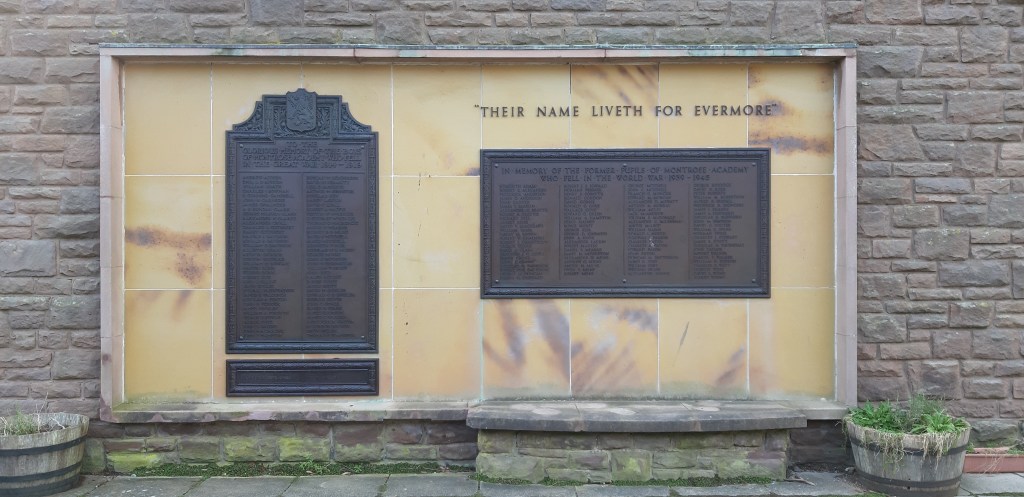
Photograph of Montrose Academy Roll of Honour, 2020, original held in private collection.
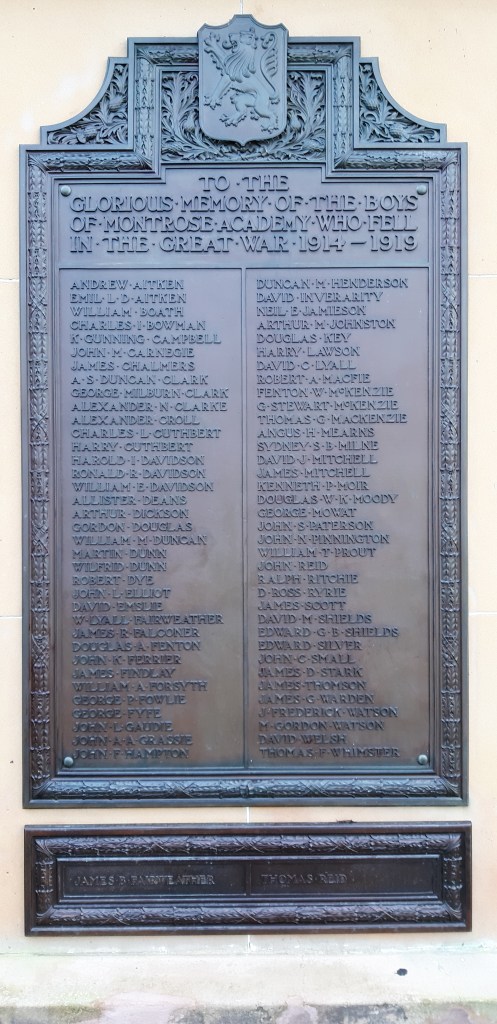
Photograph showing John Fettis Hampton’s name on the Academy Roll of Honour, 2020, original held in private collection.
Special thanks to the cousin who shared information used in writing this post.
Selected references
Wauchope, Major General A. G. (editor), A History of the Black Watch (Royal Highlanders) in the Great War, 1914-1918, volume 2, The Medici Society Limited, London, 1926.
5 Battalion Black Watch (Royal Highlanders), Battalion Diary, 1916 January – 1916 March, The National Archives, England, WO 95/2591/2.
4/5 Battalion Black Watch (Royal Highlanders), Battalion Diary, 1916 March – 1918 March, The National Archives, England, WO 95/2591/3.
Army Troops. 63 Casualty Clearing Station (Second Army), Diary, 1917 January – 1919 May, The National Archives, England, WO 95/345/4.
‘Casualties: Lance-Corporal J. F. Hampton-Died of Wounds’, Montrose Standard, 16 August 1918, p. 5.
Commonwealth War Graves Commission, ‘Lance Corporal J F Hampton’, https://www.cwgc.org/find-records/find-war-dead/casualty-details/287149/j-f-hampton/, accessed 29 March 2025.
Will of John Fettis Hampton 240175, died 4 August 1918, Soldiers’ and Airmen’s Wills, Black Watch (Royal Highlanders), SC70/8/860/40, National Records of Scotland.
‘Treat to families of Montrose soldiers and sailors’, Montrose Standard, 1 January 1915, p. 8.
‘Arbroath Fifth Black Watch Man and the Funny Side of War’, Dundee Courier, 1 January 1915, p. 6.
‘Christmas Day at the Front’, Arbroath Herald, 1 January 1915, p. 5.
‘For C Company’, Montrose Review, 1 January 1915, p. 5.
‘Thanks from the Montrose Company, Black Watch, at the Front’, Montrose Review, 1 January 1915, p. 5.
‘Fifth Black Watch’, The Broughty Ferry Guide, 11 December 1914, p. 7.
‘Montrose Territorial’s Impressions on the Continent’, Montrose Standard, 8 January 1915, p. 5.
 Untangled Family History