
There was no formal currency in early colonial Sydney. Coins were scarce, and bartering and rum were common forms of payment. Also used were promissory notes, a commitment in writing to pay a specified sum to the holder of the note. Although sometimes they were refused and they were also open to being forged.
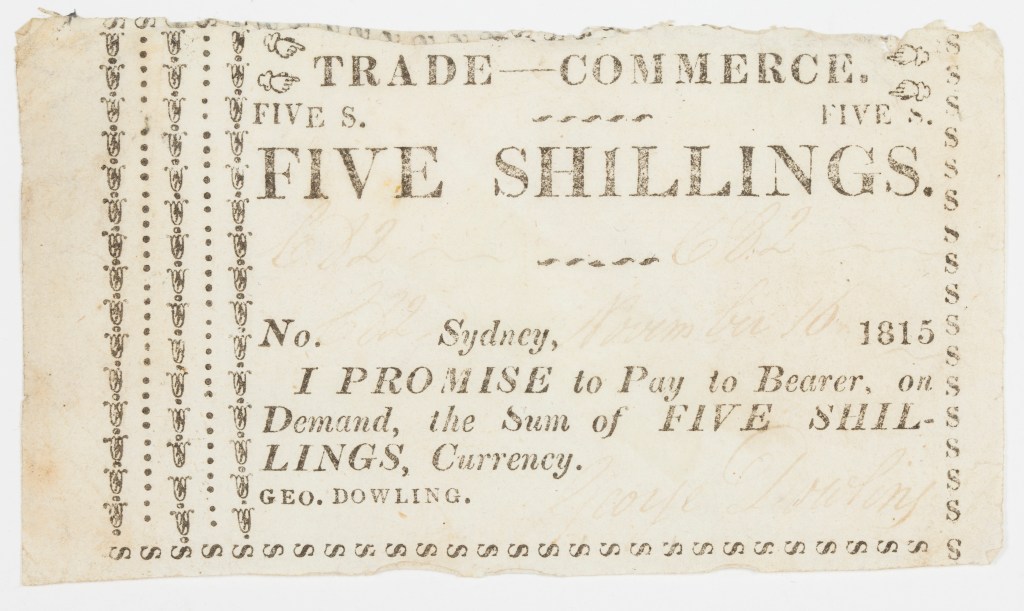
Ten original promissory notes, also known as currency notes, issued and signed by my 5x great-grandfather, George Dowling are part of the Dixson Numismatic Collection held by the State Library of New South Wales.
Colonial promissory notes were paper money and easily damaged. Any that remain today are quite rare. Their condition varies, and the handwriting is faded. I found online one promissory note issued and signed by George Dowling which sold at auction in 2008 for $12,000!
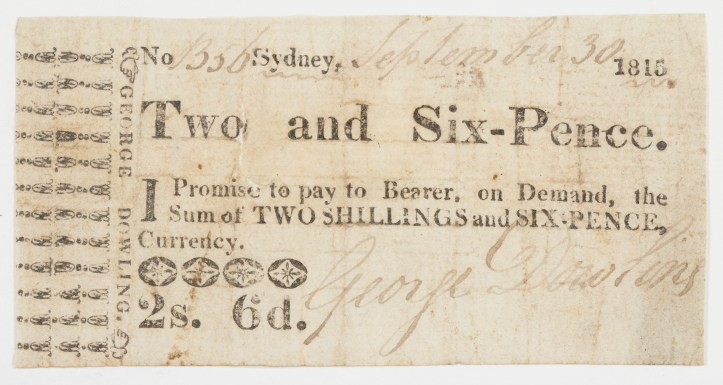
Promissory notes were the forerunner of today’s bank notes, with origins stretching back more than 300 years.
Before the establishment of the Bank of England in 1694, banking in England had been virtually restricted to the goldsmiths in London. By the second half of the seventeenth century the goldsmiths were not only acting as bailees of money and valuables entrusted to them but were increasingly using these funds for making loans. Meanwhile, their promissory notes payable on demand, which were issued to depositors, had come to be used as a convenient means of making payments and could, if desired, be cashed in part only. It is from these goldsmiths’ notes that the Bank of England ultimately derives.
– ‘The Bank of England note – a short history’, Bank of England, https://www.bankofengland.co.uk/quarterly-bulletin/1969/q2/the-bank-of-england-note—a-short-history, accessed 18 April 2025.
Selected references
‘Sir William Dixson numismatic collection’, State Library of New South Wales, https://www.sl.nsw.gov.au/research-and-collections/significant-collections/sir-william-dixson-numismatic-collection, accessed 12 April 2024.
‘Crisis in the Colony of New South Wales’, Reserve Bank of Australia Museum, https://museum.rba.gov.au/exhibitions/pocket-guides/currency-crises/crisis-in-the-colony-of-new-south-wales.html, accessed 12 April 2024.
‘Currency in early settlement’, Royal Australian Mint, https://www.ramint.gov.au/sites/default/files/currency_in_early_settlement_fact_sheet_0.pdf, accessed 18 April 2025.
‘The Bank of England note – a short history’, Bank of England, https://www.bankofengland.co.uk/quarterly-bulletin/1969/q2/the-bank-of-england-note—a-short-history, accessed 18 April 2025.
George Dowling’s notes in the Dixson Numismatic Collection held by the State Library of New South Wales include:
- Item 293: Currency note, two shillings and sixpence, issued by George Dowling, 1815.
- Item 294: Currency note, two shillings and sixpence, issued by George Dowling, 1815.
- Item 295: Currency note, two shillings and sixpence, issued by George Dowling, 1815.
- Item 296: Currency note, two shillings and sixpence, issued by George Dowling, 1815.
- Item 297: Currency note, two shillings and sixpence, issued by George Dowling, 1815.
- Item 298: Currency note, two shillings and sixpence, issued by George Dowling, 1815.
- Item 299: Currency note, two shillings and sixpence, issued by George Dowling, 1815.
- Item 300: Currency note, two shillings and sixpence, issued by George Dowling, 1815.
- Item 301: Currency note, two shillings and sixpence, issued by George Dowling, 181?.
- Item 302: Currency note, five shillings, issued by George Dowling, 1815.
 Untangled Family History