
Montrose Lunatic Asylum, Infirmary & Dispensary was established by Susan Carnegie in Montrose, Scotland, opening on 6 May 1782. Reflecting changing attitudes it went by various names over the years, including Sunnyside Royal Asylum, and later Sunnyside Royal Hospital. My 4x great-grandfather worked as Sunnyside’s gardener, and a 2x great-granduncle was a patient.
A visionary founder
Susan Carnegie, nee Scott, was born to a wealthy family, and lived near Montrose with her husband, merchant George Carnegie and a large family. Susan was a writer and philanthropist with an interest in social justice. She started a local savings bank and the Montrose Female Friendly Society which was an early version of a credit union, championed poor relief, financial empowerment for women, equal education, and “a more humane approach [to mental health], believing in a scientific and compassionate attitude towards people with mental illness”.
It was through Susan’s efforts that Scotland’s first public asylum came into being, thus enabling patients to live and be cared for in a situation which didn’t involve humiliation or poverty. She recruited supporters in the form of subscribers, otherwise known as charitable donors to fund it. Initially located on the Montrose Links near the harbour, the asylum was given a Royal Charter in 1810.
Susan also drove the appointment of resident medical superintendents, being convinced their consistent knowledge of patients would be more beneficial than ongoing turnover of such staff. It was in 1826, several years after her death, that the first permanent superintendent, Dr William Browne was appointed. He was a pioneer in art therapy and occupational therapy, also making an effort to provide public education about asylums and mental health. In 1837, five of Browne’s lectures were published as a book called What Asylums Were, Are and Ought To Be.
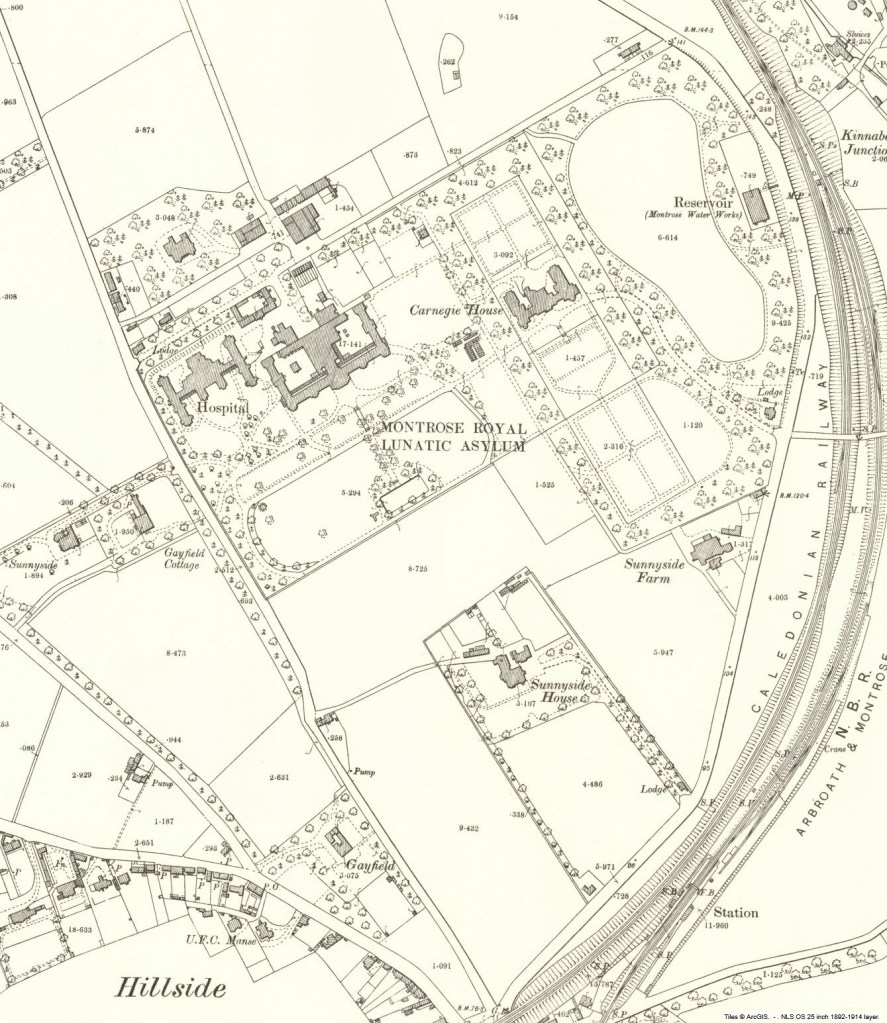
The asylum later moved to Hillside where a large, new building opened in 1857, and was later named after its Sunnyside Farm locale. By the 1880s there were about 500 patients at Sunnyside. In the 1900s it was closer to 700. More than 100 people were employed in a range of occupations to keep Sunnyside running, including medical staff, managers, a chaplain, and a variety of servants and tradesmen.
James Joss
James Joss, my 4x great-grandfather, was born in Banffshire’s Marnoch in 1826. He worked as a private gardener for some years in Ordiquihill, Monquhitter, and Carnousie before moving south to Montrose. There he worked at Sunnyside throughout the 1880s and 1890s.
With nature considered an important part of the patients’ environment and therapy, James’ gardening would have been essential in offering conducive surroundings as well as food.
James, his wife Helen, and some of their children lived at Sunnyside’s East Lodge, and James was still working as the gardener as late as 1901, when he was 75. At that time he would have been earning 75 pounds per annum, plus receiving free housing. It was at the Sunnyside Lodge that James died in 1905.
John Reid
James and Helen’s grandson, my 2x great-grandfather David Ritchie had a brother-in-law, John Reid, who spent a just over a year as a patient at Sunnyside. John was my 2x great-granduncle, and in the army training reserve when a 1917 incident led to his arrest and hospitalisation.
John was subsequently discharged from the army as medically unfit. The exact cause is unknown, but was serious, and John was immediately admitted to an asylum in Aberdeen, then transferred to the Royal Asylum in Montrose. There he was closer to his family who lived in Arbroath, and given the best care available. John sadly died at Sunnyside in January 1919, when he was just 41.
A legacy of compassion and innovation
From its beginnings with Susan Carnegie’s determined vision for compassion and innovation in mental health care, Sunnyside’s reputation remained strong as “the first institution of the kind to be established in Scotland”. Evolving and progressing over time, it operated for 230 years, until its closure in 2011.
Selected references
‘The Sunny Side of the Asylum, Psychology Today, 5 September 2024, https://www.psychologytoday.com/au/blog/a-short-history-of-mental-health/202409/the-sunny-side-of-the-asylum, accessed 24 April 2025.
‘Sunnyside Royal’, County Asylums, https://www.countyasylums.co.uk/sunnyside-royal/, accessed 24 April 2025.
Montrose Royal Asylum, Montrose Royal Asylum for the Insane 1781-1900, W. H. White, Edinburgh, n.d.
Reports of the Royal Asylum of Montrose for 1902, William Jolly, 106 High Street, Montrose, 1902.
Browne, Dr W. A. F., What Asylums Were, Are and Ought To Be, Adam and Charles Black, Edinburgh, 1837, https://wellcomecollection.org/works/uhxafb88.
Maxwell, Tracey, ‘A History of Sunnyside Royal Hospital 1781-2011’.
‘Who was Susan Carnegie?’, Sunnyside Estate, https://sunnysideestate.co.uk/who-was-susan-carnegie/, accessed 24 April 2025.
 Untangled Family History
From memory, there were a lot of medical universities in Scotland so there would have been quite a few graduates.
One of my aunts was a nurse, and also one of my grandmother’s brother’s daughters.
LikeLike
[…] were other ancestors who also moved south. My 4x great-grandparents James Joss and Helen Addison were both were born in Banffshire, where James was a gardener. They had a large […]
LikeLike
[…] for his adoptive father, and was 34 when he married Isabella Reid Currie, a mental nurse working at Sunnyside. They didn’t have any children […]
LikeLike