
English antiquarian, topographer, and historian Tristram Risdon, born circa 1580, was my first cousin thirteen times removed. He wrote The Chorographical Description or Survey of the County of Devon, and also compiled genealogy and heraldry information about prominent families in south-west England, especially in Devon, which was eventually published as The Note-Book of Tristram Risdon. It’s pretty cool for someone like me, an avid family historian, to have a distant connection to someone in the 17th century who was so involved with genealogy.
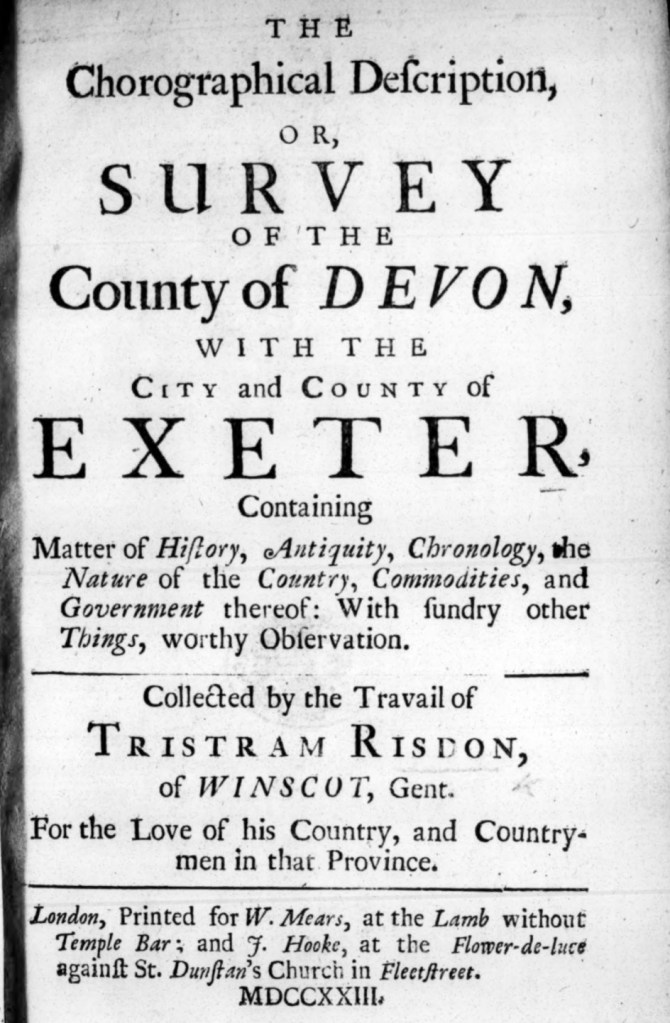
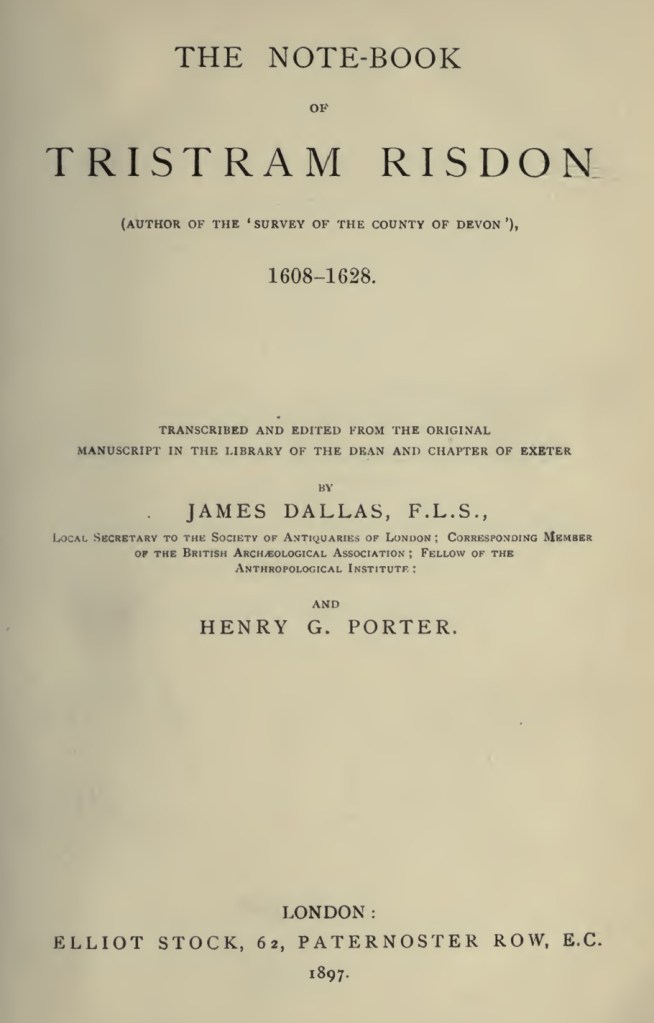
Risdon’s survey of Devon was heavily influenced by Sir William Pole, and copies of Risdon’s work were originally circulated mainly amongst fellow topographers. It was formally printed in 1714, many years after Risdon’s death, under the title The Chorographical Description or Survey of the County of Devon, although that was only part of the survey. It wasn’t until 1811 that it was printed in full. Publication of his note book was similarly delayed until the late 19th century.
Risdon’s work is acknowledged to have contributed greatly to the work of others, including John Prince‘s Worthies of Devon, which references Risdon throughout. Risdon is also mentioned in this work in his own right. Firstly, in connection to the Barry family where he is listed as his aunt Thomasin’s heir, inheriting the Barry ancestral estate, Winscott. Secondly, and more substantially, he’s featured for being descended from the Risdon family of Bableigh in the Parish of Parkham.
The images below are pages about the Risdon family from Worthies of Devon, which is in the public domain (see references below). They show how some early English genealogical research was documented, and they have contributed information to my family tree.

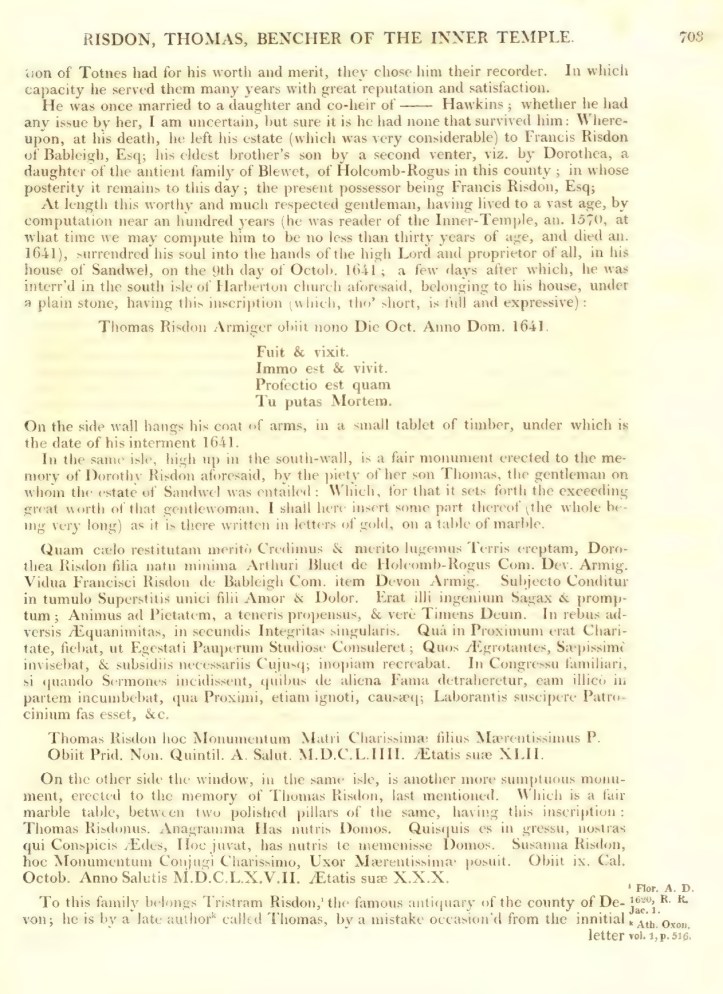


Note: Tristram’s paternal aunt was my 12x great-grandmother, Margaret Inglett nee Risdon. His maternal half-uncle, Margaret’s brother-in-law, was George Pollard, who was Gentleman Usher to Queen Elizabeth I, and was married to Bess of Hardwick‘s half-sister, Elizabeth Leche.
Selected references
Risdon, Tristram, The Note-Book of Tristram Risdon, 1608-1628, https://archive.org/details/notebookoftristr00risd/mode/2up, accessed 4 January 2025.
Risdon, Tristram, The chorographical description, or, survey of the county of Devon, with the city and county of Exeter, … Collected by the travail of Tristram Risdon, 1723, https://archive.org/details/bim_eighteenth-century_the-chorographical-descr_risdon-tristram_1723/page/n1/mode/2up, accessed 4 January 2025.
Devon Perspectives, ‘Musings on some early Devon topographers’, https://www.devonperspectives.co.uk/early_devon_topographers.html, accessed 4 January 2025.
Lysons, Daniel and Samuel Lysons, ‘Parochial history: Introduction’, in Magna Britannia: Volume 6, Devonshire (London, 1822), British History Online‘, https://www.british-history.ac.uk/magna-britannia/vol6/pp1-4, accessed 4 January 2025.
Prince, John, Danmonii [sic] orientales illustres: or, the worthies of Devon. A work, wherein the lives and fortunes of the most famous divines, statesmen, swordsmen, physicians, writers, and other eminent persons, natives of that most noble province, from before the Norman conquest, down to the present age, are memorized…out of the most approved authors, both in print and manuscript…, Reese and Curtis, Plymouth, 1810, Wellcome Collection, https://wellcomecollection.org/works/zvfpteh6, accessed 4 January 2025.
 Untangled Family History