
George Dowling, my 5x great-grandfather, came from a respectable family. They supported him to gain an apprenticeship and he seemed to have a good life. Then in 1798, eighteen-year-old George made what was probably the biggest mistake of his life.
Arrest and trial
George’s employers, linen drapers James Bream and Joseph Lockier, noted various articles missing over a period of time and suspected him. They had George arrested and he apparently confessed, writing them a list of what he’d stolen. His employers claimed he gave them the key to his personal box and some of the articles were found inside. George told the constable that he gave the remainder to two girls named Powell and Johnson.
Evidence was given by the employers, a constable, and a pawn broker.
I am a Linen Draper in Bristol, in partnership with Joseph Thomas Lockier. The Prisoner lived with us as a Shopman from October to February last. Having missed several Articles out of our shop at different times, I suspected the Prisoner, and had him taken into custody by the proper officers, on such suspition.
As soon as the Prisoner was taken to Mr. Light’s (the House of one of the Constables) and charged with having taken various Articles from our shop, he said he would confess every thing, and immediately wrote down a list of the Articles. The list was as follows: six yards of five quarter printed calico, eight yards of four quarter printed calico, six yards of six quarter worked muslin, and two pair of cotton stockings.
– Excerpt from Report on the Case of George Dowling under sentence of transportation in Bristol City Gaol, 11 April 1799, Judges’ Reports On Criminals 1784-1830 – Correspondence, 1799-1800, 8/14, England & Wales, Crime, Prisons & Punishment, 1770-1935, HO 47/23.
John Cooke and Samuel Summers, spoke in George’s defence, saying they knew him from his apprenticeship and that he had “an excellent character” and was a “very honest good servant”. George was, however, found guilty and sentenced to transportation for seven years.

Appeal and transportation
There is a rather unusual amount of information about George’s arrest and trial because an appeal was made. It was led by his parents, Richard and Sarah, described as “people of credit, whose respectable character is universally known”. They sought the intervention of the King in their son’s case.
To the King’s most excellent Majesty
The humble petition of Richard and Sarah Dowling of Henley upon the Thames in the County of Oxford. Father & Mother of George Dowling a Convict in Your Majesty’s Gaol of Newgate in the City of Bristol Sheweth that your Petitioners, whose son is only eighteen years of age, was placed by us to be an assistant in a warehouse in the said City….
That your Petitioners hope, its being the first deviation from Rectitude, & having had favourable Testimonies given on his Trial of his former character, are advis’d humbly to apply to your Most Gracious Majesty to supplicate for a mitigation of the Sentence of our unfortunate Son as your Petitioners have the fullest assurance that the Magistrates of the said City, before whom our said Son was tried, will report in his favour, if they should be referd unto.
Your petitioners therefore most humbly pray that Your Majesty with advice and consent of your Privy Council will be mercifully pleas’d to consider our said Son an object of your Royal Mercy to remit or mitigate his Sentence, in such way as to Your Majesty’s wisdom may seem meet.
And your Petitioners as by Duty bound shall ever pray.
– Excerpt from a letter accompanying the Report on the Case of George Dowling under sentence of transportation in Bristol City Gaol, 11 April 1799, Judges’ Reports On Criminals 1784-1830 – Correspondence, 1799-1800, 8/14, England & Wales, Crime, Prisons & Punishment, 1770-1935, HO 47/23.
This was in the reign of King George III. George’s case was brought to the attention of his third son, the Duke of Clarence and future King William IV, and a recommendation was made for clemency.
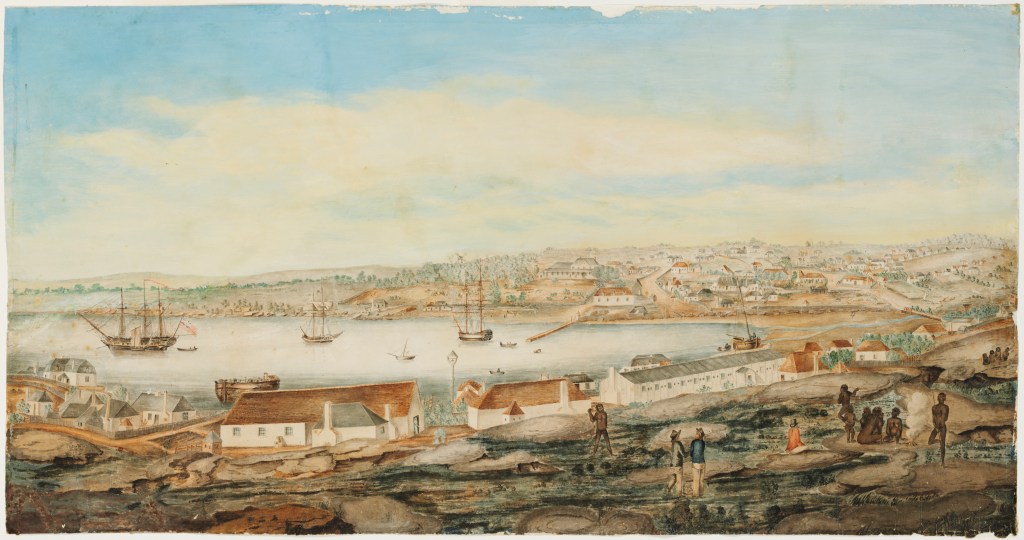
Sadly, George’s sentence remained unaltered, and he left England aboard the Royal Admiral. The ship arrived in Sydney on 20 November 1800, after an apparently eventful journey. Soon after arrival George was appointed as the Naval Officer’s clerk, an important job handling administrative and clerical tasks.
Life in New South Wales
George made the most of his changed circumstances, finding many opportunities in the growing colony. He served his sentence, and for many years remained Naval Officer’s clerk, and wharfinger, the person responsible for coordinating the loading and unloading of ships in the harbour.
In 1804 George was recorded as a member of the Sydney Loyal Association, a part-time militia. Over the course of about twenty years he also served as a constable.
On 27 April 1807, George married a free settler named Mary Ann Reynolds by banns at St John’s Parramatta, and they went on to have five children, including my 4x great-grandmother, Sarah.
A letter from early the next year lists George among people Governor Bligh proposed to take with him to England aboard the Porpoise. However, this was when Bligh was arrested and confined, and the proposal never eventuated.
During his life in Sydney, George was sole owner of at least one vessel, a sloop called Revenge, which was likely used for trade within the colony. He appears to have also run a tin warehouse and manufactory, selling products including “an elegant and very various and extensive assortment of the best planished tin-ware” from a building in The Rocks.
George made a successful request for land, and become a timber merchant with links to the saw pit on Lane Cove River. This was probably his main occupation after he was discharged as wharfinger in 1817. He remained in the timber industry until his death in 1832, when he was in his early fifties.

Selected references
Report on the Case of George Dowling under sentence of transportation in Bristol City Gaol, 11 April 1799, Judges’ Reports On Criminals 1784-1830 – Correspondence, 1799-1800, 8/14, England & Wales, Crime, Prisons & Punishment, 1770-1935, HO 47/23, The National Archives, Kew, Surrey, England, FindMyPast.co.uk, accessed 12 April 2025.
Various documents related to George Dowling, New South Wales, Australia, Colonial Secretary’s Papers, 1788-1856, State Records Authority of New South Wales. Kingswood, New South Wales, Australia.
Marriage of George Dowling and Mary Ann Reynolds, married 27 April 1807, St John’s Parramatta, New South Wales, digitised, Ancestry.com.au, accessed 12 April 2025.
‘Tin Manufactory’, The Sydney Gazette, 12 June 1808, p. 2, http://nla.gov.au/nla.news-article627525, accessed 12 April 2025.
‘Tin Warehouse’, The Sydney Gazette, 29 October 1809, p. 1, http://nla.gov.au/nla.news-article627851, accessed 12 April 2025.
‘In the Goods and Effects of George Dowling, late of Sydney, Timber Merchant, deceased’, New South Wales Government Gazette, 6 June 1832, issue number 14, p. 123, http://nla.gov.au/nla.news-article230388494, accessed 12 April 1832.
 Untangled Family History
[…] George Dowling was a warehouse assistant sentenced to seven years for stealing stockings and fabric. Despite […]
LikeLike
[…] promissory notes, also known as currency notes, issued and signed by my 5x great-grandfather, George Dowling are part of the Dixson Numismatic Collection held by the State Library of New South […]
LikeLike
[…] Reynolds: My 5x great-grandmother Mary Ann Reynolds arrived as a free settler aboard the William Pitt in 1806. She, her mother Sarah Reynolds nee Goodson, and three siblings travelled to join her father Edward who’d been transported as a convict in 1800. Sadly, a reunion was not to be, as Edward appears to have moved on with his life in the intervening years. In 1814, Sarah returned to England with daughters Amelia and Eliza, travelling on the Seringapatam. Mary Ann remained in Sydney and married convict George Dowling. […]
LikeLike