
I played cricket for a few years when I was younger. I was a much better bowler than batter, and had some solid statistics. I’m particularly proud of having taken 4 wickets for only 5 runs from 5.5 overs. However, my grandfather Jack was the really talented cricket player in the family. He was an all-rounder, good at both batting and bowling, and had some particularly memorable cricketing moments.
Like many Australian boys at the time, he played cricket with his mates. The dead-end street where he visited his grandparents was tailor-made for street cricket, and he was captain of the school team. As a teenager, Jack played grade cricket in New South Wales and family lore has it he’d been going to try out for the state, but World War Two happened and that was the end of that.
After serving overseas, towards the end of the war and in for a few months after, he was stationed in regional New South Wales, where he played both cricket and football. One particular cricket match played in Orange made the newspaper when an unusual incident occurred as the result of instinctive sportsmanship.
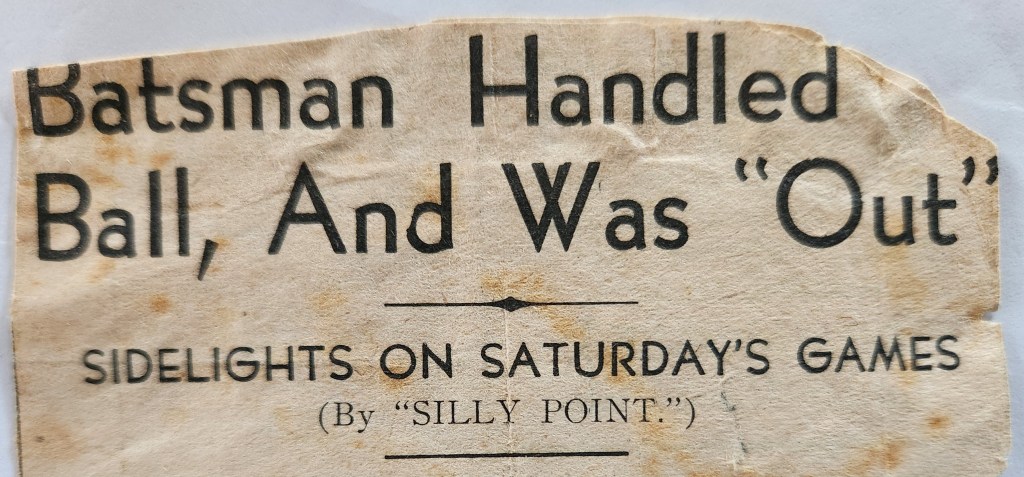
During one of the competition games on Saturday, a batsman was given out for handling the ball. The incident has set the Orange cricket world talking because of the novelty of it happening in local cricket …. Steed, the new and promising Railway batsman was the unfortunate of Saturday’s ruling.
He was batting in good style against the Pinnacle Road attack and had collected thirty odd in good time. Then it was that he indulged in the fatal bit of “courtesy fielding.” The appeal was made, and umpire Todd, whatever his view of the sporting quality of such an appeal, had to interpret the laws of the game and raise the finger. Steed was out for “handling the ball.”
– ‘Batsman Handled Ball, And Was “Out”‘, Central Western Daily, November 1945.
‘Handled the ball’ was the rarely applied law 33 of cricket, now incorporated into law 37, meaning anyone batting who touched the ball with the hand they weren’t using to hold the bat, without permission from the fielding side, could be given out. Jack had played his shot, and picked up the ball to return it to the bowler before it was declared ‘dead’. He’s one of an exclusive group of players who has been dismissed in this way.
For the 1946-47 cricket season, Jack was back in Sydney where he played A-grade for Chatswood District Cricket Club. He went on to play in Sydney’s City Houses cricket competition in the 1950s, and regularly won a trophy at the end of the season.
Amongst his achievements, he was captain of the Postal team in 1950-51 when he won the Eastern Suburbs Cricket Association’s batting trophy. He’d scored a total of 687 runs at an average of 68.7, the most runs for the season, and was not out eight times. He was also awarded most catches (19) for the season.
Joining the Hordernian Cricket Club, whose home ground was at Dulwich Hill, one year he won the batting trophy with a total of 531 runs, at an average of 40.8, and a highest score of 133 not out. Another year he won the bowling trophy for taking 33 wickets at an average of 10.95.
In 1956-57 Jack was played in the A-grade competition and won most catches (12). The following year he was part of the B-grade team who won the competition. He proudly kept his Hordernian Cricket Club Premiers’ blazer, and I’m pleased it’s now part of my family history archive.

Selected references
‘Batsman Handled Ball, And Was “Out”‘, Central Western Daily, November 1945, page unknown, held in private collection.
Miscellaneous cricket club newsletter clippings, held in private collection.
‘Hordernian Cricket Club Premiers 1957-58 B-Grade blazer’, 1958, held in private collection.
 Untangled Family History