
Not surprisingly, through family history research I’ve learned about many relatives I’ve never met, but whose names sometimes appear on the back of photos, on census records, and in family anecdotes. Perhaps that’s why it was such a surprise to recently discover the existence of a 2x great-granduncle I’d never heard of, who died in World War I.

Finding William
William Thomas McGrath was born in the Mudgee region in 1881, the youngest son of Irish immigrants. His father, James McGrath, had tried his luck at gold mining, then became a farmer, living for many years at Lawson’s Creek. When James died in 1913, he left his estate to his children, and it’s in his will I first found William mentioned. He inherited fifty acres of freehold land, as well as a share of James’ personal estate and effects.
William was a farmer and would have worked hard. He never married, and in March 1916, 34-year-old William travelled to Bathurst where he enlisted in the Australian Imperial Force (AIF). At this time, many Australian soldiers were being transferred from the Middle East to France and the Western Front.
Conditions on the Western Front were extremely challenging for the AIF. Men fought, lived and died in the trenches. They were exposed to the elements and vast amounts of rain made the battlefield muddy. And the constant explosions of shells churned up the earth. The horrible conditions meant that rats, lice and other insects were drawn to the soldiers, making the environment even more uncomfortable.
National Library of Australia, ‘1916’, https://www.nla.gov.au/digital-classroom/year-9/world-war-i/timeline-events/1916, accessed 23 March 2024.
The Western Front
William was in France with the 2nd Battalion of the AIF from mid-December 1916. However, within three months he was evacuated to England with trench foot. After recuperating he returned to his battalion, re-joining them on 20 August 1917 when they were part of the Third Battle of Ypres.
Four weeks after returning to France, William was seriously wounded in action at the Battle of Menin Road. He was taken to the 6th Australian Field Ambulance, and soon moved to the 3rd Canadian Casualty Clearing Station in Belgium. On 22 September 1917, William died as a result of his injuries.
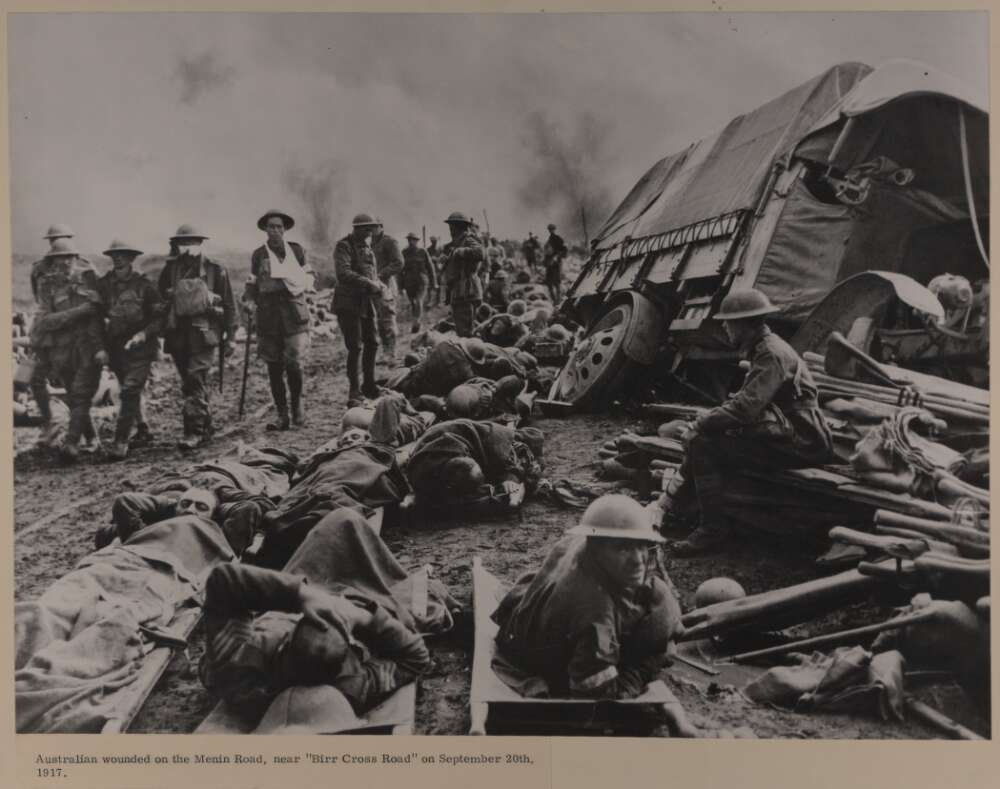
William’s family asked the Australian Red Cross for “the fullest possible details” of what happened to him, and information was provided by one of his fellow soldiers.
McGrath and I came over in the same boat and I knew him very well …. [We] were in support to the 3rd Brigade. We were in the same platoon and went over together and as we were going up McGrath was hit in the thigh by a shell and I saw him fall. The S/Bs took him out to the D/S at Menin Road where he died a little later on. I did not witness his burial but probably it took place at one of the certified grounds near the D/S. A Padre lived close at hand and no doubt he officiated at the ceremony and a cross would have been put up on the grave.
William Thomas McGrath, 6055, 2nd Battalion, Australian Red Cross Wounded and Missing Files, First World War, 1914-1918, Australian War Memorial, https://www.awm.gov.au/collection/R1495463, accessed 20 December 2023.
Remembering William
The death of a family member is difficult at any time. During the First World War the extent of human loss meant dealing with death became quite systematic for the military, though no less painful for the families and others involved. Next of kin were notified, and personal effects returned to them. Records show that William’s belongings included photos, a letter, wallet, two diaries, a book of poems, mirror, badges, Rosary, religious ‘trinkets’, knife, fountain pen, pouch, and a two franc note.
Several weeks after William’s death, a memorial service was held for him at St Mary’s Roman Catholic Church in Mudgee. It was “attended by a congregation that filled the Church to overflowing”.
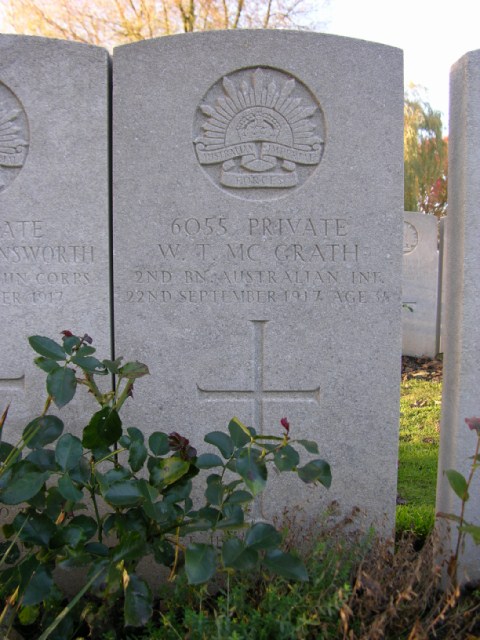
William is buried at Lijssenthoek Military Cemetery, in Flanders. His name is also on the Roll of Honour commemorative wall at the Australian War Memorial, and features in the schedule of Roll of Honour names “projected onto the façade of the Hall of Memory [between sunset and sunrise as] …. a tribute to those who made the ultimate sacrifice.”
William McGrath’s name may have been lost in time for a while, but I’m pleased to have found him, to learn a little of his story, and place him on my family tree.
Selected references
Will of James McGrath, died 17 January 1913, Probate Packets, NSW State Archives, NRS-13660-6-798-Series 4_59923.
Service record of William Thomas McGrath, Australian Imperial Force Personnel Dossiers, 1914-1920, National Archives of Australia, B2455, McGrath, W T.
William Thomas McGrath, 6055, 2nd Battalion, Australian Red Cross Wounded and Missing Files, First World War, 1914-1918, Australian War Memorial, https://www.awm.gov.au/collection/R1495463, accessed 20 December 2023.
Australian War Memorial, ‘First World War 1914–18’, https://www.awm.gov.au/articles/atwar/first-world-war, accessed 23 March 2024.
National Library of Australia, ‘1916’, https://www.nla.gov.au/digital-classroom/year-9/world-war-i/timeline-events/1916, accessed 23 March 2024.
Frank Hurley, Australian wounded on the Menin Road, near Birr Cross Road on September 20th, 1917, National Library of Australia, http://nla.gov.au/nla.obj-147383296, out of copyright.
Australian War Memorial, ‘Roll of Honour: William Thomas McGrath’, https://www.awm.gov.au/collection/R1651157, accessed 23 March 2024.
‘Mass for fallen soldier’, Mudgee Guardian, 29 October 1917, p. 2, http://nla.gov.au/nla.news-article156191063, accessed 23 March 2024.
 Untangled Family History
A terrific way to honor this ancestor’s service and keep his memory alive for the future.
LikeLiked by 1 person