
In 1841, Ireland was a country about to descend into the Great Famine, Britain was in an economic depression, and transportation of convicts to New South Wales stopped. Mass migration from Ireland had begun more than two decades earlier, and New South Wales was one of the destinations of choice.
The Kells family of five hailed from the north of Ireland. It’s uncertain exactly when they left, but in June 1841 they were in Birkenhead, on the Wirral Peninsula opposite Liverpool, when the census was taken. Immigration documentation also records their health and character as being certified by Birkenhead-based officials – doctor, clergyman, and magistrate – which suggests their residence in England was long enough to form relationships. Richard, a weaver by trade, supported his family by working as a garden labourer. His wife, Elizabeth described herself as a farm servant, and sixteen-year-old daughter Margaret (Richard’s step-daughter), as a nursemaid. Eleven-year-old Robert, and Jane who was eight, made up the rest of the family.
The bounty immigration scheme
The Kells were part of the bounty immigration scheme which had begun in 1831. In the privately-run system, shipowners provided passage for the chosen migrants, recruited because they fulfilled specific requirements, and agents received a bounty payment after their arrival.
Although single men and women of a certain age were most desirable to support labour needs in the colony, the small Kells family was considered acceptable, probably because of Richard’s occupation. Margaret was just old enough to be categorised as a single female, making her eminently suitable, though she was importantly recorded as travelling under her parents’ protection.

Unruly behaviour and poor conditions
Their ship, the Sir Charles Napier, should have departed by early October 1841, but didn’t leave until November, apparently due to delays caused by crowding of the port and bad weather. The journey from Liverpool to New South Wales was usually three to four months. However, it took five months to reach their new homeland, despite not stopping at any port along the way.
Within two weeks of leaving Liverpool, the Captain died of consumption and the First Mate took charge. The crew behaved badly and were often drunk. At one point a fire began as a result of the spirits on board, and single women were observed consorting with the crew. The Surgeon Superintendent also reported the accommodation was not sufficiently suitable for the passengers, and some provisions were not of appropriate quality, nor as regular as should have been expected.

The difficulties were acknowledged by some of the passengers, including the Kells family, in an open letter to a newspaper. They thanked the surgeon, for his efforts on their behalf, noting his “great and impartial kindness and attentions…[and] strict integrity”.
The Sir Charles Napier was not alone in controversy, and was the subject of an investigation, along with the Carthaginian which arrived earlier that year. Claims of fraud, drunkenness, and licentious behaviour were investigated and written about in letters and reports sent between the Governor of New South Wales, Sir George Gipps, and the Colonial Secretary in England, Lord Stanley. Irregularities were found in relation to the character and identity of some of those accepted for passage, bounties were withheld, and recommendations made in relation to future dealings with the agents. I’m pleased to know the Kells were not amongst those who were deemed unacceptable.
Arrival in the colony
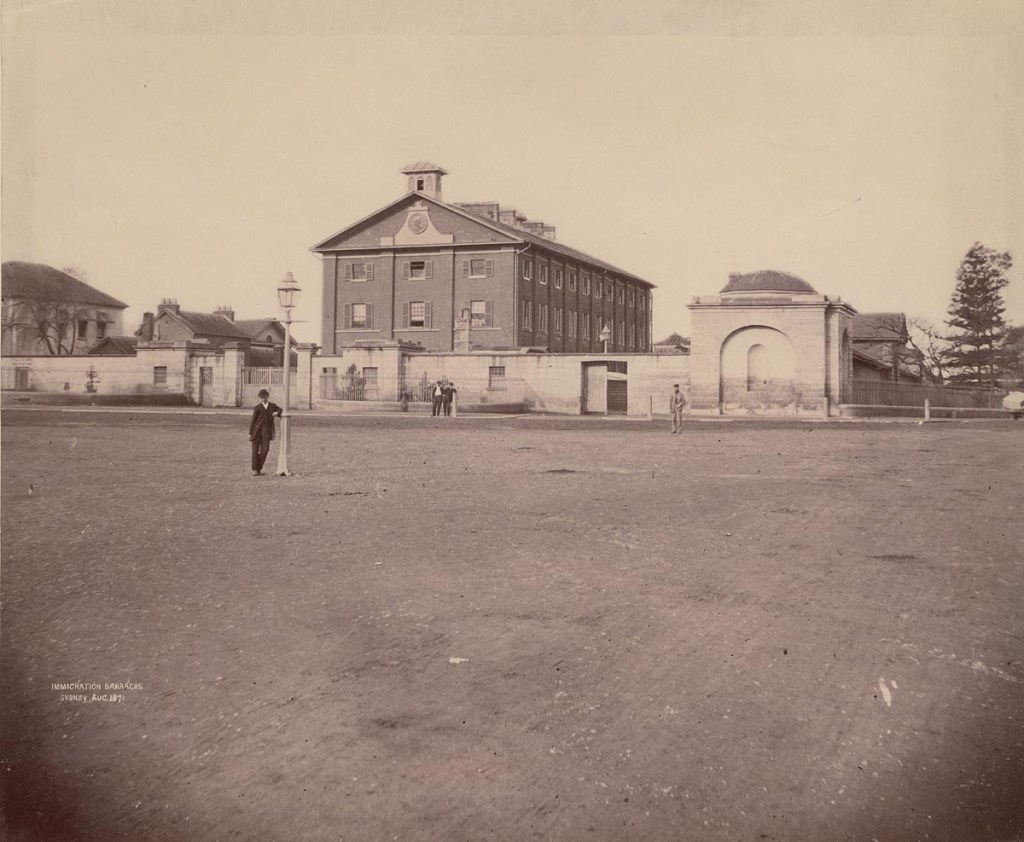
When the Kells and their fellow passengers arrived in 1842, seeking a new and prosperous life, on the back of their challenging journey they found the colony slumping into an economic depression. They may have wondered whether or not they’d made the right decision to emigrate. The bounty immigration scheme ceased that year, in response to fraud and abuse of the system. What had begun as a strategy to improve the quality and quantity of the colonial workforce, had run its course, though other forms of immigration continued.
As bounty immigrants, on arrival the Kells family would have had their references checked, participated in an immigrants’ muster, and been examined by the Colonial Emigration Agent to confirm their heath and suitability. Only then would they have disembarked and been taken to the Immigration Barracks where they were allowed free accommodation for 24 hours. Their exact movements immediately thereafter are unknown, but they eventually settled on south coast of New South Wales, in the settlements at Shoalhaven and Ulladulla.
Almost twenty percent of the New South Wales population at that time was Irish-born, and the Shoalhaven region attracted a higher concentration of Irish people than elsewhere. The Kells family, now part of that number, would have left Ireland with hope for their future, which they seem to have found. Although they encountered some tragedy along the way, they eventually flourished, and some of their Australian descendants have remained living on the New South Wales south coast to this day.
Selected references
Malcolm Campbell, Ireland’s New Worlds: Immigrants, Politics and Society in the United States and Australia, 1815-1922, The University of Wisconsin Press, Wisconsin, 2008, pp. 3-36.
John McDonald & Eric Richards, ‘Workers for Australia: A Profile of British and Irish Migrants Assisted to New South Wales in 1841’, Journal of the Australian Population Association, vol. 15, no. 1, 1998, pp. 1-33.
Census record for Richard Kells and family, Carpenters Row, Birkenhead, Cheshire, 1841 census, The National Archives HO107/126/6, UK Census Collection, Ancestry.com, accessed 28 May 2021.
Entitlement certificate entry for Richard Kells, Sir Charles Napier, departing Liverpool, 6 November 1841, Entitlement certificates of persons on bounty ships, Series 5341, Reel 1347, State Records Authority of New South Wales, New South Wales, Australia, Assisted Immigrant Passenger Lists, 1828-1896, Ancestry.com, accessed 1 May 2021.
Robert Joe Schultz, ‘The Assisted Immigrants, 1837-1850: A Study of Some Aspects of the Characteristics and Origins of the Immigrants Assisted to New South Wales and the Port Phillip District, 1837-1850’, PhD thesis, https://open-research-repository.anu.edu.au/handle/1885/132075, pp. 9-13.
Ship Return A, Sir Charles Napier, 30 April 1842, Australia, Assisted Immigrant Passenger Lists, 1828-1896, State Records Authority of New South Wales, Series 5341, Reel 1347, Ancestry.com, accessed 1 May 2021.
Frederick Watson & Peter Chapman & Australia. Parliament. Library Committee., Historical Records of Australia, Library Committee of the Commonwealth Parliament, Series 1, Vol, 22, p. 130, http://nla.gov.au/nla.obj-494337100.
Frederick Watson & Peter Chapman & Australia. Parliament. Library Committee., Historical Records of Australia, Library Committee of the Commonwealth Parliament, Series 1, Vol, 23, pp. 355-357, http://nla.gov.au/nla.obj-495604761.
Frederick Watson & Peter Chapman & Australia. Parliament. Library Committee., Historical Records of Australia, Library Committee of the Commonwealth Parliament, Series 1, Vol, 24, pp. 279-282, http://nla.gov.au/nla.obj-496380980.
‘Ship News’, Sydney Gazette and New South Wales Advertiser, 12 April 1842, page 3, http://nla.gov.au/nla.news-article2556220.
‘To D. J. Tierney, Esq., M.D., Surgeon Superintendent of the Sir Charles Napier, emigrant ship’, Australasian Chronicle, 10 May 1842, p.3, http://nla.gov.au/nla.news-article31735875.
Leone Huntsman, ‘Bounty Emigrants to Australia’, Clogher Record, vol. 17, no. 3, 2002, pp. 801-812.
Robin Haines & John McDonald, ‘Skills, Origins and Literacy: A Comparison of the Bounty Immigrants into New South Wales in 1841, With the Convicts Resident in the Colony’, Australian Economic History Review, vol. 42, no. 2, 2002, pp. 132-159.
Margaret Blair, From Bullocks to Bypass: A Local History of the NSW South Coast Village of Tomerong, Margaret Blair, Tomerong, 2000.
 Untangled Family History
[…] Kells is my half-great-uncle, a direct descendant of my Irish immigrant Kells family, but I know very little about him. In fact the first I knew of him was when I found his name […]
LikeLike
[…] The Kells family from Ireland, including my 4x great-grandparents Richard and Elizabeth Kells, and 3x […]
LikeLike