
Henry Wickham Steed, better known as Wickham Steed, worked as a journalist during a similar time period as his second cousin, my 2x great-grandfather George Steed. Wickham and George were however quite different people, both in personality and professional style.
Wickham was the son of a politically-minded country solicitor. British-born and bred, he became internationally influential. He was described at various times as loyal, confident, arrogant, flawed, a name-dropper, and a scapegoat. Yet he apparently declined recognition and honours including a knighthood.
Wickham’s first foray into journalism is documented as an 1891 report about a lecture on old age pensions. It drove his interest, and studying abroad he attended university in Germany and France, before working as a foreign correspondent in Berlin, Rome, Vienna, Budapest, and The Balkans.
Wickham became an expert on Eastern Europe, and developed relationships with diplomats, British nobility, senior politicians, and royalty. Cosmopolitan in looks and manners, as well as his native English he spoke fluent French, German, Italian and Spanish. He is reputed to have had a brilliant memory, a great aid in his profession.
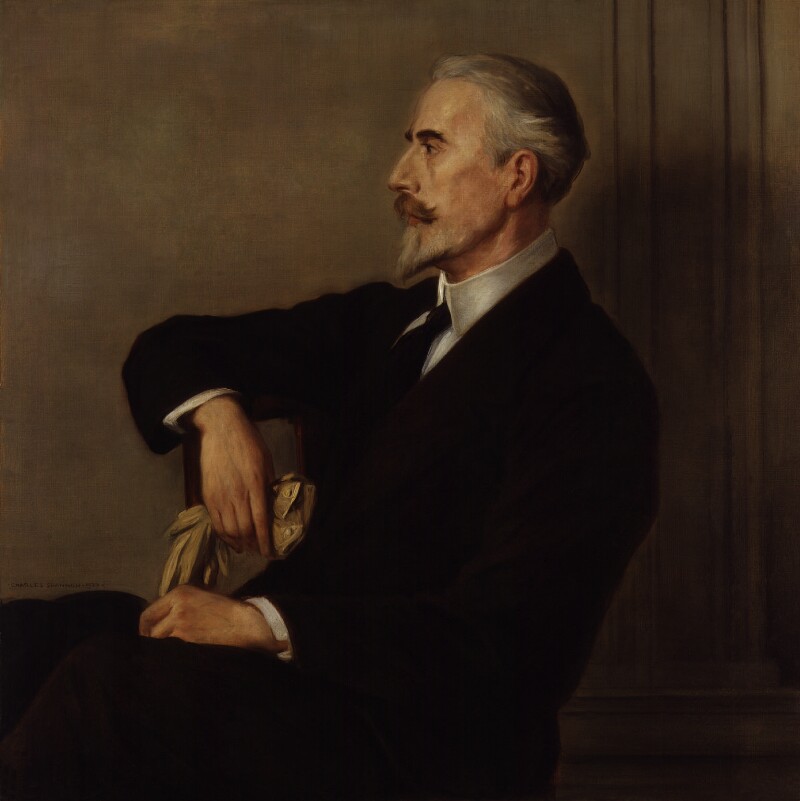
Henry Wickham Steed by Charles Haslewood Shannon, oil on canvas, 1920, 37 1/8 in. x 37 1/8 in. (943 mm x 943 mm), Primary Collection, NPG 5745, National Portrait Gallery, London, CC BY-NC-ND 3.0 DEED.
From foreign correspondent to editor
Wickham was first employed by The Times in 1896 and spent 25 years working for that paper. His scoops and commentary created headlines, and he frequently courted controversy, or at least heated debate.
When Wickham was working in Vienna he was introduced to King Edward VII, and thereafter became the King’s personal consultant on news and events, keeping the him well informed and ahead of the newspapers.
Wickham wrote about issues including bimetalism, Ireland and Home Rule, and advocated for war in 1914. He also argued for the creation of Yugoslavia, and against Bolshevik rule in Russia. As Editor of The Times from 1919-1922, he was sometimes accused of bias. He clashed strongly with David Lloyd George, who was the British Prime Minister from 1916-1922, and a war of words played out on the pages of newspapers.
War and peace
Wickham is credited with having given early warning of both world wars. In fact his 1913 publication The Hapsburg Monarchy, in which he wrote that World War One was inevitable, was banned in Austria. During the war he worked on propaganda, and at the end of it he was present at the Paris Peace Conference.
In the 1930s Wickham created “a network of German exiles, whom he both befriended and used as an informal intelligence service”. Their information and stories were used as evidence of what was to come, forecasting World War Two.
The “Wickham Steed affair” was yet another example of Wickham’s contacts and appetite for a scoop. In a 1934 magazine article, “Aerial Warfare: Secret German Plans“, he made public information about apparent biological weapons experiments using underground stations in London and Paris which were conducted by the German War Office. The story surrounding Wickham’s claims and their impact all sound like the perfect plot for a thriller, and in fact Australian historian Brett Holman pointed out a reference to this in an episode of the television show Foyle’s War. Foyle’s War wasn’t the first time Wickham’s information featured in popular culture. Fall of Eagles, a 1970s BBC drama series, included a scene between Wickham and King Edward VII.
Author, public speaker, and broadcaster
When he left the role of Editor of The Times, Wickham was called “a very brilliant journalist with an altogether exceptional knowledge of foreign politics”. He went on to write extensively for the English and international press, mostly as an independent journalist which was a rather unique position to be in.
He also lectured on Central European history at Kings College London from 1925-1938, and was a regular broadcaster for the BBC from 1933-1947, including as the chief correspondent for the Empire and overseas service during the war. He was a frequent public speaker and the BBC also broadcast several talks by Wickham in his latter years in which he discussed “some of the notable people and events in his life”.
Perhaps not unexpectedly given his career and experiences, Wickham wrote many books including titles like The Press, A Programme for Peace, The Real Stanley Baldwin, and volumes I and II of Through Thirty Years 1893-1922: A Personal Narrative.
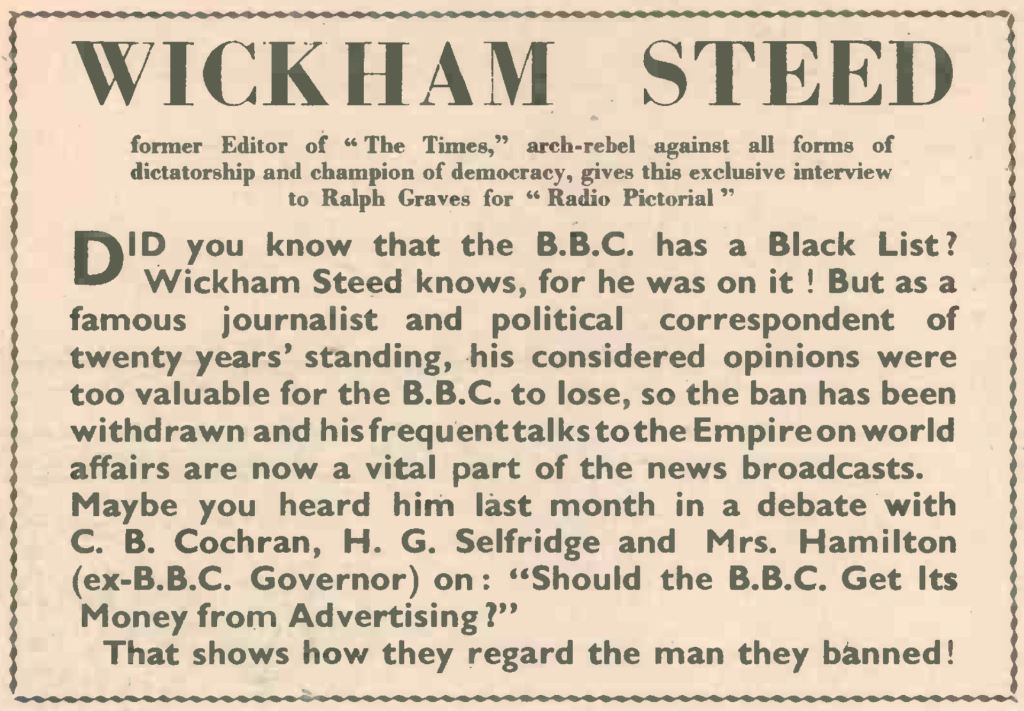
Excerpt from ‘B.B.C. Censorship Revelations’, Radio Pictorial, 10 February 1939, No. 265, pp. 20-21, 27.
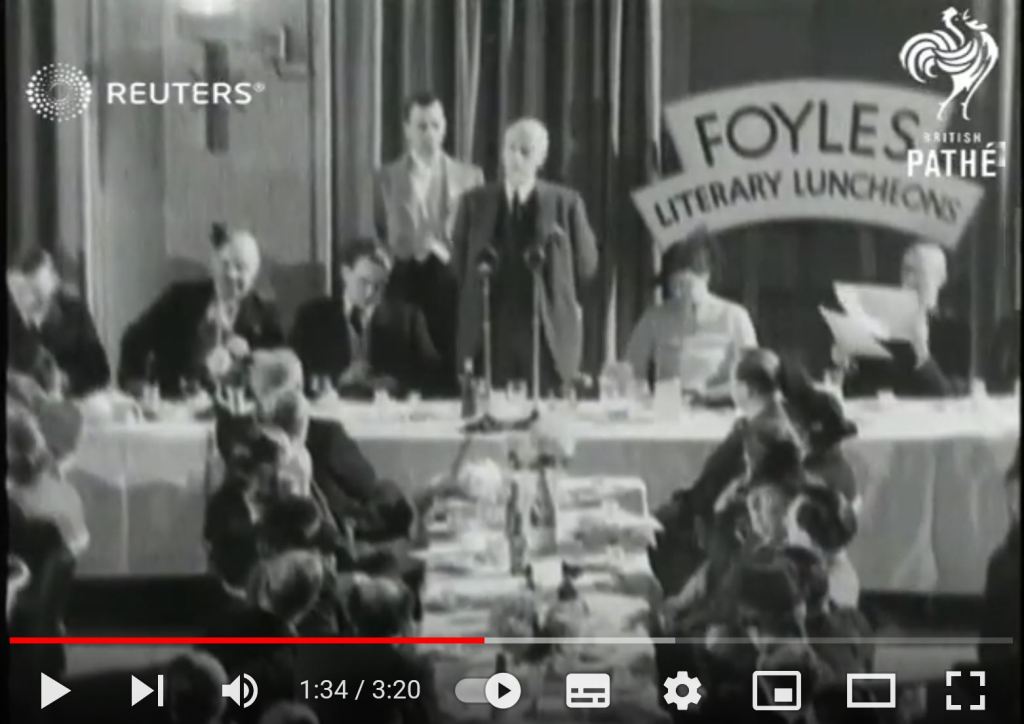
Wickham Steed, ‘Free Press or Censor?’, British Paramount Newsreel Reuters, 19 December 1938, https://youtu.be/BNHRYQj-Cko.
Legacy
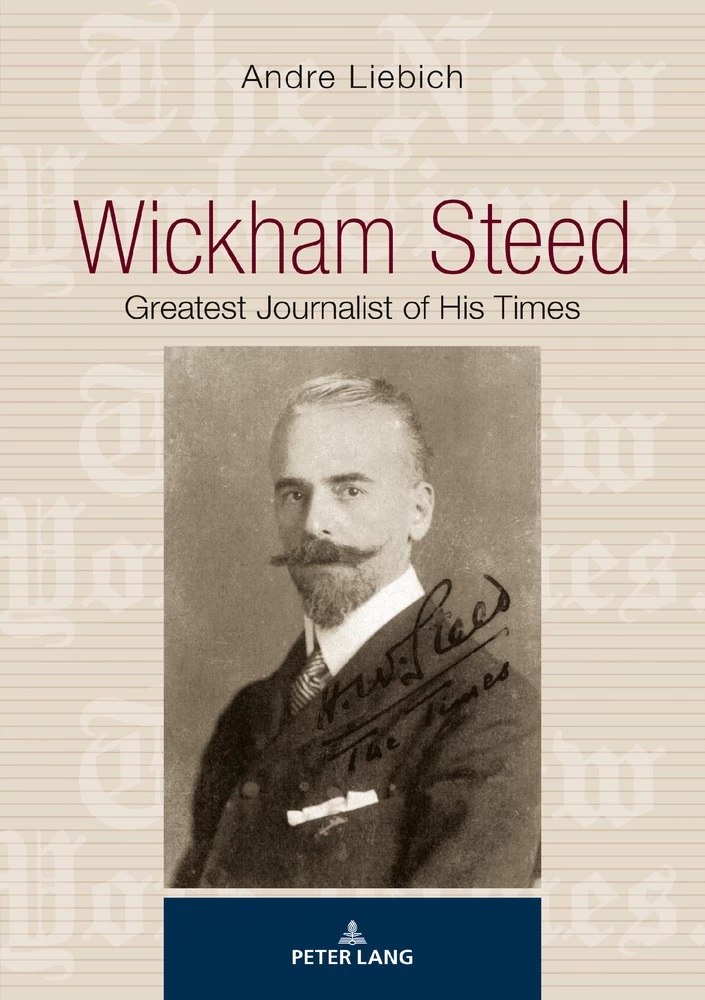
Just how influential Wickham was is highlighted by a book about him. Written by André Liebich, a professor of international history and politics, its thoroughly researched narrative provides ample evidence of Wickham’s involvement and influence in world events throughout a career of more than fifty years. If you want to learn more about Wickham this is the book to read. The preface summarises some of his reputation and accomplishments:
Wickham Steed’s life is a rich fresco of an era. In the words of an authoritative historian, Steed “not only influenced world policy but actually made history.” During the First World War and in its aftermath, he was instrumental in the creation of new states throughout Europe and in the establishment of a new order founded upon the internationalist idealism incarnated in the League of Nations. As an independent journalist in the 1920s and 1930s, he led an initially solitary crusade against threats that were later to be called totalitarian. As the Second World War approached, in the course of it, and even afterwards, he threw himself with zest into the new media that was radio, a powerful voice broadcasting analyses of international politics throughout the world.
André Liebich, Wickham Steed: Greatest Journalist of His Times, Peter Lang, 2018, p. 11.
It might be said that Wickham Steed has been harshly judged by some historians, particularly if events are considered in isolation. He was certainly a polarising figure. However, when newspapers extensively covered his death in January 1956 they remembered him as a “confidant of princes, adviser of statesmen and leader of public opinion”. Whether or not you agree with his opinions, writing, or actions, it cannot be denied that Wickham was a man of influence who lived life fully. His story is a fascinating one.
Selected references
André Liebich, Wickham Steed: Greatest Journalist of His Times, Peter Lang, Bern, Bruxelles, Frankfurt am Main, New York, Oxford, Warszawa, Wien, 2018.
‘News and Notes’, The Civil and Military Gazette, 2 December 1922, p. 6, FindMyPast.co.uk, accessed 19 January 2024.
‘”Deliberate & Malicious Invention.” Mr Wickham Steed and The Premier.’ The Daily Mail, 9 May 1922, p. 7, FindMyPast.co.uk, accessed 19 January 2024.
‘Germany’s Denial: Mr. Wickham Steed’s Disclosures’, Tweed Daily, 3 July 1934, p. 3, http://nla.gov.au/nla.news-article192616465, accessed 27 January 2024.
‘Wickham Steed Thinks Peace Still Safe’, The Advertiser, 3 August 1937, p. 18, http://nla.gov.au/nla.news-article74198142, accessed 27 January 2024.
‘B.B.C. Censorship Revelations’, Radio Pictorial, 10 February 1939, No. 265, pp. 20-21, 27.
Airminded, ‘The Wickham Steed affair in popular culture’, https://airminded.org/2007/02/17/the-wickham-steed-affair-in-popular-culture/, accessed 12 January 2024, CC BY-NC-ND 4.0 DEED.
Wickham Steed, ‘Free Press or Censor?’, British Paramount Newsreel Reuters, 19 December 1938, https://youtu.be/BNHRYQj-Cko.
‘Sudbury and District Topics’, The Suffolk & Essex Free Press, 9 December 1922, p. 5, FindMyPast.co.uk, accessed 19 January 2024.
‘Death of Former “Times” Editor Mr Wickham Steed’, The Scotsman, 14 January 1956, p. 8, FindMyPast.co.uk, accessed 27 January 2024.
National Archives, ‘Steed, Henry Wickham, (1871-1956), journalist and publicist’, https://discovery.nationalarchives.gov.uk/details/c/F68117, accessed 27 January 2024.
 Untangled Family History