
George Steed was a journalist who had a front row seat for politics, social and sporting events. During his career he represented several newspapers and the Country Press Association, and was active in the Institute of Journalists from its beginnings.
The youngest child of English and Irish immigrants, George was born in regional Victoria. He was only fourteen when his father died, and fifteen when his mother died.
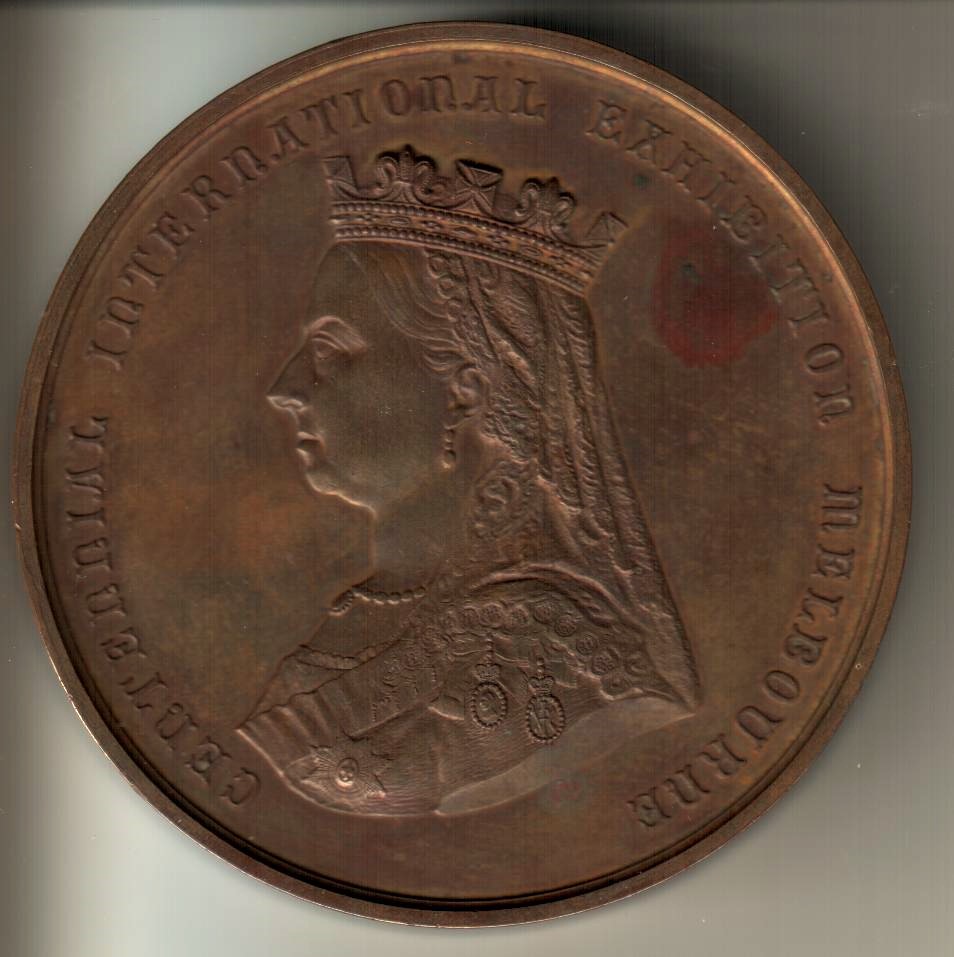
George’s career in journalism may have been motivated, or propelled, by his experience aged 21 working in the Commissioner’s Office for the Centennial International Exhibition. The Exhibition which opened in Melbourne in 1888 was a major event, and he was one of the clerks entrusted with “various and onerous duties” including shorthand secretary to official committees. At the end of his time there he was given a bronze medallion and glowing reference highlighting his “intelligence, capability and zeal”.
Imperial Penny Postage
George was a fully-fledged journalist by the 1890s or earlier, and a major story he covered in 1894 was the campaign for postal reform championed by Sir John Henniker Heaton. Henniker Heaton was English-born, but lived in Australia for almost twenty years working first as a jackeroo, then a journalist. He returned to England where he was elected to Parliament and became jokingly known as the ‘Member for Australia’. On one of his return visits he advocated for Imperial Penny Postage and George interviewed him on the subject. The interview resulted in three articles being published in The Evening Standard. I haven’t found a copy of the articles, so if you come across them, please let me know.
George received a letter of thanks from Henniker Heaton describing his work as “picturesque, graphic yet marvellously accurate”. Penny postage — pre-paid standard postage — was eventually implemented across most of the British Empire in 1898, but it wasn’t until 1905 that it was used to send mail to Australia.
By 1896, George had moved his growing family to New South Wales and the township of Hamilton, which became part of central Newcastle. Working as chief reporter for the Newcastle Herald, he became well-known and his experience reporting on local and national issues continued to grow. His work took him from musical eisteddfods and Newcastle Council meetings, to the bottom of coal mines, and events with politicians and dignitaries.

Politics and war
In 1905 George moved his family again, this time to Sydney. It was there he attended a celebration for the fiftieth anniversary of the “Assembling of the First Parliament Under Responsible Government in New South Wales”. What a mouthful that is! This milestone came just six years after a federation of states had formed the Commonwealth of Australia.
George became “a recognised authority on Labor politics and the conscription campaign”. Two referendums seeking support for conscription were defeated and had vast ramifications, with a split in both the country and the Labor Party providing plenty of fuel for journalists. With sons of an age to be fighting in World War One it must have been difficult reporting on an issue of such national and global importance while knowing the potential personal cost. In fact, in 1918 George wrote to one of his sons who was underage at the time and the letter reluctantly gave his consent to enlist.
Family lore has it that during his career George also interviewed, reported, or met, internationally renowned cricketer W.G. Grace, and there may have been a photo of them together, or perhaps in a group photo. It would probably have been when Grace toured as captain of Lord Sheffield’s English team in 1891-92, which coincided with the early days of George’s career. I’ve not been able to track down evidence of them meeting, although I did find articles about George playing cricket including in a later Parliament versus Press match at the Sydney Cricket Ground.
I’m proud to say George, my 2x great-grandfather, appeared to be well-respected and valued by family, friends and colleagues. He was praised as “one of the most widely known journalists in the State….[and] looked upon in his day as one of the greatest authorities on coal-mining matters”.
In the papers
Thanks to the digitised newspapers on Trove, I’ve been able to find some of the newspaper articles George wrote, and which were written about him. Here are a few which showcase some of his experiences and the regard with which he was held.
- Showing support for a new railway bridge – ‘A Public Convenience’, Newcastle Herald and Miners Advocate, 9 June 1897, p.7.
- Dinner in a coal mine with Edmund Barton, the man who would become Australia’s first Prime Minister – ‘The Banquet’, Newcastle Morning Herald and Miners advocate, 24 May 1898, p.5.
- A farewell as he left Newcastle for Sydney – ‘Mr G. H. Steed’, Newcastle Herald and Miners Advocate, 24 March 1905, p. 6.
- The Prime Minister’s speech beginning the campaign for conscription in World War One – ‘Opening the Referendum Campaign’, Western Grazier, 23 September 1916, p. 3.
- An obituary – ‘Funeral of late George H. Steed’, The Daily Telegraph, 9 June 1931, p. 7.
Selected references
State Library of Victoria, ‘Intercolonial and international exhibitions’, https://guides.slv.vic.gov.au/interexhib/1888to89, accessed 3 January 2024.
‘The Centennial International Exhibition’, Illustrated Australian News, 15 August 1888, p. 154, http://nla.gov.au/nla.news-page5729775, accessed 5 January 2024.
Secretary, Executive Commissioners, Centennial International Exhibition Melbourne, letter, 25 January 1889, held in private collection.
Australian Dictionary of Biography, ‘Sir John Henniker Heaton (1848-1914)’, https://adb.anu.edu.au/biography/heaton-sir-john-henniker-3745, accessed 4 January 2024.
J. Henniker Heaton to George H. Steed, letter, 30 October 1894, held in private collection.
National Museum of Australia, ‘Australia’s 1st Prime Minister’, https://www.nma.gov.au/explore/features/prime-ministers/edmund-barton, accessed 5 January 2024.
Australian War Memorial, ‘Conscription during the First World War, 1914-1918’, https://www.awm.gov.au/articles/encyclopedia/conscription/ww1, accessed 5 January 2024.
Museum of Australian Democracy at Old Parliament House, ‘How Billy Hughes Lost the 1916 Conscription Referendum’, https://www.moadoph.gov.au/explore/stories/history/how-billy-hughes-lost-the-1916-conscription-referendum, accessed 5 January 2024.
National Museum of Australia, ‘Conscription referendums’, https://www.nma.gov.au/defining-moments/resources/conscription-referendums, accessed 5 January 2024.
Parliament of New South Wales, ‘The history of the Legislative Assembly’, https://www.parliament.nsw.gov.au/la/roleandhistory/Pages/The-history-of-the-Legislative-Assembly.aspx, accessed 12 January 2024.
 Untangled Family History
[…] worked as a journalist during a similar time period as his second cousin, my 2x great-grandfather George Steed. Wickham and George were however quite different people, both in personality and professional […]
LikeLike
[…] great-grandfather, Harry Steed born 1900 was the son of George Harry Steed born 1867, both in Victoria, Australia. George Harry Steed was the son of Henry Steed born in […]
LikeLike
[…] 22 May 1906, my great-great grandfather George Steed attended the celebrations of the fiftieth anniversary of ‘responsible government’ in […]
LikeLike