
One day when I was trawling through newspapers on Trove, I came across a story involving my great-great-aunt Martha Vaughan. As I looked more closely and explored what happened, it felt a lot like one of the plots of Pride and Prejudice, where Lydia Bennet runs away with George Wickham. Here’s what I discovered.
On 8 April 1882, William Vaughan was notified by his wife Harriet that their thirteen-year-old daughter Martha was missing. He began an unsuccessful search for her. Another daughter, Mary Jane, said she’d seen her sister sitting some distance from the house with John Hill, a much older family acquaintance. Harriet told William she’d previously found letters between Martha and Hill, described as the correspondence of lovers.
William reported the incident to police and a warrant was issued for John Hill, for Martha’s alleged abduction. The description given of Martha and John was was quite detailed, and gives a good sense of what they looked like, the clothes they wore, and even mannerisms.
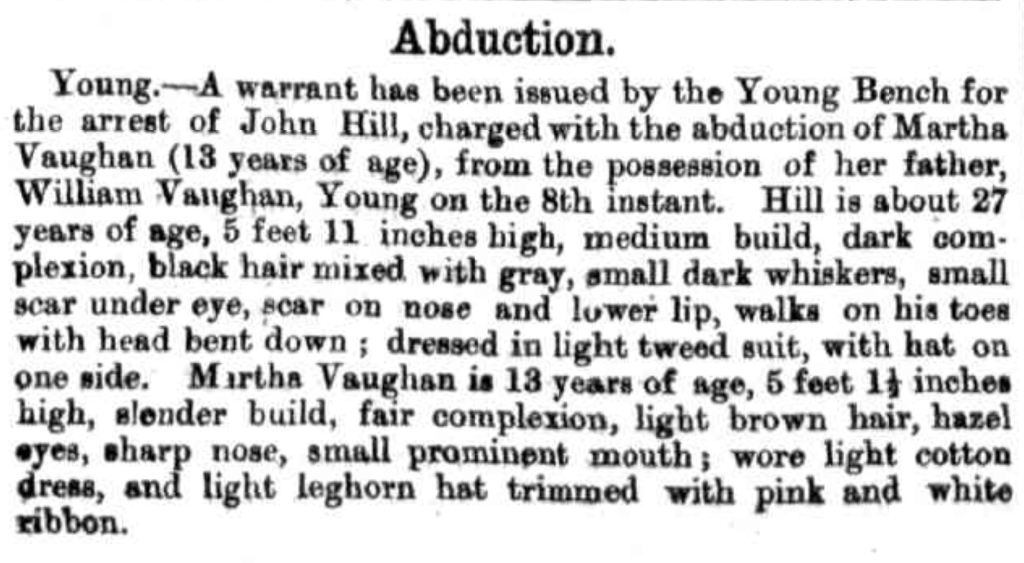
William and Harriet eventually received a letter from Martha and John Hill. William apparently replied he would allow them to marry if Hill brought her back and her mother consented. It was likely a ruse to try and get them to return, as unsurprisingly Harriet didn’t think Martha was mature enough.
In November, eight months after Martha first disappeared, John Hill was arrested and charged with abducting her, to which he pleaded not guilty. At the trial at the Young Police Court, Martha gave evidence that she and her mother had disagreed about her relationship with Hill, so she had run away with him. The defendant’s lawyer put the case there was no abduction. They had been living all that time together in a tent and hut at Gorman’s Hill after all. However, this request was dismissed because Martha was under-age and her father hadn’t given consent for her to leave.
In the end, the jury recommended Martha Vaughan and John Hill be married. Hill was, however, remanded on a separate charge, that of horse stealing, and there is no record of a marriage between them. Martha went on to a relationship with someone else and had several children. She died in 1928.
Selected references
‘Abduction’, New South Wales Police Gazette and Weekly Record of Crime, 26 April 1882, Issue No. 17, p. 156, http://nla.gov.au/nla.news-article252052718.
‘Local Intelligence: Young Police Court’, The Burrangong Argus, Wed 15 Nov 1882, p. 2., http://nla.gov.au/nla.news-article247742653.
‘Local Intelligence: Young Police Court’, The Burrangong Argus, Sat 18 Nov 1882, p. 2., http://nla.gov.au/nla.news-article247742657.
‘Young Quarter Sessions’, The Burrangong Argus, Wed 6 Dec 1882, p. 2., http://nla.gov.au/nla.news-article247742768.
 Untangled Family History